
Buried in Apple’s June-quarter report is a small line that changes how the whole quarter reads: $0.11 of the $2.02 in earnings per share came from tariff refunds. The company also said the refunds lifted gross margin by about two percentage points. Take both out and the quarter is still very good, just not quite as good as the headline.
This is not a call that Apple is a weak business. It has $416 billion of annual sales and a 32% operating margin. The issue is the price. At $336.13 the stock sits 2.4% below its 52-week high, and that price assumes a lot of things keep going right at once. When the price, the analysts and the mood all agree, I get more careful.
The title says everyone is bullish. On the price, that is true. On the analyst tally it is not, as you will see below, and that gap is the most interesting part of the story.
The quarter with the one-timers removed
Revenue for the quarter ended in June was $109.4 billion, up 16%, following 17% the quarter before. iPhone brought in $54.3 billion, about half of sales, and Services added $30.7 billion, another 28%. The financials tab shows what a turn this is. In fiscal 2025 revenue grew only 6% to $416.2 billion, and in the two years before that it was down 3% and up 2%. Apple has gone from a company that barely grew to one growing at mid-teens, and the stock noticed.
Earnings per share was $2.02, up 29% from a year earlier. Strip out the $0.11 refund and it is $1.91, which is up about 22%. That is a fine number. It is also the number the market should be using to judge how fast the business really moves, and it is seven points lower than the headline.
Gross margin of 50.1% looks superb, but roughly two points of it came from the refunds, which means the underlying figure is closer to 48%. Operating margin for the full fiscal 2025 year was 32.0%, and that is the steady figure I would anchor on. Nothing here says the business is deteriorating. It says the strongest quarter in years had a little help.
What the multiple asks for
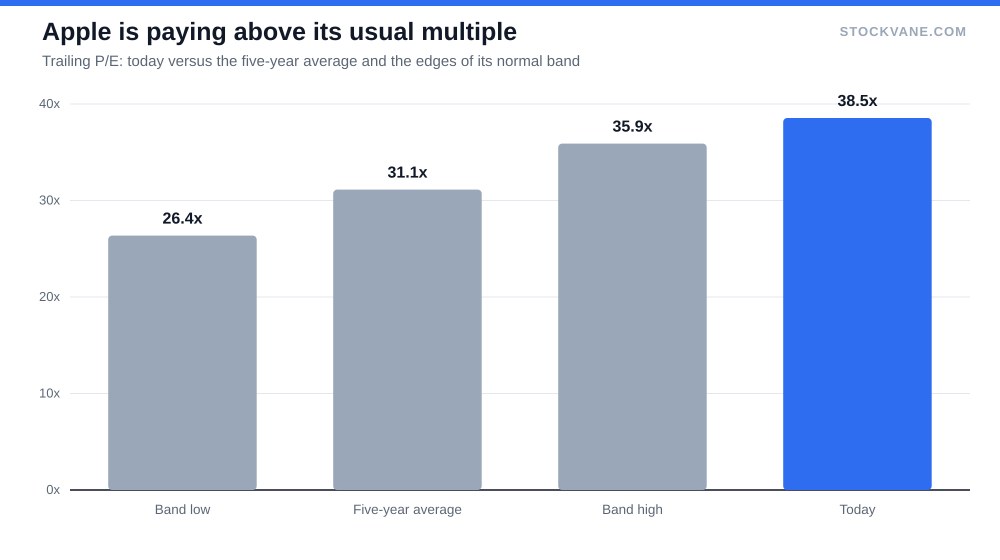
The valuation tab is where the case for caution lives. Apple trades at 38.5 times trailing earnings. Its five-year average is 31.1, and the upper edge of its normal band is 35.9. Today’s multiple is above that band and sits in the 94th percentile of its own history. On price to sales, at 10.5, it is in the 99th.
Over the past year the shares are up about 42%, from $237 to $336, while trailing EPS has grown about 17%, from $7.46 for fiscal 2025 to roughly $8.72. In other words, most of the return came from paying more per dollar of earnings and not from earning more dollars. That can continue, but it is a different kind of return from the one Apple delivered for most of its history.
The clearest way to see how much room this leaves is to hold earnings fixed and change the multiple.
| Apple’s P/E multiple | Price on trailing EPS of $8.72 | Price on next-year EPS of $9.30 |
|---|---|---|
| Low edge of five-year band (26.4x) | $230 (-32%) | $245 (-27%) |
| Five-year average (31.1x) | $271 (-19%) | $290 (-14%) |
| High edge of band (35.9x) | $313 (-7%) | $334 (-1%) |
| Today (38.5x) | $336 | $359 |
Trailing earnings are about $8.72 a share. Analysts expect roughly $9.30 over the next year, which is 7% more. Even on that higher figure, the top of Apple’s five-year band works out to about $334 a share, and that is where the stock trades today. You are paying the ceiling multiple on next year’s earnings. A return to the five-year average on the same estimate would put the stock near $290, about 14% lower.
A report-day drop the stock has already erased
After the June-quarter report the shares closed at $333.14 on July 30 and $308.64 the next day, a drop of 7.4%, the worst earnings reaction in the last four reports. Coverage at the time tied it to guidance that cited supply constraints, according to MacRumors’ summary of the report.
Seven weeks later the stock is back above where it started, at $336.13. It shrugged off a beat-and-soft-guide quarter with no lasting damage. To me that shows how eagerly buyers still step in. It also worries me, because a market that will not let a stock stay down after soft guidance is not asking many questions about what could go wrong.
The analysts are less excited than the price
Of the 25 analysts covering Apple, 60% rate it a buy, 24% say hold and 16% say sell. The analyst consensus page shows an average target of $348, only about 3.5% above the current price. The low target of $245 sits 27% below it, and the high of $400 is 19% above.
Set against other large technology stocks, Apple has the coolest analyst reception of the group.
| Company | Trailing P/E | Latest quarter revenue growth | Analysts rating it a buy |
|---|---|---|---|
| Apple (AAPL) | 38.5x | 16% | 60% |
| Microsoft (MSFT) | 27.5x | 18% | 97% |
| Alphabet (GOOGL) | 17.5x | 24% | 86% |
| Amazon (AMZN) | 20.4x | 20% | 97% |
| Meta Platforms (META) | 25.1x | 28% | 86% |
Apple is the most expensive stock in that table and has the slowest latest-quarter revenue growth. It also has the lowest share of buy ratings, by a wide margin. The other four are rated a buy by 86% to 97% of analysts and trade at roughly 17 to 28 times earnings. Alphabet, the cheapest name in the table, is the subject of a separate piece on why a low multiple is not automatically a bargain, but the gap between Apple and the rest is large on any reading.
So who is bullish? The stock price is. The people paid to model the company are lukewarm, and their targets say you are being offered a few percent of upside to hold a stock that has already gone up 42%. That is the setup I am wary of.
The iPhone is doing the heavy lifting
Half of Apple’s revenue is still one product, and that product is having a big year. Reports on the quarter put iPhone growth near 22%, and the dollar figure, $54.3 billion, is consistent with that. With iPhone about half of sales growing 22% and the whole company growing 16%, my arithmetic says roughly two-thirds of the quarter’s growth came from the phone. Services, the higher-margin line that supports the premium multiple, brought in $30.7 billion. A stock at 38 times earnings is being priced like a Services company, while the quarter was carried by a hardware cycle.
Upgrade cycles do not last forever. They tend to run a few years and then flatten, and the comparison gets harder every quarter that passes. If iPhone growth falls from 22% back toward the high single digits while Services keeps growing at its usual pace, total growth returns to something closer to 10%. That is still a healthy number. It is not the number that supports the highest multiple Apple has carried in five years.
A new CEO, and one I cannot price
Apple announced in April that Tim Cook would become executive chairman on September 1, with John Ternus, the head of hardware engineering, taking over as CEO, according to Apple’s own announcement. The handoff happened two and a half weeks ago. Ternus has been at Apple since 2001, so this is continuity and not a stranger, and I do not think the transition is a reason to sell.
What I cannot do is tell you what it is worth. Cook’s record on supply chains, pricing and Services is the reason the margin sits where it does, and the market is assuming it carries over. It probably will, but at the 94th percentile of its valuation history the stock has no margin for the cases where it does not.
What has to stay true
I should say plainly where I could be wrong. The iPhone rose 22% last quarter, and if the supply constraints Apple mentioned only delayed sales and did not lose them, the next report could show a catch-up that makes today’s multiple look reasonable. A stock in the 94th percentile of its valuation can stay there for a long time, and anyone who sold Apple on multiple alone in the last two years missed a lot.
That is why I am not calling for a drop. I am saying the price leaves no room for a merely good quarter. For the stock to justify $336, revenue growth has to stay in the mid-teens, margins have to hold near 48% without help from refunds, and Services has to keep gaining share of the mix. If all three happen, the stock is fairly priced. If any one slips, the multiple has a long way to fall.
There is no income cushion either. The dividend yields about 0.31%, so a holder is paid almost nothing to wait. With that yield and a few percent of analyst upside, the return has to come from the multiple staying high, which is a thin thing to rely on.
For readers who already own it for the long run, the retirement-account math on holding Apple is a good reminder that patience has paid here. Nothing in this piece argues you should sell. For a new position, I would rather wait for a price nearer $290, which is where the five-year average multiple lands on next year’s earnings, than pay the top of the band today.
Financial disclaimer: The content on StockVane is for educational and informational purposes only and should not be construed as professional financial advice. Stock market investing involves risk of loss.
Pingback: How Buying Apple Stock Turned a Retirement Plan Into an 80% Gain – StockVane