
Here’s the thing nobody tells you when you Google “how to invest in stocks.”
All the articles assume that you have $10,000 lying around, a Bloomberg terminal within easy reach, and a degree in finance from someplace that has a squash court. They discuss “diversifying your portfolio” and “rebalancing every quarter” as if they’ve already done it. You are not on the half way mark. You’ve got $200 and a ton of questions, and you have a general feeling that it must be wrong to do nothing.
This article is for you. Not for the person who already has a brokerage account and wants to optimize their Sharpe ratio. For the person who doesn’t know what a Sharpe ratio is and frankly doesn’t need to know yet.
Let’s start from actual zero.
Why Investing with Little Money Is Better Than Waiting Until You Have More
Before the step-by-step, I need to kill a specific lie that keeps people out of markets for years.
The lie is: “I’ll start investing when I have more money.”
The math disagrees.
At an average annual return of 8% (the kind that the S&P 500 has historically provided over long periods of time), that $100-a-month investment will grow to about $349,000 by age 65. At age 35, you would have about $150,000, if you had started the same $100 contribution a year earlier. Same monthly amount. Same return rate. The cost of 10 years of delay is $199,000.
The number one most important factor in investing is not how much you invest. It’s the early start time. It’s better to have a $200 account today than a $2,000 account 5 years from now. This isn’t motivational information. It’s compound interest and it’s a cheat code in finance.
Step 1 — Figure Out What You’re Actually Working With
You must know three numbers before you open a brokerage account or buy a share of anything.
1, Your net income per month. The net amount that is deposited into your bank account.
2, Your monthly bills. The costs you incur regardless of whether you invest or not: rent, utilities, subscriptions, food, transportation, etc.
3, Your emergency fund status. The rule of thumb is 3 to 6 months living expenses in cash, and easily accessible, and not invested. This isn’t optional. Imagine the emergency fund is invested and the stock market crashes by 30% the month your car breaks down, you have to sell at the worst time.
What remains after those three boxes are dealt with is the amount of money that can be invested. This is a lesser count than most beginners would desire. That’s fine. 50/month is a real number. 25/month is a real number. At this stage, it’s more about the habit than the amount.
Step 2 — Open the Right Account First
The first step for most novices in the U.S. is not a standard brokerage account. It’s a Roth IRA, provided that you have earned income and your income is under the contribution limit (for 2026, it is $161,000 for single filers).
A Roth IRA is a first account for the following reasons.
You pay after tax dollars (money that you have already paid income tax on). The investment is totally tax-free. The good news is that when you retire, you won’t have to pay any taxes on the gains, not reduced taxes, zero. If you invested $7,000 in a Roth account this year (the maximum contribution limit for 2026) and it increased to $70,000 over 30 years, you get $70,000 back tax-free.
That tax-free growth is more valuable than just about any stock-picking advantage you can build over the next 10 years.
Fidelity, Charles Schwab and Vanguard are the three easiest platforms to open a Roth IRA. All three offer no minimum investment, no annual fees and no minimum accounts. Both Fidelity and Schwab offer the ability to purchase fractional shares, so if Apple stock is at $200, and you only have $50 to invest, you can purchase a quarter of a share. You don’t have to purchase a full share to be locked out.
If you already have an employer-sponsored 401k plan, and your employer matches, put in at least the amount that they will match first. A 100% employer match is a guaranteed 100% return on your contribution before the market does anything. That is the most sure-fire return that most people in the American financial system can get.
Step 3 — Understand What You’re Actually Buying
Ownership is a stock. Each share of a company represents a small part of the company. The more valuable the company, the more valuable your piece is. If the company becomes less valuable, so does your piece.
A bond is a loan. You make a loan to the government or a corporation. They pay interest on you. When the loan term is over, they pay back the principal. Generally, bonds are less volatile than stocks and offer lower long-term returns.
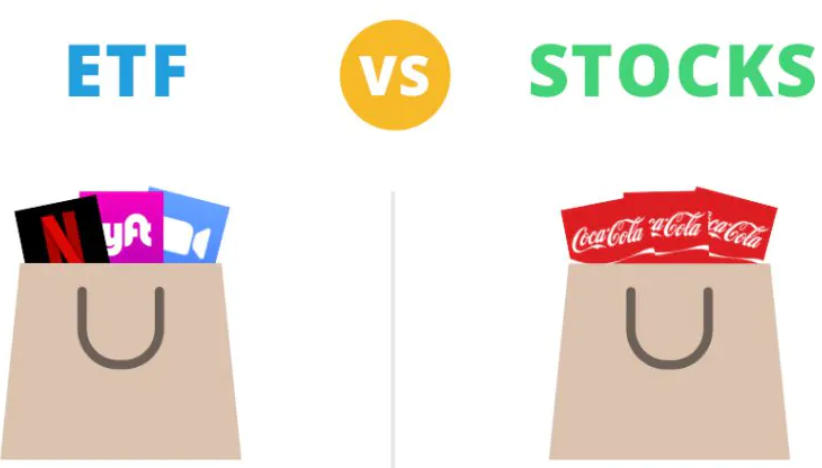
An Exchange-Traded Fund (ETF) is a collection of stocks or bonds that is grouped together and traded on a stock exchange just like a single stock. You can purchase one share of an S&P 500 ETF and own a very small fraction of every one of the 47 companies.You can purchase one share of an S&P 500 ETF and own a tiny piece of each of the 47 companies at once. This is known as diversification and is the closest thing to a free lunch in investing.
ETFs are the right place to begin investing for most novices who lack funds. Not individual stocks. Not options. Not cryptocurrency. ETFs.
The specific reason is: Individual stock selection takes research, time and experience. If you take one stock and it goes down 40%, you’re in trouble. If you own an ETF that tracks 500 companies and one of them loses 40%, you will experience a loss on your portfolio of about 0.08%. You barely feel it.
Step 4 — The Three ETFs That Cover Most of What Beginners Need
You do not need to own twenty different funds to be well-diversified. The academic research on this is clear: most of the diversification benefit comes from the first handful of holdings. Beyond that, you’re adding complexity without meaningfully reducing risk.
For a beginner, three ETFs cover most of the bases. You can buy all ETFs from Moomoo or IBKR.
SPY (SPDR S&P 500 ETF): The S&P 500 ETF is an index of the 500 largest companies listed on the S&P 500. Expense ratio of 0.03% (or 30 cents on every $1,000 invested). The annualized return for 10 years to 2025 was about 13.1% per annum. It is the primary holding of most long term investors, whether professional or retail.
VTI (Vanguard Total Stock Market ETF): All of the same stocks in VOO and another 3,500 smaller U.S. companies. Expense ratio 0.03%. Incorporates a small amount of mid-cap and small-cap growth. The one ETF that every serious investor would recommend you having for the duration of your investment is the VTI.
VXUS (Vanguard Total International Stock ETF): About 7,900 stocks outside of the U.S. – Europe, Japan, emerging markets and everything else. Expense ratio 0.07%. The U.S. accounts for about 60% of the world’s market capitalization. If you invest solely in U.S. stocks, you’re missing out on the other 40% of the world’s publicly traded companies.
A simple starting portfolio: 70% VTI, 30% VXUS. Globally diversified, extremely low cost, no stock-picking required. Add to it every month. Don’t touch it for decades.
Step 5 — Dollar-Cost Averaging: The Strategy That Makes Timing Irrelevant
Every beginner wants to know “When is the right time to buy?”.
The answer is: not as much as you’d think, and there’s a strategy that makes it irrelevant.
Dollar-cost averaging is the practice of investing a set amount at a set time, such as $100 on the 1st of each month, regardless of the market. The more expensive the price, the fewer shares you can purchase for $100. If prices are low, you can buy more shares for $100. This smooths out your cost basis over time and gets rid of the psychological pressure to try and get the “best” price.
The S&P 500 plummeted 34% in March 2020, bounced to new highs by August 2020, and stayed higher through 2021, dropping 19% in 2022, and climbing back higher through 2025. An investor who attempted to time all of those moves would likely have underperformed an investor who invested a $200 monthly amount over the entire time period without paying attention.
The proof is irrefutable and consistent over many decades of market information. Over the long term, most professional fund managers do not outperform a dollar-cost averaging approach. The failure rate is consistently between 80% and 90%, by class of asset and time frame.
This isn’t my opinion of Wall Street. That’s the information in the numbers.
Step 6 — The Numbers Behind Starting Small
Let’s be specific with scenarios.
If you start with $500 and add $50 per month: At 8% annual return over 30 years: approximately $77,000. Annual return of 10% for 30 years: about $114,000.
With $500 initial investment and $200 monthly contributions: 30-year time horizon at 8% annual return: $294,000. At 10% annual return over 30 years: approximately $434,000.
If you invest $100 per month for 40 years starting with $0 and earning 8% per year: About $335,000. At 10% annual return: approximately $637,000.
These scenarios are not motivational fiction, but the math. This is simple compound interest calculations. The inputs are conservative — the actual historical return of the S&P 500 over rolling 30-year periods has been less than 8% very few times, and more than 10% many times.
It also shows that the monthly contribution is more important than the initial amount, which is what the math indicates. If you increase your monthly contribution from $50 to $200, or $150 more, you are able to double your ending balance. For most people, an additional $150 a month can be found by concentrating on spending. The rest is done by the investment return.
Step 7 — The Mistakes That Erase Years of Progress
The difficulty is getting started. The second difficult part is staying invested during the rough times. These are the specific behaviors that will derail beginners.
Crash selling. All major declines throughout history (1987, 2001, 2008, 2020) have been followed by recovery and new highs. Every single one. Those who sold at the bottom suffered permanent losses. Those investors who held on or who purchased additional shares, more of them, had a recovery and then some. The 2020 crash was 34% in five weeks. It took 5 months to get the market back to new highs. Those who panicked sold and missed all the recovery.
Reviewing your portfolio on a regular basis. This is not only psychologically injurious, but also of no use to anyone. Checking portfolios daily is correlated with increased trading, increased emotional decisions and poorer performance. If you have a thirty-year time horizon, what happens to your portfolio Tuesday in November isn’t relevant information. Monthly check-ins are okay. Quarterly is fine.
Chasing performance. One of the poorest performing asset classes over the previous three years is often one of the best over the next three years. Those who “buy the dip” in this hot sector, after the rally, come in late and are mostly buying the bottom. It’s been so consistent and so prevalent over the years that behavioral economists have christened it by a number of names and written hundreds of papers about it.
Waiting to purchase on a crash. Between 2013 and 2023, the S&P 500 gained approximately 280%. Those who hoped for a “good time” to invest missed much of the crash. Time in the market is better than timing the market. This is a cliché because it is undoubtedly true.
Paying high fees. This one’s subtle and devastating. The difference in an expense ratio of 1% vs. 0.03% seems like a small amount of money. That difference in returns comes to about $145,000 in lost compounding on $100,000 invested over 30 years at 8%. The only thing you can be sure of that will slow your portfolio down is fees. The only sure way to improve is to minimize them.
Step 8 — Building the Habit Before Anything Else
The most difficult aspect of investing with a small amount of capital isn’t the money part. It’s the habit part.
Make it a habit to transfer money from your checking account to your investment account on a monthly basis. Choose a quantity that isn’t so difficult to sustain that it demands willpower. The automation takes away the decision from your monthly routine. You no longer consider investing this month, but you consider other matters.
Most big brokerages will have investment options that are automatic, which will purchase the ETF you want on a regular basis without you having to do anything. This is available at both Fidelity and Schwab. Enable it. Walk away. Check it quarterly. Increase the contribution when your income increases. This is the full script for the first few years.
Returns will be poor initially. A 10% return on $500 is $50. That’s lunch money. This is not the time when the math is fun. This is the time that you are laying the groundwork, creating the account, creating the habit, creating the emotional tolerance for the excitement of watching numbers move, that the exciting math runs on later.
What Comes After the Basics
After you have the cornerstones in place, the Roth IRA or brokerage account, automatic monthly contributions, simple 2-fund portfolio, no debt with interest rate greater than 7%, you can begin learning more. Read company earnings reports. Understand the meaning of P/E ratio. Follow some companies that you know and use their products.
But not yet. Do the dull task right. Open the account. Set up the automatic transfer. Buy the boring ETF. Repeat 12 months, then move on to other items.
The investors who read this article and act on it today will be in meaningfully better financial positions a decade from now than the ones who read it, found it interesting, and closed the tab. The only difference between those two outcomes is a fifteen-minute account opening process and one automated bank transfer.
That’s genuinely all it takes to start.
This article is for informational and educational purposes only. It does not constitute financial advice. Past market performance does not guarantee future results. All figures are approximate and based on historical data. Consult a licensed financial advisor for advice specific to your situation.