
A stock scores five factors on Seeking Alpha and gets a single letter, Strong Buy to Strong Sell. Thousands of contributors publish an opinion on the same stock the same week, some of them contradicting the grade outright. Neither one is wrong on its own. The question this review actually answers is whether combining them makes you a better investor or just a busier one.
By 2026 Seeking Alpha is really three products stacked together: a crowdsourced content engine, a structured data layer, and a quant model scoring roughly 5,000 US stocks. It is not a brokerage. It is not a data terminal, and it is not a traditional research shop either. It sits between all three, and that is exactly where both its value and its traps come from. Disclosure: this article contains affiliate links. If you sign up through one, StockVane may earn a commission at no extra cost to you; see our Editorial Standards for how that works and how it does not affect our coverage.
Most reviews of a tool like this default to a features list. Features are not the interesting part. The interesting part is what a product this loud and this fast does to an investor’s process once they lean on it daily, and that is the question the rest of this review is actually built to answer.
The content engine rewards a good story, not a correct one
The main strength is scale. Thousands of contributors cover large caps and small caps, reaching into sectors mainstream financial media rarely touches. They react to earnings and news faster than a traditional newsroom can turn a story around. You can find contrarian takes and full valuation models here, the kind of granular sector detail that simply does not exist anywhere else in one place.
The structural weakness sits right next to that strength. Contributors are rewarded for engagement rather than accuracy. That pushes the median article toward a confident narrative instead of a probability-weighted argument with the uncertainty left visibly in. The most persuasive piece on a stock is not reliably the most correct one. Read two or three opposing articles on a name you already hold, not only the one that agrees with you.
A newer reader tends to skip that second step entirely. It feels slower and less decisive, and the platform’s own layout rewards clicking through to the next confident headline over sitting with the boring, hedged one that turned out to be right. The pricing breakdown between Premium and Alpha Picks covers how much of this content actually sits behind the paywall versus what is visible for free.
The quant score: a filter, not a decision
| Factor | What it measures |
|---|---|
| Value | Valuation relative to peers and to the stock’s own history |
| Growth | Revenue and earnings expansion |
| Profitability | Margins and capital efficiency |
| Momentum | Recent price trend |
| EPS revisions | Whether analysts are raising or cutting estimates |
Five factors, rolled into one grade, continuously updated across a huge universe. That combination is exactly why people lean on it more than they should. The model reacts to data. It cannot see a structural shift coming, whether that is a business model quietly getting disrupted or a moat eroding, until the damage has already shown up in the numbers it reads. Use the score to build a shortlist worth investigating. Do not use it to skip the investigating.
I would put it this way: the quant grade tells you what happened, filtered and ranked, faster than you could compute it yourself. It does not tell you what is about to happen, and it will not warn you when a five-year pattern in the numbers is about to break for a reason no historical dataset could have captured.
The data layer is the most underrated part of the product
Financials, earnings summaries, dividend history, and analyst-revision tracking are laid out for interpretation rather than dumped as a raw export. You can compare several years of statements in one screen and catch a sentiment shift in analyst revisions before it shows up in the price. It is not as deep as an institutional terminal, and some fields are simplified for a retail audience, but for a self-directed investor it covers most of what actually gets used day to day.
This is also the part almost nobody mentions when they describe the product, because a data table does not generate engagement the way a contributor’s confident headline does. That asymmetry in attention is itself useful information about the platform: the loudest part of Seeking Alpha is rarely the most reliable part, and the quiet data layer underneath it does more of the real work than its placement in the interface would suggest.
How people actually use it, and where it goes wrong
Three patterns show up repeatedly. Content-driven investors make decisions off the single most persuasive article they read that week and end up overconfident. Quant followers screen by grade alone and trust the model as if it were a person with judgment. The users who do best treat the quant score as a filter, the data as validation, and the articles as perspective, then make the actual call somewhere away from the platform entirely.
The failure modes are predictable once you see the pattern. Treating a quant grade as a buy signal, and an article as conviction, just replaces thinking with a shortcut dressed up as research. Reading only bullish takes on names you already own amplifies confirmation bias instead of testing it. A constant stream of new content manufactures urgency that was never really there, and that manufactured urgency pushes trading frequency up for no improvement in decision quality. None of that is the platform’s fault. It is what the platform makes easy to do without noticing.
None of this is unique to Seeking Alpha, either. Any tool that publishes continuously will train its heaviest users to check it continuously, and checking a portfolio more often than the underlying business actually changes is a well-documented way to trade worse, not better. The platform did not invent that behavior. It gives it somewhere convenient to happen forty times a day instead of four.
Pricing: what $299 actually buys
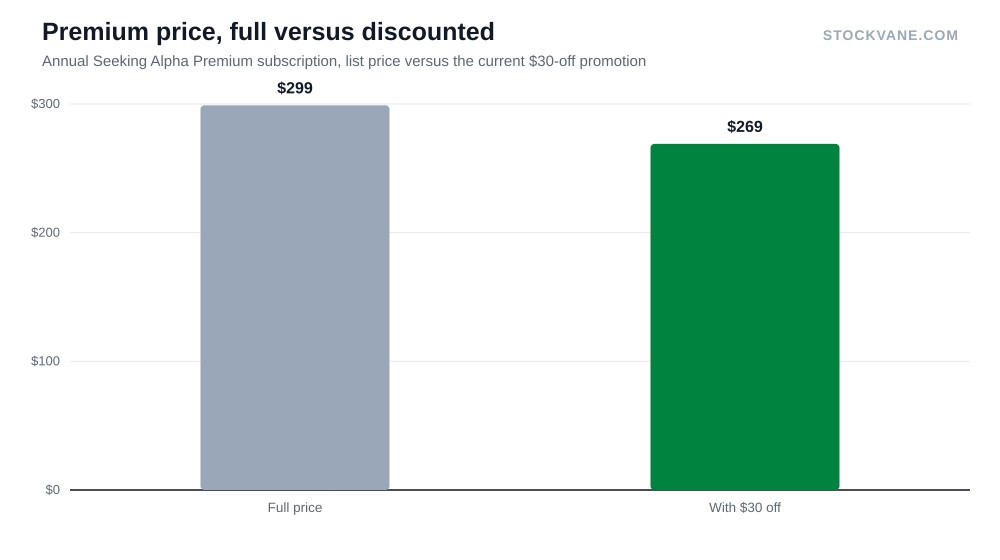
It runs on a freemium model. Limited free access, then Premium, currently $299 a year before promotions, unlocks full articles, quant ratings, dividend grades, and the screener. Premium currently has $30 off with a 7-day free trial, which brings the effective first-year price to $269, a discount of about 10%. That is a temporary offer, not a standing price, so confirm the live number before you commit a card.
You are not paying for information here. Information is abundant and mostly free elsewhere. You are paying for time compression: structure, faster idea discovery, and a shortlist generated for you instead of one you would have to build from scratch across a dozen open tabs.
Alpha Picks sits a layer above the base subscription
Higher tiers add a curated portfolio product called Alpha Picks on top of the base research, a small, actively managed list rather than the full 5,000-stock universe. The Alpha Picks guide covers how the selection process actually works and what kind of return pattern to expect from following it, separate from the marketing copy. If you decide to try the curated list rather than build your own shortlist from the quant screen, compare its cost against the base Premium price before you pick a tier.
Who it fits, and who it does not
Seeking Alpha suits an investor who already understands basic market mechanics and wants structured research plus better idea sourcing, without the complexity of an institutional desk. It is a poor fit for a complete beginner with no framework yet for judging an article’s claims, for anyone looking for a straight buy or sell signal instead of an input, and for a trader who needs execution-level precision the platform was never built to provide.
The honest risk case: if your own process is weak going in, a faster, louder stream of confident opinions does not fix that. It amplifies whatever mistake you were already prone to making, just with better production value and a letter grade attached. A subscription cannot substitute for a framework you have not built yet.
There is a middle group worth naming, too: investors with a reasonable process who simply do not have the hours to read ten filings a week. For that group the platform actually compresses work that would otherwise not get done at all, and the honest comparison is not Seeking Alpha against a perfect process. It is Seeking Alpha against the shortlist you would have built anyway, at three in the morning, off two headlines and a hunch.
The instinctive assumption is that the quant score is the real value and the articles are filler wrapped around it. I would argue the ranking runs the other way. The score is a fine screen, nothing more and nothing less. The articles, read in bulk and read skeptically rather than one at a time, are where you actually learn how other serious investors are thinking through a name you had not considered on your own. That is a different kind of value than any letter grade can provide, and it is easy to miss if you only ever check the score.
Weigh it against the other research options on the market before committing a full year of subscription cost to any single platform, this one included.
The honest verdict
It is not a shortcut to better investing. It is a multiplier on the process you already bring to it. If that process is weak, it amplifies the mistakes. If it is disciplined, it speeds up the insight. In markets today the scarce resource is rarely access to information. It is filtering that information and then acting on it with some consistency. Seeking Alpha helps with the first two of those. The third, still, is entirely on you.
Financial disclaimer: The content on StockVane is for educational and informational purposes only and should not be construed as professional financial advice. Stock market investing involves risk of loss.
Sources: Dividends (SEC Investor.gov glossary) (https://www.investor.gov/introduction-investing/investing-basics/glossary/dividend) · Dividends tax topic (IRS) (https://www.irs.gov/taxtopics/tc404)
Pingback: Microsoft Stock in July 2026: A Trillion-Dollar Company Having a Very Public Identity Crisis – StockVane