
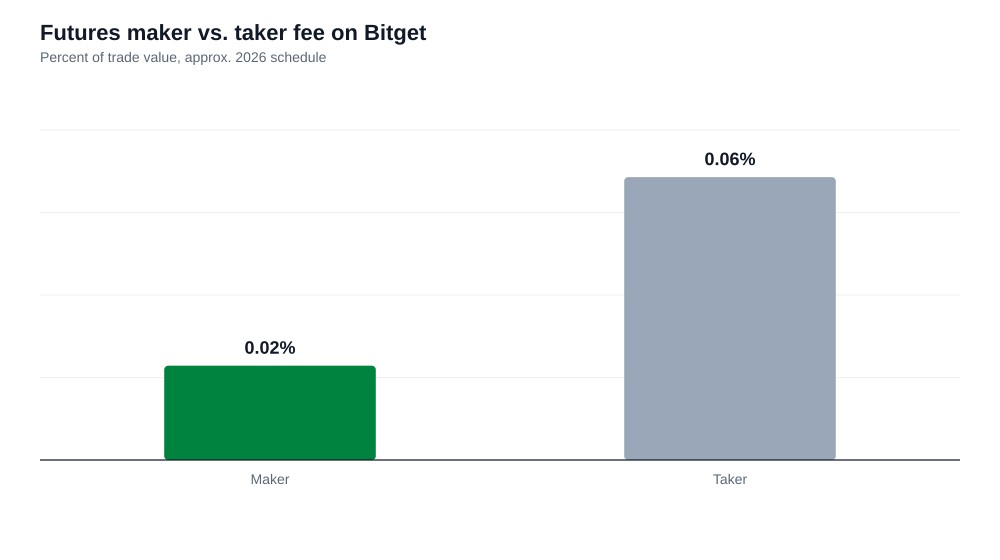
Bitget’s own fee schedule prices futures maker orders at 0.02%, five times cheaper than the 0.1% it charges on a spot trade. That gap tells you what this exchange is actually built for, and it isn’t the buy-and-hold crowd.
Bitget has spent the last couple of years growing from a niche derivatives venue into a full-range exchange, and it now shows up alongside Binance, OKX and Bybit in most comparisons. That doesn’t mean it plays the same game as any of them. The difference is less about size and more about how the platform feels to use once real money is involved. The Bitget vs OKX piece and the Binance vs Coinbase breakdown make the same fit-over-features argument from other angles.
It’s a derivatives platform first
Futures aren’t an add-on here. They’re the core product. Margin is wide, liquidity on the major pairs is solid, and the layout and default settings all nudge a new account toward shorter-term, higher-frequency trading. Coming from a spot-first exchange, the shift is obvious within the first session. That’s not a flaw. It shapes how you end up trading more than most beginners expect going in.
The fee schedule, and the gap between advertised and actual
| Fee type | Bitget (approx., 2026) |
|---|---|
| Spot maker / taker | ~0.1% / ~0.1%, lower with volume or token discounts |
| Futures maker / taker | ~0.02% / ~0.06% |
| Crypto deposit | Free |
| Crypto withdrawal | Network fee, varies by coin |
On paper the structure is competitive, especially on the futures side. The catch sits in the gap between the advertised rate and what a casual account actually pays. Holding the platform token cuts costs. So does a referral code, and so does a higher volume tier. Casual users tend to overestimate how much of that discount applies to them, while active traders capture most of it. Assume you’ll pay closer to the headline 0.1% than any promotional rate until your own trading volume proves otherwise.
A trader running meaningful futures volume pays a fraction of what a spot buyer pays per trade, and that asymmetry is deliberate. It’s how the exchange steers new accounts toward the product it wants them using most.
Funding rates sit underneath that fee line and rarely get mentioned in a comparison table. Every eight hours, one side of a perpetual contract pays the other, a small transfer that keeps the contract price tethered to the underlying spot price without an expiry date forcing the issue. A position can look flat on the price chart and still be quietly losing money to a funding payment if it sits on the crowded side of a trade through several settlement windows in a row. That cost never shows up on the fee schedule above, and new accounts routinely miss it until a statement makes it obvious.
Copy trading is the real differentiator
This is Bitget’s clearest point of separation from most competitors, and it’s more developed here than almost anywhere else in the category. You browse traders, see performance metrics attached to each one, and allocate funds to mirror their positions. It looks like a shortcut to participating without a strategy of your own.
In practice, the leaderboards flatter short windows. Consistency across traders is hard to judge from the numbers Bitget surfaces on any given day. Treat copy trading as passive income and you’ll be disappointed. Treat it instead as a way to watch how other people manage risk. Small allocations spread across two or three traders, run as an experiment rather than a core holding, make it an actually useful research habit. Bitget’s current sign-up bonus is where that account setup starts if you want to test it with a small amount first.
Security, reliability, and what “held up” actually means
Bitget has avoided a major headline security incident so far, which counts for something in this industry. It runs the standard protections: cold storage, multi-signature wallets, risk controls on outsized positions. What actually matters, though, is behavior under stress, withdrawals processing normally, system stability during a volatile session, orderly liquidation of margin positions rather than a cascading freeze. It has held up reasonably well through recent volatile stretches, with the occasional latency or delayed fill when markets move fast. That’s not unique to Bitget. You mostly notice it when you’re trading real size, and it’s worth checking the exchange’s own status page during any unusual stretch rather than assuming everything is fine by default.
Regulation shifts the responsibility onto you
Like most global crypto exchanges, Bitget operates across jurisdictions with uneven oversight. That doesn’t automatically mean higher risk on any single trade, but it does mean you should be clear-eyed about what protections you actually have if something goes wrong. A regulated stock broker defines investor protections by statute. Here, that responsibility shifts much further onto the account holder. Read that as a caution, not a verdict. Plenty of active traders accept the trade-off deliberately, in return for margin access and a product range a regulated broker simply won’t offer.
The practical question worth asking before funding the account isn’t whether Bitget has ever been hacked. It’s what happens the moment a margin position gets liquidated during a fast move: whether the automated risk-reduction queue behaves the way the documentation describes, and whether an insurance fund actually absorbs the shortfall rather than passing it to counterparties on the other side of the trade. I don’t have a clean answer to that from outside the platform, and honestly neither does most marketing copy on any exchange in this category. Sizing positions small while you’re still learning the mechanics is the only real hedge against not knowing the answer in advance.
Verification tiers and what they actually unlock
Bitget, like every exchange operating across multiple jurisdictions, gates withdrawal limits and product access behind identity verification tiers. Basic verification gets you started with modest daily withdrawal caps. A fuller tier, address proof and sometimes a video check, raises those caps substantially and unlocks the higher-margin futures markets. Plan for the higher tier before you need it. Nothing is more frustrating than a fast-moving market and a withdrawal that’s capped at a fraction of what you’re trying to move, discovered only after the position is already open.
Two-factor authentication is not optional in any practical sense, whatever the account settings default to. An exchange account with meaningful balance and no hardware-key or authenticator-app protection is a target, and the loss, if it happens, sits with the account holder rather than the platform.
What it’s like after a few months of real trading
A few patterns become clear once you’ve traded real size rather than just poked at the interface for an afternoon.
It’s easy to start trading, and just as easy to overtrade. Execution is fast, switching pairs is smooth, and margin sits one tap away at all times. That low friction sounds good right up until you notice you’re opening positions more often than planned, especially coming from a traditional broker where a trade feels like a slower, more deliberate act.
Execution is generally reliable. In fast markets, though, slippage on sized positions becomes noticeable enough that limit orders start mattering more than market orders. The interface also constantly surfaces opportunities: trending pairs, top traders, signals, all by design. Without discipline you end up reacting to the platform instead of following your own plan. Once you know the layout, position management runs efficiently. Adjusting a stop, setting a target and tracking running profit and loss are all fast, and for an active trader that matters more than almost any single feature on the platform.
Who it’s actually for
If you’re focused on derivatives, comfortable with margin trading, and want copy trading as a research tool rather than a shortcut to returns, Bitget is a solid choice. If you’re a long-term spot investor who wants a simple buy-and-hold experience, other platforms fit that better and won’t tempt you into a futures position you didn’t plan to open.
The mistake is expecting Bitget to be everything at once. It’s not the simplest exchange on the market, and it isn’t the most institutional either. It sits in the middle, where retail traders who want more control and will accept more complexity for it tend to land, and that middle ground is a real market on its own, not a compromise between two better options.
A beginner arriving with no futures experience should treat the first month as tuition, not a track record. Open the smallest position size the interface allows, let a handful of trades run their full course without adjusting stops mid-move, and only widen the account once the mechanics of margin, funding and liquidation stop requiring a second look every time a number changes on the screen. That patience is unglamorous and it’s also the entire difference between the traders who last a year on this platform and the ones who fund an account, get liquidated twice in a volatile week, and never come back.
If derivatives are the reason you’re reading this, the current Bitget offer is the same link to check for today’s terms before funding anything; promotions rotate and the exchange doesn’t keep old ones live once a new cycle starts.
The number I’d track before funding an account isn’t the headline 0.1% spot fee. It’s how many futures trades you place in a typical week once the account goes live, because that behavior determines whether this exchange ends up working for you or against you far more than any line on the fee schedule.
Financial disclaimer: The content on StockVane is for educational and informational purposes only and should not be construed as professional financial advice. Stock market investing involves risk of loss.
Sources: Price-to-earnings ratio (SEC Investor.gov glossary) (https://www.investor.gov/introduction-investing/investing-basics/glossary/price-earnings-pe-ratio) · Stock options tax topic (IRS) (https://www.irs.gov/taxtopics/tc427)
Bitget has been one of the best crypto trading platforms I’ve used so far. The app is smooth, secure, and packed with features like copy trading, futures, spot trading, and regular airdrop rewards. I especially love how easy it is to navigate, even for beginners.