
Seven of the last eight quarters, TJX grew revenue between 5.1% and 9.2%. The eighth, the quarter ended January 2025, was down 0.4%. That is the whole record on cyclicality that our database offers, and it is the reason this post is not going to tell you TJX is a recession stock. The data cannot say that, and I would rather say so than borrow a story.
What it can say is narrower and more useful. TJX has grown sales every fiscal year since fiscal 2022, raised its EBIT margin four years running, and now trades at 23.6 times trailing earnings, 16% below its own five-year average of 28.1. The stock closed at $127.24, 24.9% under its 52-week high of $169. My read is that the market is charging TJX a lower multiple for a business whose earnings are growing faster than its sales, and that the discount only holds up if the margin gains have run out. The rest of this post tests that.
What the eight quarters show
Quarterly revenue growth ran 6.0%, -0.4%, 5.1%, 6.9%, 7.5%, 8.5%, 9.2% and 5.4%, oldest to newest. The latest figure, for the quarter ended July 31, 2026, is the slowest since May 2025, and revenue was $15.2 billion. Here is the last five quarters in one place, from the financials tab.
| Quarter ended | Revenue | Revenue growth | Operating profit | EBIT margin | Diluted EPS | EPS growth |
|---|---|---|---|---|---|---|
| August 2025 | $14.40 billion | +6.9% | $1.62 billion | 11.6% | $1.10 | +14.6% |
| October 2025 | $15.12 billion | +7.5% | $1.89 billion | 11.7% | $1.28 | +12.3% |
| January 2026 | $17.74 billion | +8.5% | $2.35 billion | 12.2% | $1.58 | +28.5% |
| May 2026 | $14.32 billion | +9.2% | $1.69 billion | 12.6% | $1.19 | +29.3% |
| July 2026 | $15.18 billion | +5.4% | $1.99 billion | 13.0% | $1.36 | +23.6% |
The right-hand columns are the story. Sales grew 5.4% in the latest quarter, and operating profit grew 22.7%. Diluted EPS went from $1.10 to $1.36, up 23.6%. In each of the last three quarters, profit grew about three to four times as fast as sales. That is a margin story, not a traffic story.
The margin numbers are specific. Gross margin was 32.0% in the latest quarter against 30.6% a year earlier, a gain of 1.4 points. EBIT margin (the database figure, which is calculated a little differently from operating profit divided by revenue, so I cite only the database one) was 13.0% against 11.6%, a gain of 1.5 points. So nearly all of the operating margin improvement came at the gross-margin line. Selling and administrative costs did not add much. Whatever TJX is doing on buying, markdowns or freight, it is doing it before the expense lines, and that is where I would look for whether it lasts.
Four straight years, in the annual numbers
EBIT margin by fiscal year runs 9.3% in fiscal 2022, 9.5%, 11.2%, 11.6% and 12.2% in fiscal 2026. Revenue over the same stretch went from $48.6 billion to $60.4 billion, with annual growth of 3%, 9%, 4% and 7% after the reopening year of fiscal 2022, when sales rose 51% off a pandemic-shut fiscal 2021 that had fallen 23%. Gross margin followed the same path, from 27.6% in fiscal 2023 to 31.0% in fiscal 2026.
Read that stretch carefully, because it is where the recession story fails in the data. The one large revenue decline in the database, -23% in fiscal 2021, reads to me as a pandemic closure year rather than a spending slowdown, though the database does not say. Every other year is a gain, none of them a spike. Sales that rise 3% in a year and 9% in the next are not the pattern of a business that gets a bump when consumers trade down. They are the pattern of a business that adds stores and comparable sales at a fairly even clip, and improves what it keeps from each dollar.
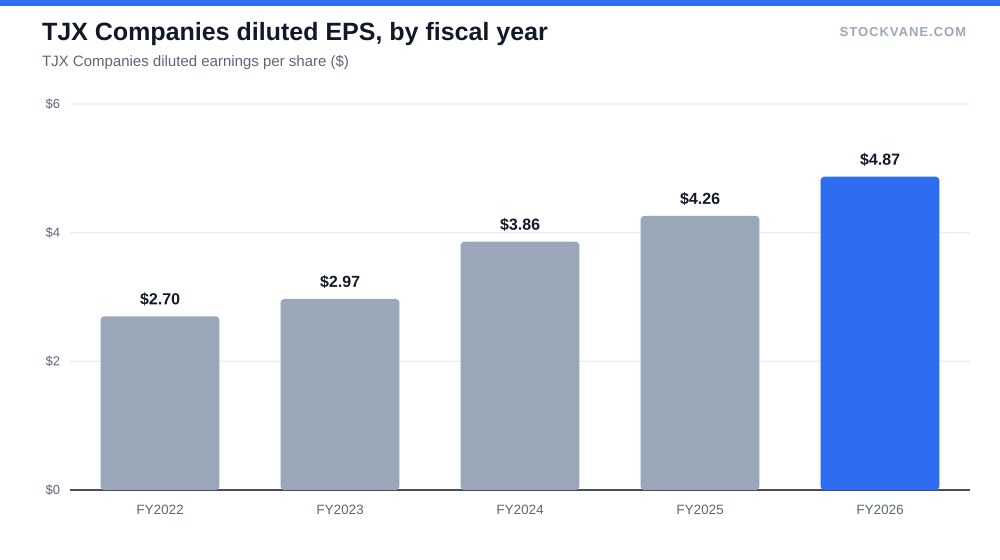
Net profit tells it the same way: $5.5 billion in fiscal 2026 against $4.9 billion in fiscal 2025, on diluted EPS of $4.87 after $4.26. Trailing EPS is now $5.40, because the last four quarters ($1.36, $1.19, $1.58 and $1.28) add to $5.41.
One more check, on concentration. Marmaxx, the U.S. apparel and home chain, is 60.0% of quarterly sales ($9.1 billion), HomeGoods is 16.5%, TJX International 13.8% and TJX Canada 9.7%. A business that is 60% one U.S. banner is not a diversified macro hedge. If a recession does arrive and hits discretionary spending, most of the exposure sits in one place. I do not have segment profit in the database, so I cannot say which of these four is earning the margin.
What 23.6 times earnings buys
Here the discount is real. The trailing P/E is 23.6 in the snapshot and 23.0 in the valuation series, against a five-year average of 28.1 and a band of 24.6 to 31.5. That puts today’s multiple below the bottom of its own range, in the 9th percentile. The forward P/E is 22.7. The valuation tab has the full history.
Two anchors bracket the price. At the five-year average multiple of 28.1 on trailing EPS of $5.40, the stock would be about $152, 19% above today. At the industry average of 18.5 times, it would be about $100, 21% below. TJX trades at a 27% premium to its industry and a 16% discount to itself. Which anchor you believe is the whole argument. Off-price retail has better growth and returns than a typical retailer, which is my case for the premium to the industry, but the database does not measure that directly.
The other gauges are quieter. Price to sales is 2.2, the same as its five-year average, and price to book is 12.8 against 15.5. On sales, the stock is priced as it usually is. The discount is entirely in the P/E, and it exists because earnings grew faster than the price. For a comparison, see Walmart, which trades like a software company: a big-box retailer with a multiple that assumes far more than TJX’s does. And Costco at 50 times earnings is the same debate in more extreme form.
There is an odd detail in the forward number. The forward P/E of 22.7 implies $5.61 of EPS, which is only 4% above the trailing $5.40, when the latest quarter alone grew 23.6%. Either the estimate is cautious, or analysts expect the growth to fade. Our data does not say which. I lean to cautious, but I hold that lightly.
Why the stock fell anyway
The price is 24.9% below the high, and it is only 4% above the 52-week low of $123. The August 19 report showed EPS up 23.6%, and the shares fell 4.2% the next day, against an average earnings-day move of 2.8%. In May the reaction was +5.7%, and in February -1.2%. So the last report was a bigger reaction than usual, in the wrong direction.
Our news feed has no attribution for that move, so I will not supply one. What I can offer is an inference: a stock priced at 28 times earnings needs growth to be accelerating, and the latest quarter’s 5.4% sales growth was a step down from 9.2%. At 23.6 times the market has already taken some of that out. The quant rating fell from C to D on September 16 (a score of 16, after 60 the day before), and it stood at 20 on September 20. I treat that as a description of recent price momentum, not evidence about the business.
Analyst sentiment has not followed the price. Seventeen analysts cover TJX, 82% rate it Buy and 18% Hold. The average target is $173, 36% above the price, with a range of $145 to $198. In September, Morgan Stanley and Goldman Sachs each kept Buy with a $178 target, and BofA kept Buy at $175. Even the lowest target is 14% above the current price. Short interest is 2.0% of float, so nobody is betting hard against it. The yield is 1.38%, from $1.75 paid over twelve months, which is about 32% of trailing EPS.
Where the thesis breaks
The counter-case has two parts, and both deserve a direct answer.
The first is that margins cannot rise forever. EBIT margin at 12.2% for fiscal 2026 and 13.0% in the latest quarter is the highest in the five-year record. A retailer earning 13 cents of operating profit per dollar of sales in a quarter has less room to add than one earning 9. If gross margin plateaus near 32%, EPS growth falls to the pace of sales, which is 5% to 7% on the recent record, and the current 23.6 multiple looks fair rather than cheap. The forward estimate of $5.61 is essentially a bet on that outcome.
The second is that the recession case might still be right in the opposite direction. If consumer spending weakens and TJX benefits from trade-down, sales growth should speed up, and I would expect to see it show up as revenue growth above 9%. If spending weakens and TJX suffers too, the 60% Marmaxx exposure means it would be visible fast. Neither has happened in the eight quarters here. I am not covering macro data, comparable-store sales, inventory or the balance sheet, because the database does not hold them. Anyone who wants the method for that kind of check can start with how to read an earnings report.
The margin line that settles the discount
TJX next reports on November 18, 2026. I would look at two numbers before the EPS. Gross margin: last year’s comparable quarter was 30.9% for the period ended October 2025, and I would want at least 31.5% again, with EBIT margin above the 11.7% of a year ago and, ideally, 12.2%. Revenue growth: at least 5%. If both hold, EBIT margin should come in above 12.2% and the discount to the five-year average of 28.1 is hard to defend. If gross margin slips under 31% while sales growth stays under 5%, the margin story is finished, and 23.6 times is about the right price.
Financial disclaimer: The content on StockVane is for educational and informational purposes only and should not be construed as professional financial advice. Stock market investing involves risk of loss.
Sources: Dividends (SEC Investor.gov glossary) (https://www.investor.gov/introduction-investing/investing-basics/glossary/dividend) · Price-to-earnings ratio (SEC Investor.gov glossary) (https://www.investor.gov/introduction-investing/investing-basics/glossary/price-earnings-pe-ratio)