
Most Moomoo reviews run through features, fees, and charts, then wrap up. That’s useful if you’ve never opened the app. It’s less useful if you’re trying to work out whether it will actually change how you trade. After using it through a few different market conditions, the question I care about isn’t “is Moomoo good.” It’s whether it makes you trade better or just feel more informed. The Moomoo vs Webull and Moomoo vs Robinhood comparisons ask the same thing from the other angles.
First impressions vs reality
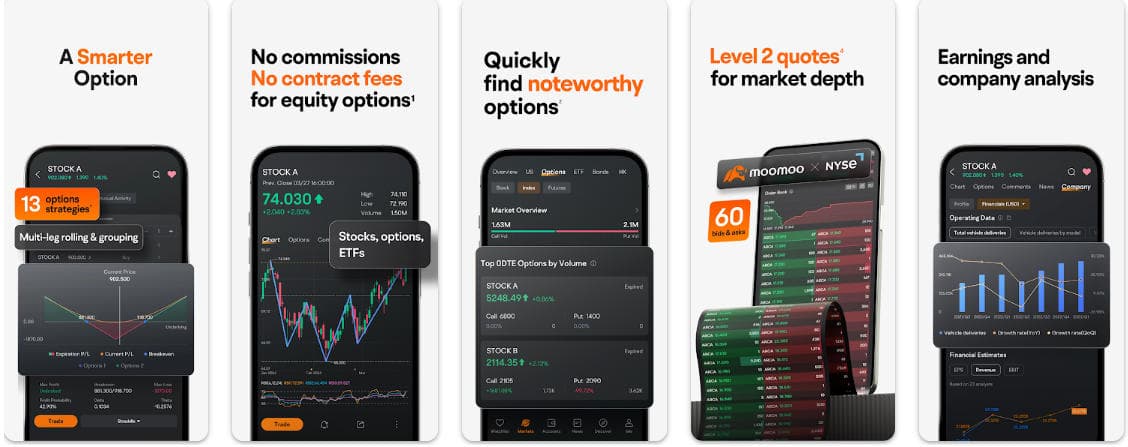
The first time you open Moomoo it feels dense. Order book data, technical indicators, capital flow, rankings, news, sentiment, all on screen at once. Compared to something like Robinhood, it’s like skipping a few levels and landing in a semi-pro interface. For some people that’s a barrier; for others it’s the point.
Most beginners start by asking “do I really need all of this?” A few weeks in, the question becomes “which of this actually matters?” That transition is where Moomoo either becomes useful or stays overwhelming.
What it does well
The standout isn’t the volume of data, it’s how accessible it is. You can check price action, volume behavior, order-flow signals, and basic fundamentals in one place without jumping between tools. That has a subtle effect: you pause more before entering a trade. On simpler apps the path from idea to execution is very short. On Moomoo there’s just enough friction, extra context and extra numbers, that you slow down and double-check. It doesn’t guarantee better trades. It cuts down on careless ones.
It’s also strong in active situations. During earnings, high-volatility days, or momentum spikes, you get more visibility into what’s happening under the price. Not just movement, but its structure. For anyone whose strategy depends on timing, that matters.
Where it works against you
The same information density is a liability if you don’t have a system. Moomoo can become a place where you hunt for confirmation forever, there’s always another indicator, another signal that seems relevant, and instead of deciding, you keep analyzing. That’s a different failure than overtrading: it’s hesitation from too much input.
There’s also the risk of misreading what you see. Order-flow data looks powerful, but without context it can mislead. The platform shows you more; it doesn’t teach you to interpret it. That part is still on you.
Execution and cost
Execution is smooth enough for retail use, orders fill reliably, and you get more visibility into pricing than most zero-commission apps. You see bid/ask depth and can set entries with more precision instead of hitting market orders blind. What’s interesting is how that changes your behavior: because the data is right there, you start noticing spread, liquidity, and order size, small differences you’d ignore elsewhere. Over time those add up more than commissions ever did.
Moomoo advertises zero-commission trading, which is accurate but not where the real cost sits. The real costs are spread and fill quality, trade frequency, and behavior-driven mistakes. Moomoo helps with the first by making pricing visible and with the second by slowing you down. The third depends entirely on how you use it. Treat it as a signal generator and costs go up; treat it as decision support and they go down.

Who it fits
Moomoo works best for someone who already cares about improving their process. If you just want to buy a stock quickly and check your portfolio once a day, it’s more than you need and the extra data will sit unused. But if you’re at the stage of trying to understand why your trades work or don’t, it gives you enough visibility to review your thinking, not just your results.
| Moomoo is a good fit if you… | Look elsewhere if you… |
|---|---|
| Want order-flow and Level 2 data in the same screen as the quote | Just want to buy a stock quickly and check it once a day |
| Are trying to understand why your trades work, not just track results | Have no process yet and would use the extra data to hunt for confirmation |
| Trade around earnings or volatility and rely on timing | Are a set-and-forget index investor |
| Are willing to spend a week learning the interface | Want the simplest possible first brokerage |
The verdict
The mistake people make is expecting Moomoo to improve their outcomes automatically. It doesn’t. It gives you a better environment to make decisions in; whether that turns into better results depends on your discipline. If you already have some structure, Moomoo sharpens it. If you don’t, it just becomes a more complex version of the same behavior. It doesn’t push you to trade more, it gives you more reasons to think before you do, and that’s usually where the edge actually comes from.
Financial disclaimer: The content on StockVane is for educational and informational purposes only and should not be construed as professional financial advice. Investing carries risk of loss.
Pingback: How to Invest in Stocks With Little Money: The Brutally Honest Beginner’s Guide – StockVane