How to Read an Earnings Report: The Skill That Separates Investors

A retail investor owns a stock. The company reports quarterly results. Revenue grew 14%. EPS came in at $2.31. The press release uses words like “strong execution” and “continued momentum.” By any ordinary measure, the numbers look good. The investor nods, feels confirmed, maybe adds to the position.

The stock drops 9% the next morning.

The investor goes online and reads that the company “missed” — that analysts had expected $2.38 per share, not $2.31, and that management’s guidance for next quarter came in below what the Street had modeled. The business performed reasonably well. The stock got punished anyway. And the investor, who looked at the headline numbers and drew entirely the wrong conclusion, is now holding a position that moved hard against them without understanding why.

This scenario doesn’t happen because the investor was stupid. It happens because reading an earnings report is a specific skill that nobody teaches retail investors systematically. The financial press assumes you know it. Brokerage platforms don’t explain it. So most people learn it the hard way, after several expensive lessons.

This piece is the guide I wish someone had handed me before my first few earnings seasons. It covers what’s actually in a report, what actually matters, what almost everyone misses, and how to develop a framework for interpreting earnings that works across industries and company sizes.


What an Earnings Report Actually Contains

Every public company in the United States files quarterly financial results with the SEC within 40 to 45 days of its fiscal quarter ending. The formal filing is called a 10-Q. Alongside it, most companies issue a shorter press release summarizing the highlights. Many companies also hold an earnings call — a live audio event where management presents results and takes questions from analysts — usually the same day results are published.

Most retail investors read only the press release. Some listen to a few minutes of the earnings call. Very few read the 10-Q itself. This is understandable given how dense regulatory filings are, but it means most investors are working from a document that management specifically designed to present results in their most favorable light.

The formal financial package contains four core components.

The income statement shows revenue, cost of goods sold, gross profit, operating expenses, operating income, and net income cascading downward from top to bottom. This is why revenue is called the “top line” and net income is called the “bottom line” — they are literally the first and last lines on the statement.

The balance sheet is a snapshot of the company’s financial position at a specific moment — what it owns (assets), what it owes (liabilities), and what’s left for shareholders (equity). The balance sheet doesn’t tell you how the quarter went. It tells you the company’s structural financial health at quarter-end.

The cash flow statement shows actual cash moving in and out of the business across three categories: operating activities, investing activities, and financing activities. This is the document that catches the things income statements can obscure.

Management commentary — the MD&A section in the 10-Q, the CEO’s prepared remarks on the earnings call, and the guidance section of the press release — provides the qualitative context that numbers alone can’t convey.

Each of these serves a different purpose, and understanding which questions each one answers is the foundation of reading earnings properly.


The Number Everyone Watches and What It Actually Measures

Earnings per share is the most widely quoted number in any earnings report. Calculated by dividing net income by the weighted average shares outstanding, it compresses the company’s profitability into a single per-share figure that allows comparison across time and between companies.

The thing most beginners don’t know about EPS is that there are two versions of it, and they can diverge significantly.

GAAP EPS — earnings calculated according to Generally Accepted Accounting Principles — includes every item that affected the company’s financials during the quarter, including one-time charges, restructuring costs, asset impairments, stock-based compensation, and acquisition-related expenses. It’s the number the company is legally required to report.

Non-GAAP EPS — sometimes called “adjusted” or “core” EPS — excludes items that management argues don’t reflect the ongoing operating performance of the business. Stock-based compensation, amortization of acquired intangibles, and restructuring charges are common exclusions.

The gap between GAAP and non-GAAP can be enormous. A technology company paying its engineers substantially in stock options might report GAAP EPS of $0.80 and non-GAAP EPS of $1.40. The non-GAAP figure is what management wants you to focus on. The GAAP figure is what actually happened. Neither is dishonest by itself — the question is whether the excluded items are genuinely one-time and non-recurring, or whether they are recurring costs that the company would prefer you didn’t count.

Stock-based compensation is the most commonly questioned exclusion. When a company pays employees in stock, it dilutes existing shareholders and represents a real economic cost of running the business. Excluding it from adjusted earnings makes the profitability picture look better than it is for companies where stock compensation is a large and recurring expense. If a company has been excluding “one-time” items for twenty consecutive quarters, they are by definition no longer one-time.

The practical rule: look at both figures, understand the reconciliation between them, and form your own view about whether the exclusions are reasonable. If adjusted EPS is dramatically higher than GAAP EPS year after year, understand what’s being excluded and whether it represents a real cost of doing business.


Revenue: The Number That Tells You If the Business Is Growing

Revenue — also called net sales, total revenue, or the top line — represents the total value of goods and services the company sold during the quarter. Before any expenses are subtracted. Before any taxes are paid. Before any interest charges. Just the raw commercial activity of the business.

Revenue matters because it tells you whether demand for the company’s products is growing, stable, or declining. EPS can be manipulated through share buybacks, cost cuts, and accounting choices. Revenue is harder to manufacture. A company can’t cut its way to sustained revenue growth.

There are two dimensions to evaluating any revenue figure.

Year-over-year growth compares this quarter to the same quarter twelve months ago. This removes seasonal effects — a retailer’s fourth quarter will always be larger than its third quarter because of holiday spending, so comparing Q4 to Q3 tells you nothing meaningful about growth trajectory.

Sequential growth compares this quarter to last quarter. For businesses without strong seasonality, sequential growth or deceleration can signal near-term momentum shifts before they show up in annual comparisons.

The more important question beyond the absolute growth rate is whether growth is accelerating or decelerating. A company growing revenue at 15% for four consecutive quarters is performing consistently. A company that grew 30%, then 24%, then 18%, then 15% over four quarters is a business whose trajectory is heading in one direction — and the market will usually price that trajectory before it fully arrives at its destination.

Quarter over quarter deceleration is one of the most reliable leading indicators of near-term stock price pressure, even when the absolute growth rate still looks impressive. The market doesn’t just ask “is it growing” — it asks “is it growing faster or slower than before.”


The Part of Every Earnings Report That Moves Stocks More Than the Results Do

Here is the thing that surprises most beginning investors when they first encounter it seriously.

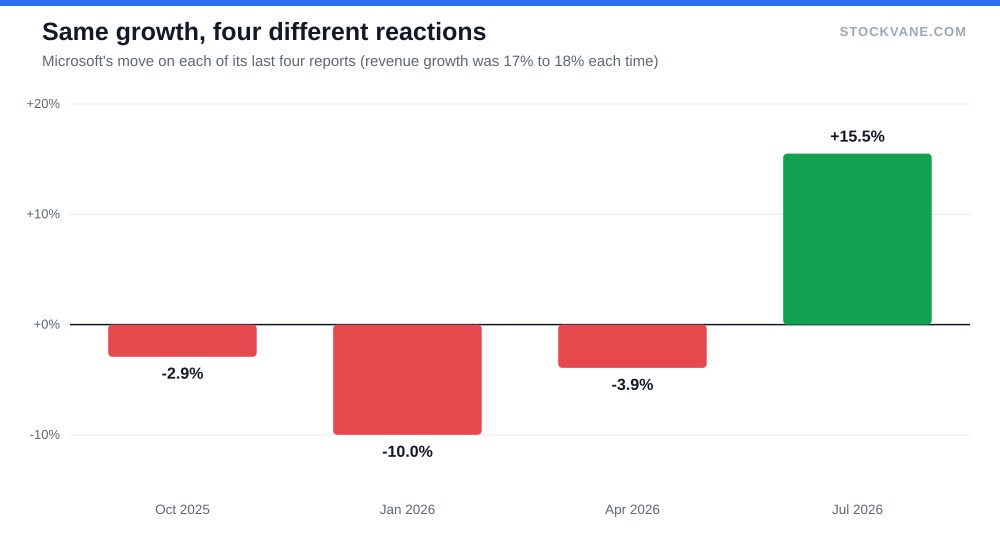
In most cases, the guidance section of an earnings report has more influence on the stock’s price reaction than the actual reported results.

The reported results describe what already happened. The market had months to form expectations about those numbers — analyst estimates, whisper numbers from company insiders, industry data, competitor results. By the time the earnings release lands, much of the historical quarter’s outcome is already priced into the stock. That is the fundamental meaning of the phrase “the market is forward-looking.”

Guidance describes what management expects to happen next. That is genuinely new information. Analysts had their own models for next quarter, but they didn’t have what management knows about the current sales pipeline, the order backlog, the pricing environment, and the cost structure the company is carrying into the coming months. When those two pieces of information — analyst expectation and management guidance — diverge significantly, the stock reprices to bridge the gap.

The mathematical version of this principle is straightforward but worth making explicit.

When a company beats the current quarter and raises full-year guidance, the stock typically rallies. When a company beats the current quarter but merely maintains or slightly trims guidance, the reaction is often flat to slightly negative — because the beat is old news and the guidance disappointed the expectations built around it. When a company misses the current quarter and cuts guidance, the reaction is usually severe. When a company misses but raises guidance — implying the weakness was temporary — the reaction is often surprisingly mild or even positive.

This framework produces outcomes that confuse investors who focus primarily on the reported numbers. Strong results plus weak guidance produces a falling stock. Weak results plus strong guidance produces a rising one. The stock is pricing the future, not confirming the past.

In Q1 2026, FactSet data showed that 84% of S&P 500 companies reported EPS above analyst estimates, and 81% reported revenue above estimates. Beat rates that high are a consistent feature of earnings seasons — companies and analysts have developed a mutual understanding over decades where management tends to guide conservatively and analysts tend to set expectations that can be cleared. The game is not whether the company beats the estimate; it’s by how much, and what they say happens next.


What the Cash Flow Statement Reveals That the Income Statement Hides

The income statement is an accounting document. The cash flow statement is a financial reality document. This distinction matters more than most investors realize.

Revenue is recognized on the income statement when it is earned, not necessarily when cash changes hands. If a software company signs a three-year subscription contract for $300,000, it might recognize $100,000 per year in revenue regardless of when the customer actually pays. The income statement looks healthy. The cash flow statement shows whether that revenue translated into actual cash in the company’s bank account.

Expenses work similarly. Depreciation — the accounting charge that reduces the book value of physical assets over time — appears on the income statement as a cost but does not involve any actual cash leaving the business. Stock-based compensation appears as an income statement expense but involves no cash outflow. These non-cash items make the income statement a less direct picture of actual cash generation than many investors assume.

The operating cash flow section of the cash flow statement strips out these non-cash items and shows the actual cash generated by the business’s operations during the quarter. For a company reporting strong earnings, operating cash flow that is consistently in line with or above net income is a quality signal. Operating cash flow that is consistently below net income — or that has been declining while earnings grow — warrants investigation.

Free cash flow is the most commonly used metric derived from the cash flow statement: operating cash flow minus capital expenditure. This is the cash available to pay dividends, repurchase shares, reduce debt, or reinvest in the business after maintaining and growing the physical infrastructure the company needs to operate. For a company to be genuinely financially healthy over time, free cash flow needs to be consistently positive and ideally growing.

The gap between reported earnings and free cash flow is one of the most reliable quality signals in financial analysis. Companies where they track closely over time are generally running honest accounting. Companies where earnings consistently look better than free cash flow deserve scrutiny about which accounting choices are creating the gap.


Reading the Earnings Call: The Information That Doesn’t Appear in the Numbers

The earnings press release contains the numbers. The earnings call transcript contains the texture around those numbers, and texture is frequently where the actionable information lives.

Most earnings calls follow a predictable structure. The CFO or CEO opens with a prepared summary of the quarter, walking through the headline metrics and providing context management wants investors to focus on. Then analysts ask questions. The answers to those questions — and the way management handles questions it would prefer not to answer directly — tell you things that no financial statement can convey.

Pay attention to what management chooses to highlight in the prepared remarks. Companies emphasize the metrics that are performing well. If the CEO spends significant time on gross margin improvement and very little time on revenue growth, it may be because revenue growth isn’t the story management wants you focused on.

Pay equal attention to how management answers difficult questions. Experienced analysts push on the areas of weakness — why a specific segment missed, what the competitive environment looks like in a particular market, whether margin guidance assumes successful cost reduction that hasn’t been demonstrated yet. Management that answers directly, provides specific data, and acknowledges challenges candidly is communicating differently from management that pivots to strengths, uses future-tense language to describe things that should already be happening, and deflects with references to long-term potential.

Language precision matters. “We expect continued momentum” is different from “we expect revenue acceleration.” “Growth in line with prior periods” is different from “double-digit revenue growth.” These distinctions are deliberate — management and their legal teams choose words carefully specifically to shape interpretation without making commitments they can’t keep.

The questions analysts ask are also informative. A cluster of analyst questions about the same specific topic — customer churn in a subscription business, inventory levels in a hardware company, the sustainability of a particular margin figure — signals that the investment community has identified something it doesn’t fully understand or trust. When six analysts ask about the same thing and management’s answer doesn’t fully satisfy them, the stock often continues to face pressure as the underlying concern remains unresolved.


A Practical Framework for Processing Any Earnings Report

Rather than reading earnings reports reactively — opening the press release after the results are already known and the stock has already moved — developing a consistent pre-earnings and post-earnings process produces better decisions over time.

Before earnings are reported, know the analyst consensus for revenue, EPS, and guidance. These are available for free on platforms like Seeking Alpha, Yahoo Finance, and Stockanalysis.com. Know what the “whisper number” is for closely followed companies — the informal expectation that often differs slightly from the official consensus. Know the previous quarter’s results and guidance so you have a baseline for comparison. Know what the stock has done in the weeks leading up to earnings — a stock that has rallied 25% into an earnings report has already priced in optimism that the results will need to validate.

When results are released, look at reported revenue versus estimate, then EPS versus estimate, then guidance versus analyst expectations for next quarter, in that order. These three data points explain 80% of the stock’s initial reaction in most cases. Then read the press release for the specific commentary that explains the numbers — segment performance, geographic trends, margin dynamics, any unusual items.

Then read or listen to the earnings call. Form an opinion about whether management’s answers to analyst questions increase or decrease your confidence in the business trajectory. Note any discrepancies between the tone of the prepared remarks and the specificity of the answers to hard questions.

Then wait before acting. Earnings-day volatility is frequently the worst time to make buy or sell decisions. Stocks often overreact in both directions in the hours immediately following results as positions are adjusted, short-term traders respond to headline numbers, and the market digests guidance. The more durable signal usually emerges over one to three trading days as more investors work through the numbers and the call.


The Benchmarks That Give Results Context

No earnings result means anything in isolation. Context comes from three comparisons that should accompany every quarterly review.

Year-over-year comparison removes seasonality and tells you whether the business is growing. Sequential comparison shows recent momentum. And performance relative to analyst estimates tells you whether the stock should reprice based on the new information.

Beyond these three, sector and competitive context matters. A company reporting 8% revenue growth might be accelerating strongly if the industry is growing at 3%. The same 8% growth might represent market share loss if competitors are growing at 15%. Neither assessment is visible in the company’s numbers alone — it requires knowing what the comparable cohort is doing simultaneously.

FactSet’s earnings data for Q1 2026 provides a useful sector-level reference point: the S&P 500 blended earnings growth rate for the quarter reached 28.4%, the highest single-quarter growth rate in several years, driven by technology and communication services. This context means that a technology company reporting 15% earnings growth in Q1 2026 was actually underperforming its peer group by a wide margin, even though 15% earnings growth sounds impressive in isolation.

The sector baseline is the lens that converts an absolute number into a relative assessment. Always ask not just “is this good” but “is this good relative to what was expected, and relative to what similar companies are delivering.”


What Most Retail Investors Get Wrong and Why It’s Costing Them

The single most common error I observe among investors at every level of experience is anchoring to the most recent quarter as the primary input for investment decisions.

Quarterly earnings are important. They are not the complete story. A single quarter of strong results in a business with deteriorating fundamentals is not a reason to buy. A single quarter of disappointing results in a fundamentally excellent business is usually not a reason to sell. The pattern across four to six consecutive quarters is more informative than any individual data point.

Specifically watch for these patterns over time rather than in isolation.

Gross margin trend — is the company retaining more or less of each dollar of revenue after direct costs? Expanding gross margins over time indicate improving pricing power or scale efficiency. Contracting gross margins, even alongside revenue growth, signal that the business is working harder to generate the same profit per unit.

Operating leverage — as revenue grows, are operating expenses growing faster or slower? A business with true operating leverage should show operating income growing faster than revenue over time. If both lines grow at the same rate, the company is not demonstrating the economic benefits of scale.

Free cash flow conversion — over rolling four-quarter periods, is the company converting a stable percentage of earnings to free cash flow? Improving conversion indicates earnings quality. Declining conversion with stable or rising reported earnings is a warning sign worth investigating specifically.

Management credibility — over eight to twelve quarters, does management consistently guide conservatively and beat, or do they guide optimistically and miss? The pattern of guidance accuracy is one of the most underused tools for evaluating management quality. A management team with twelve consecutive quarters of conservative guidance that they’ve beaten tells you something real about how they run their business and how they communicate with investors.

Earnings reports are quarterly snapshots of an ongoing business. Each one adds one piece to a picture that takes years to develop fully. The investors who get the most from them are the ones who treat each quarter as an update to a long-running thesis rather than a standalone decision trigger.

That patience — reading quarterly results as data points in a longer story rather than as binary buy or sell signals — is the skill that separates investors who compound wealth steadily from investors who are perpetually surprised by stocks they thought they understood.

Leave a Comment

Scroll to Top