
At a Shiller CAPE of about 40.7, you are paying roughly $40.70 for every dollar of average inflation-adjusted profit a company earned over the past decade. Flip it over and the market’s earnings yield is about 2.5%. That is the number to hold against a 10-year Treasury bond, and it is why so many people have called the S&P 500 expensive this year.
Whether that gives you anything to act on is a separate question. My view is that the market is expensive, that part of the price is deserved, and that nobody can tell you the exact split.
What CAPE measures
Robert Shiller of Yale built the cyclically adjusted price-to-earnings ratio to fix a flaw in the ordinary P/E. Normal P/E divides today’s price by one year of earnings, and one year is noisy. If a recession knocks earnings down for a while, the ordinary P/E spikes and makes stocks look expensive at exactly the moment they are cheapest. CAPE smooths that out by using ten years of inflation-adjusted earnings, so a single bad or great year cannot move it much.
The long-run average since 1881 is about 17.3. As of September 1 the reading was 40.7, after sitting near 41.6 in May. In more than 140 years of data, the only reading clearly higher was December 1999 at 44.19, two months before the dot-com peak. The May 2026 reading of 41.6 sat a little above today’s, and little else in the record comes close.
The case for worry comes first, because it is stronger than its critics allow.
The case for worry
When CAPE has been near 40, the decade that followed has usually delivered poor returns. Shiller spent years showing an inverse relationship between the starting CAPE and long-run forward returns, and the work is part of why he shared a Nobel Prize. It is not a fringe method. The relationship is loose, there is scatter around it, but it has held often enough to be taken seriously.
Other gauges point the same way. The Buffett indicator, total U.S. market value divided by GDP, was about 244% at the end of June by the Advisor Perspectives calculation, a level that series classes as strongly overvalued. The forward P/E on the S&P 500 is around 21 to 22 depending on whose estimates you use, against a ten-year average near 19. And the equity risk premium, the extra return stocks are expected to pay over Treasury bonds, has narrowed to well under one percentage point on some calculations, though the measure varies a lot with the method.
| Valuation measure | Current level | Long-run reference | How stretched |
|---|---|---|---|
| Shiller CAPE | About 40.7 (Sept. 1, 2026) | About 17.3 since 1881 | More than twice the average |
| Forward P/E, S&P 500 | About 21 to 22 | About 19 (10-year average) | Roughly 10% to 15% above |
| Buffett indicator | About 244% (June 30, 2026) | 2.6 standard deviations above trend in that series | Near the top of its range |
| Equity risk premium | Well under 1 point on some methods | A few points over long stretches of history | Near a historic low; depends on method |
Four different frameworks, one direction. None of them is a timing tool, and the last one in particular depends on definitions, but I would not wave all four away.
Why the ratio may overstate the problem
Here is where I stop following the pessimists. The CAPE denominator includes ten years of earnings, and right now that window reaches back to 2016. In 2016 Microsoft’s cloud business was small next to what it is now, and Apple’s services line was just getting started. The profits anchoring the denominator come from a technology industry that looks very little like the one earning money today.
That matters because a software business with 70% gross margins and almost no cost to serve one more customer deserves a higher multiple than a manufacturer with 35% margins and heavy capital needs. The index has shifted a long way toward the first kind. This is the “this time is different” argument, and I know how it sounds, because every bubble has produced a version of it. The difference is that the shift in business models here can be measured in margins and cash flow, which the 1999 revenue multiples on companies with no profits could not be.
There is also an honest counterpoint from the other side. Profit margins for the largest companies are higher than they were a decade ago, and if they stay there, the ten-year average will catch up to today’s earnings over time and the ratio will drift lower even if prices go nowhere. That is a real path, and it is the one bulls are quietly counting on. It is also a path that requires margins to hold, which is a bet, and bets can lose.
Still, I cannot tell you what fraction of the stretch is earned and what fraction is excess. I doubt anyone can. The honest position is that CAPE is stretched, some of that is warranted, and the split is unknown.
What our own coverage shows
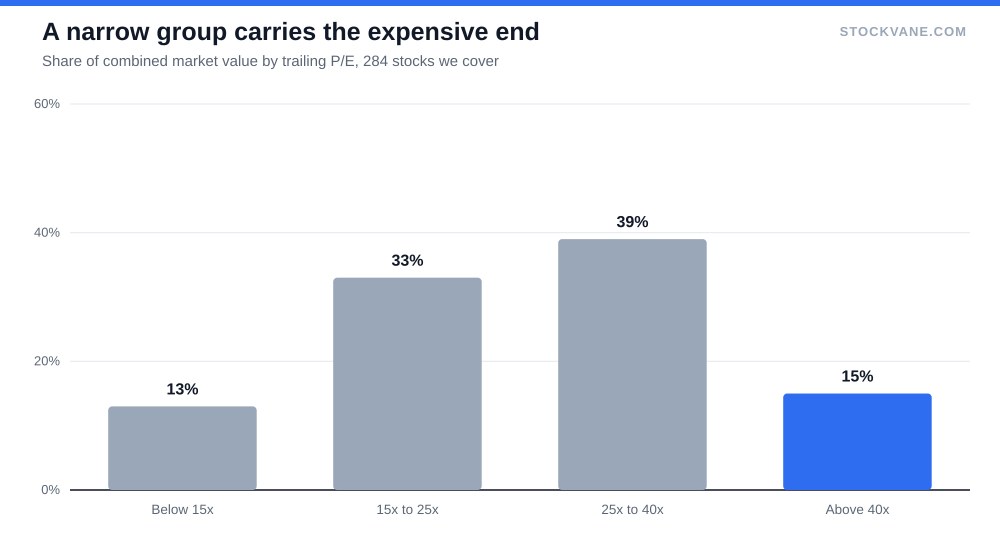
The index-level number hides how uneven the market is. Among the 284 stocks we cover with positive trailing earnings, the median P/E is about 23, not 41. Most of the market is priced in a range that would not look out of place in any decade. The expensive part is narrow but sizable: 50 stocks above 40 times earnings account for about 15% of the combined value of the group.
| Trailing P/E | Stocks | Share of combined market value |
|---|---|---|
| Below 15x | 58 | 13% |
| 15x to 25x | 102 | 33% |
| 25x to 40x | 74 | 39% |
| Above 40x | 50 | 15% |
I would read that two ways. First, an index this concentrated can look expensive because a small group of very large companies is expensive, while the median company is fairly valued. Second, that group is exactly the one people are counting on to keep growing. Some of these companies deserve their multiples. Others are riding an AI narrative that has less to do with current profit than with hope, and the difference will matter a great deal if growth disappoints.
What the past says about ten-year returns
Research across multiple periods keeps finding that a starting CAPE above 35 has been followed by below-average returns over the next decade, and that the range of outcomes is wide. Some starting points produced small gains in nominal terms and losses after inflation. Some produced outright losses. The central tendency is poor even though it is not always negative.
It helps to split returns into three pieces: what companies pay out, how fast their earnings grow, and whether the multiple rises or falls. From a CAPE of 40.7 the third piece cannot be counted on to help. If the multiple slipped back to 30, which would still be well above the long-run average, earnings would have to grow about 36% just to leave prices where they are today. That arithmetic is why forecasts from this starting point tend to be modest. Modest is not the same as bad, but it is a different promise from the one investors got used to.
Bulls have a fair reply, which is that CAPE speaks about the next ten years and says almost nothing about the next one. Someone who called the market dangerous in 1997 was right about the ten-year picture and watched the index climb for three more years first. Valuation is a poor timing tool, and the market can stay expensive for a long time.
That leaves the practical question, which is what a sensible investor does differently because CAPE is high. Knowing the number is high is the easy half.
The mistake to avoid
I would not make a large move to cash on valuation alone, and the reason is that it takes two correct decisions, not one. You have to be right that the market is overvalued, and you also have to be right about when the market decides to care. The first is much easier than the second. Valuation has been a bad reason to sell for years at a stretch, and the investors who did it on that basis had to wait a long time to be proved right.
The more common error is extrapolation. From 2010 through 2025 the S&P 500 returned something in the low double digits a year, above its long-run average near 10%, partly because valuations rose from reasonable to stretched. That rise is a one-time tailwind. You cannot expand your way from expensive to more expensive forever, so treating the last fifteen years as the baseline is the one error a high-CAPE market makes very easy.
What carrying an umbrella means
A portfolio that worked well over the last fifteen years, heavy in U.S. large caps with a growth tilt and little in bonds or overseas stocks, has a different range of outcomes going forward than its recent record suggests. Not necessarily bad ones. Lower expected returns from today’s starting valuation, more sensitivity if any multiple compresses, and an international allocation that looks better on relative value than it has in years, since European and Japanese multiples have stayed far calmer than the U.S. multiple over the past decade and a half.
Owning stocks broadly still makes sense for most people with long horizons. The alternatives, cash and bonds with duration risk in an uncertain rate environment, are not clearly better over ten years once inflation takes its share.
I am not predicting a crash, and I would not sell everything on the theory that one is coming. I would size positions so that a 20% drop is survivable, look hard at which companies sit inside the index fund, and plan on returns well below the last fifteen years. That is what an umbrella means here: you still go out, you just do not assume the weather stays fine.
Financial disclaimer: The content on StockVane is for educational and informational purposes only and should not be construed as professional financial advice. Stock market investing involves risk of loss.
Pingback: Sell Puts on VOO in 2026: Chasing a 95%+ Win Rate Without Giving Up Double-Digit Yield – StockVane