
“AI Cloud Infra sustained strong momentum this quarter, with GPU Cloud growth accelerating further.” That is the sentence Baidu’s chief executive chose to lead the second-quarter release, and it is accurate. It is also the only sentence about the quarter that does not need a footnote.
The title of this piece promised what to expect from Baidu in August. The report arrived on August 18, so what follows reads the fundamentals as they stand now, with the numbers in hand. My view is that Baidu is two companies sharing one balance sheet: a fast-growing AI infrastructure business that is eating cash, and an advertising business that is shrinking and paying for it. The stock is a bet on which one wins the race before the cash runs low.
What the second quarter showed
Total revenue was RMB 31.3 billion, down 4% from RMB 32.7 billion a year earlier and down 2% from the first quarter. Baidu General Business, which leaves out the iQIYI streaming unit, brought in RMB 25.2 billion, also down 4%. Operating income was RMB 3.0 billion, a 10% margin, and net income attributable to Baidu was RMB 2.3 billion, a 7% margin. Diluted earnings per ADS were RMB 5.74 on a GAAP basis and RMB 7.22 excluding items the company adjusts out. All of these figures come from the company’s second-quarter release, and I will use its numbers throughout because Baidu is not in our quote database.
| Revenue line, Q2 2026 | RMB billions | Change from a year earlier |
|---|---|---|
| Total revenue (including iQIYI) | 31.3 | -4% |
| Baidu General Business | 25.2 | -4% |
| Online marketing services | 13.1 | -19% |
| AI-powered business (total) | 12.5 | +25% |
| AI Cloud Infra | 7.3 | +50% |
| AI applications | 2.5 | +3% |
| AI-native marketing services | 2.6 | Flat |
The table shows the split that matters. AI Cloud Infra revenue was RMB 7.3 billion, up 50% from a year earlier. Inside it, GPU Cloud revenue grew 283%, which is faster than the 184% of the first quarter. AI applications were RMB 2.5 billion, up 3%, and AI-native marketing services were RMB 2.6 billion, flat. Online marketing, the legacy advertising line, fell 19% to RMB 13.1 billion.
The company groups the AI lines as its “AI-powered business,” which was RMB 12.5 billion, up 25%, and 50% of Baidu General Business revenue. That is up from 38% a year ago, though down two points from 52% in the first quarter.
The trade-off inside the growth
The income statement holds up better than you would expect. Cost of revenues rose 4% from a year earlier to RMB 19.1 billion while operating expenses fell 17% to RMB 9.2 billion. Subtract both from RMB 31.3 billion of revenue and you get the RMB 3.0 billion of operating income, so the profit is being defended by cutting expenses, not by growing sales. The gap between GAAP and adjusted earnings per ADS, RMB 5.74 against RMB 7.22, is about 26%, which is wide enough that I would quote the GAAP figure first.
Fast growth in AI infrastructure is expensive, and the cash flow statement is where that shows. Operating cash flow was RMB 3.4 billion, positive for a fourth straight quarter, which management pointed out. Free cash flow was negative RMB 8.0 billion. The difference is capital spending, which works out to about RMB 11.4 billion in the quarter, more than three times operating cash flow and roughly 36% of revenue.
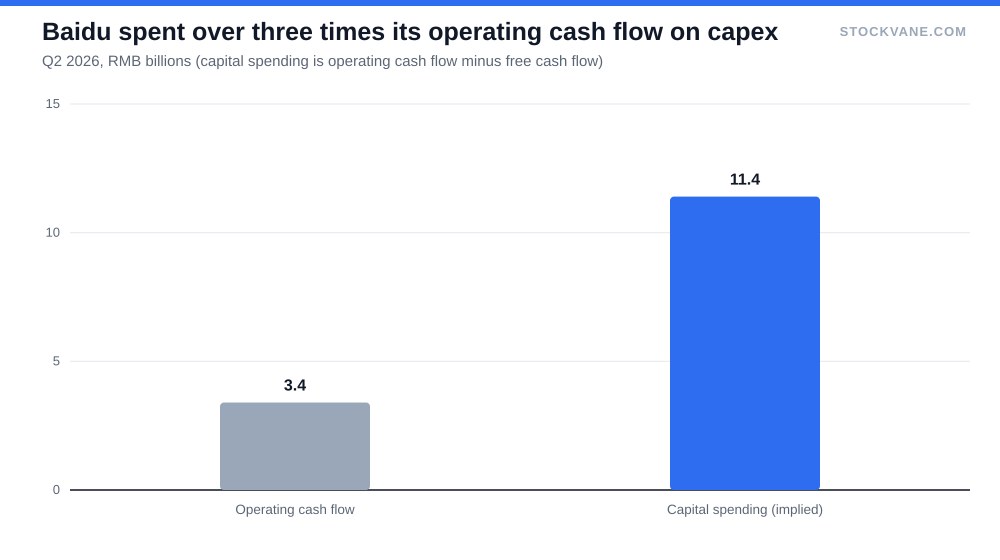
I would not call that reckless. Building GPU capacity ahead of demand is what a cloud business does, and the release says customer demand is driving it. It does change the argument, though. The debate used to be whether Baidu’s ads could keep growing. Now it is whether the money spent on GPUs earns a return before the advertising line shrinks further. Those two lines are moving in opposite directions at very different speeds. For the wider picture of who profits from the AI spending Baidu is joining, our guide to the AI infrastructure buildout covers the suppliers.
Advertising is the drag
Online marketing services made up 52% of General Business revenue this quarter, against 62% a year ago. That share is falling because the business is shrinking. A 19% decline is a large drop for the line that carried the company for most of its history. Management said it expects advertising to stay under pressure through the second half, because it is prioritizing the AI search experience over monetization for now.
Management is being candid, and the arithmetic explains why. If both lines simply held their current rates for a year, AI Cloud Infra would reach about RMB 11 billion and online marketing would fall to about RMB 10.6 billion, so the two would cross. Rates rarely hold, and the company’s own outlook says advertising stays under pressure, so I would treat that as a direction and not a date. Either way, shareholders are being asked to wait through a stretch where the total does not grow. Our earlier note on Baidu’s earnings-day drop shows how sharply the shares can react to a report.
The balance sheet buys time
Cash and investments were RMB 283.1 billion, about $41.7 billion at the release’s exchange rate, which is about 2.3 times a year of revenue at the latest quarter’s pace. At the latest quarter’s free cash flow deficit, cash alone would cover close to nine years, before counting any debt. Baidu has also been buying back stock, about $259 million across the first half of 2026. That is only about 0.6% of the cash pile, so the buyback says more about management’s confidence than it does about shrinking the share count.
The comparison I find most useful is Alibaba, which is in our data. It trades at 25.6 times trailing earnings and 18.0 times forward earnings, so the market pays a moderate multiple for another large Chinese internet company. I cannot show you the same numbers for Baidu, and I would not guess them. What I can say is that a business with this much cash relative to its size does not need a high multiple to be safe. It needs one to be interesting.
Apollo Go and the other bets
The autonomous driving service, Apollo Go, now operates in 28 cities and has passed 23 million cumulative rides and more than 350 million autonomous kilometers, of which over 240 million were fully driverless. The release mentions commercial operations in Dubai, first permits in Hong Kong, open-road testing in London with Uber and Lyft, and testing in Switzerland. It also says ride volume was temporarily affected by regulatory adjustments in certain domestic cities.
I treat this as an option, not as a part of the valuation. The ride counts are impressive, but nothing I have seen from the release shows the unit economics, and I have not seen a separate revenue line for it. The AI cloud story is the one with reported numbers behind it. Other items in the release, including the planned Hong Kong dual-primary listing, a shareholder vote set for August 26, and the Kunlunxin chip unit’s listing process, could change how the stock is held and priced, and I would watch them without building a thesis on them. The Hong Kong listing matters mainly because the company says it is preparing for Stock Connect inclusion, which would open the shares to a new pool of mainland investors. More buyers do not change what the business earns, but they can change how the market prices it.
Two smaller figures from the company: ERNIE Assistant daily active users rose 83% from a year earlier, and demand for embodied AI grew about sixfold. Neither is a revenue line yet.
The risk that stays in the background
Baidu is a U.S.-listed ADR that owns its China business through a variable interest entity, a legal structure that gives foreign shareholders economic exposure without direct ownership of the operating company. It has held up through years of scrutiny, but “has held up” is not the same as “cannot break.” The planned dual-primary listing in Hong Kong may broaden who owns the shares. I would size a position in any Chinese ADR smaller than a comparable U.S. company for that reason alone, whatever the fundamentals look like.
If you trade options, the cash-secured put walkthrough on BIDU shows how one investor turned this kind of volatility into an income position. It is an example, not a recommendation.
The two numbers I would track
I am not confident in a firm price view, because the stock’s data is outside our quote feed and the story turns on two variables I cannot forecast well. The first is the growth rate of AI Cloud Infra. If it stays near 50% and GPU Cloud keeps accelerating, the cash being spent looks like an investment. If it drops toward 25%, the spending starts to look like a bet that did not pay off. The second is operating cash flow. It has been positive for four quarters, and if it turns negative while capital spending stays near RMB 11 billion, the balance sheet is no longer a comfort, it is a countdown.
My judgment is that Baidu is a reasonable holding for someone willing to wait through a shrinking advertising line, and a poor one for someone who needs the total to grow soon. The AI numbers are real. They are also not yet big enough to offset what is falling.
Financial disclaimer: The content on StockVane is for educational and informational purposes only and should not be construed as professional financial advice. Stock market investing involves risk of loss.