
Eighteen percent in one day is not a normal move for Accenture. It happened on June 18, the morning after the fiscal third-quarter report, and it was more than four times the size of any reaction to the three reports before it. The stock now trades near $181, about 36% below its 52-week high, and the next report arrives before the open on October 1.
We think the market is arguing about one question, and the last three months have made the price much more sensitive to the answer. Accenture is priced today like an ordinary services company. Whether it deserves to be depends on how much of its revenue survives the arrival of AI tools that can do in minutes what its consultants bill hours for.
What the argument actually is
Accenture sells consulting, technology services and outsourcing, and a large share of that work is priced by the hour. The bear case is simple: if AI tools cut the hours a client needs, revenue slows even while clients spend more on AI projects. The bull case is that a company deploying AI across a large organization still needs someone to integrate it with systems, data and compliance rules, and Accenture is the biggest firm that does that.
The June reaction shows which side won the day. It does not settle the argument. A single bad print can reset expectations without changing the business underneath, and it can also be the first visible sign that the business is changing. We cannot tell those apart from one report. What we can do is track the numbers that would change first if the bears are right, and those are the ones below: growth, margin and the multiple investors are willing to pay.
There is a second pressure that gets less attention. Hourly billing is being replaced by fixed-price and outcome-based contracts, where the client pays for a result and the consulting firm keeps the savings if it delivers faster. That can work in Accenture’s favor if its people and tools get more efficient, and against it if clients push the savings back into lower prices. The report is one of the few chances investors get to see which way that is going.
Growth slowed, but it did not stop
The financials tab shows revenue of $69.7 billion for fiscal 2025, up 7%, and diluted EPS of $12.15, up 6%. Growth over the four most recent quarters has been 7.3%, 6.0%, 8.3% and 5.6%. The June quarter, at $18.7 billion, is the slowest of the four, but it is still growth, and quarterly EPS of $3.80 rose 8.9% from a year earlier.
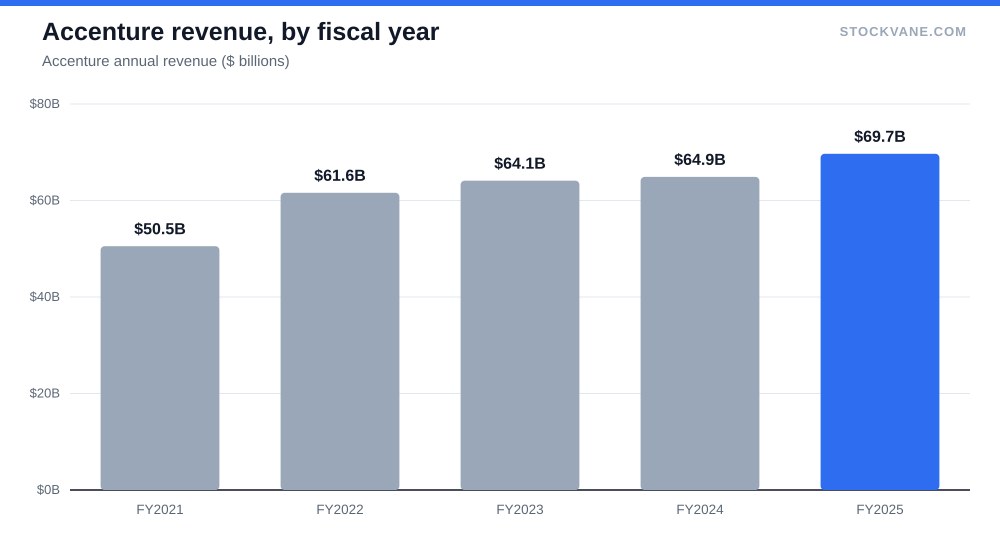
That does not look like a business in decline. It looks like one that has downshifted from the 14% and 22% growth of 2021 and 2022, when clients were spending heavily on digital projects after the pandemic. Growth of 5% to 8% is closer to the company’s long-run pace, and the question is whether the next number is 4% or 2%.
The multiple has been cut in half
The valuation tab is where the story shows up most clearly. At 14.5 times trailing earnings, Accenture sits at about the 8th percentile of its own five-year range, where the average is 26.8 times. The information technology services group averages 15.5, so the stock is priced like an ordinary member of its peer group and not like the premium franchise it was. On forward estimates the multiple is 13.2.
A stock does not go from 27 to 14.5 on a single bad quarter. It gets there when investors change what they believe about long-term growth, and the report on October 1 is where that belief gets tested again. For comparison, IBM, which also sells consulting and software to large clients, trades at about 20 times trailing earnings, and ADP at about 25.
Five years in two numbers
Since October 2021, when Accenture closed the month near $326, the shares have fallen about 44%. Over the same stretch diluted EPS rose 33%, from $9.16 in fiscal 2021 to $12.15 in fiscal 2025. From the December 2021 monthly high of about $376 the decline is 52%. Profit grew and the stock roughly halved, which means all of the drop, and more, came from the multiple.
That is why this reads to us as a valuation argument and not a performance one. The business kept growing. What changed is the price investors are willing to pay for each dollar of its profit, and a repricing of that size usually needs a report to reverse it.
What the price already assumes
One way to read a multiple is to ask what earnings it implies. Holding the price at $181, the table below shows the earnings per share that would make the stock look fairly valued at three different multiples. Fiscal 2025 EPS was $12.15.
| If the stock deserved | EPS implied at $181 | Change from FY2025 EPS |
|---|---|---|
| 15.5 times (IT services group average) | $11.70 | -4% |
| 20.0 times (A multiple still below its own history) | $9.06 | -25% |
| 26.8 times (Accenture’s own five-year average) | $6.76 | -44% |
At the peer average, the price assumes earnings a little below last year’s, which is a mild view. At 20 times it assumes a quarter of earnings has gone. At Accenture’s own historical average it assumes nearly half. The market is not pricing a collapse. It is pricing a real chance that the earnings power of the last five years does not carry forward, and that is a fair thing to worry about even if it is not the likeliest outcome.
Margins have not moved
If AI were already eating into Accenture’s pricing, the first place it would show up is the operating margin. It has not. Operating profit as a share of revenue rose from 14.7% in fiscal 2020 to 15.6% in fiscal 2025, and it rose in every one of those years. The company has been able to keep about the same share of each dollar it bills while revenue grew 57% over the period.
That is the strongest single piece of evidence for the bull case in the data we track, and it is also the number the bears will watch most closely. A margin that stays above 15% says clients are still paying for the work. One that slips below it would say the price cutting has started.
How the stock reacts to reports
The three reports before June moved the stock by +4.3%, -1.4% and -2.7%, all under 5%. June’s drop was a break from that pattern, which is why October 1 matters more than a typical quarter: it shows whether June was a one-time reset or the start of a more volatile phase for the shares.
Short interest is about 4.2% of the float, with roughly five days of volume needed to cover it. That is not extreme, but it is higher than most large companies in the data we cover, and it means some investors are actively betting the answer will be worse.
Across the last four reports the stock moved an average of 6.6% in one direction or the other, a figure that includes June. A good report on October 1 does not restore a 27 times multiple. Getting back to the peer-group average of 15.5 would be worth only about 7% from here. Anything beyond that has to come from earnings growth or from investors deciding Accenture deserves more than an average services company.
Analysts and the dividend
Eighteen analysts cover the stock: 56% rate it a buy, 44% hold, and none sell. The analyst consensus average target is $187, only about 3% above the current price, and the range runs from $130 to $275. In mid-September the news feed also carried a Wells Fargo downgrade to Hold, so the sell side is not becoming more optimistic ahead of the report.
| Metric | Value | Context |
|---|---|---|
| Price (approx.) | $181.29 | 52-week range $117 to $285 |
| P/E (TTM) | 14.5x | Five-year average 26.8x |
| Price-to-sales | 1.6x | Five-year average 3.0x |
| Analyst ratings | 56% buy, 44% hold | 18 analysts; average target $187 |
| Dividend yield | 3.51% |
The dividend yields 3.51%, or $6.37 over the last twelve months, which is about 52% of trailing EPS. Accenture raised its quarterly payment to $1.63 last October from $1.48, an increase of about 10%, after a roughly 15% increase the year before. At the current rate the payout is $6.52 a year, about 54% of fiscal 2025 EPS, which is comfortably covered. A yield of this size is a reason for income investors to pay attention, not a substitute for growth.
What we need to see on October 1
We would want three things from the report. Revenue growth that holds at or above 5%, which would say the June slowdown was not the start of a slide. EPS that keeps growing, since that is what the dividend and the multiple rest on. And management language on hiring and pricing that does not suggest AI is already shrinking billable work.
Accenture also reports new bookings each quarter, which is the best forward indicator of consulting demand. Our data does not track it, so read it in the release itself. Weak bookings alongside a stable margin would tell you demand is softening before pricing does.
If those arrive, a stock at 14.5 times earnings with a 3.5% yield looks like it is pricing in more than the numbers show. If growth slips toward 3%, the price is probably still finding its level. We would rather wait for the report than guess which way it goes.
Financial disclaimer: The content on StockVane is for educational and informational purposes only and should not be construed as professional financial advice. Stock market investing involves risk of loss.