
Caterpillar has climbed roughly 78% from its 52-week low. As I write this it trades near $809, against a floor of $455 and a peak of $1,071, and the StockVane Quant Rating on the stock is an A. Strong trend, strong score. The usual advice is to ride it.
I would rather wait. The reason is a number that never shows up on a price chart: operating margin, which peaked in 2024 and then fell hard in 2025 while the shares kept making new highs.
That is the whole argument, and I hold it with some humility. Caterpillar has a genuine new growth engine, and I will get to it. But when a stock goes up 78% off its low while the profit it earns on each dollar of sales goes down, somebody is paying for something that has not arrived yet.
The margin peaked a year ago
Between 2020 and 2024, Caterpillar’s operating margin climbed almost without interruption, from under 11% to just over 20%. It got there by turning each dollar of machine and engine sales into more profit than it used to, and that improvement is what changed how investors valued the company. A business people file under “cyclical industrial” started getting a multiple you would normally see on something with pricing power.
Then 2025 arrived. On the income statement figures in the financials tab, revenue rose 4% to $67.6 billion, but operating profit fell from $13.1 billion to $11.2 billion. That takes the margin from 20.2% to 16.5%. Net income dropped 18% and diluted EPS fell from $22.05 to $18.81. Management has pointed to tariff costs and higher input prices, and it expects tariffs alone to run about $2.2 billion this year before any refunds. None of that reads like weak demand. It reads like a company selling more and keeping less.
What the quant score actually rewards
It is worth separating what the A means from what it does not. As I read the rating history, the score leans heavily on price trend: how far the stock sits above its longer-term averages and how steadily it has moved. On that test Caterpillar is a textbook A. The trend is unbroken and the technical picture has no cracks.
I take that signal seriously. Momentum in industrial stocks tends to last longer than skeptics expect, because the earnings upgrades that justify the move often arrive a couple of quarters after the price. Betting against a clean trend has cost a lot of people money.
But the score tells you the stock has been going up. It does not tell you whether the price is a fair deal today, and those are different questions. A rating built around momentum will always look best at the moment valuation looks worst.
A cyclical with a new engine
Caterpillar is really three businesses under one ticker, and they have not been moving together. Construction Industries follows housing and infrastructure and is the most cyclical of the three. Resource Industries sells mining equipment on multi-year capital cycles. Power & Energy, which sells large engines and turbines, has been the standout.
The second quarter is where the shift shows. Total revenue was $20.5 billion, up 24% from a year earlier and the strongest growth in the set of quarters I checked. Power & Energy brought in $8.2 billion, essentially level with Construction’s $8.3 billion.
I think that segment explains most of the re-rating. Data centers need power faster than the grid can deliver it, and large reciprocating engines are one of the few technologies that can be installed on a two-year timeline instead of five. I looked at the wider supply chain in a piece on the real AI bottleneck and the conclusion holds here: for now, the buyers of this equipment are not price shopping.
My hesitation is proportion. One segment’s structural tailwind is being used to support a premium multiple on the whole company, including the roughly 60% of revenue that still behaves like an ordinary industrial. If Power & Energy keeps growing at this pace, the premium looks earned. If it slows, the rest of the business will not fill the gap.
What 35 times earnings asks for
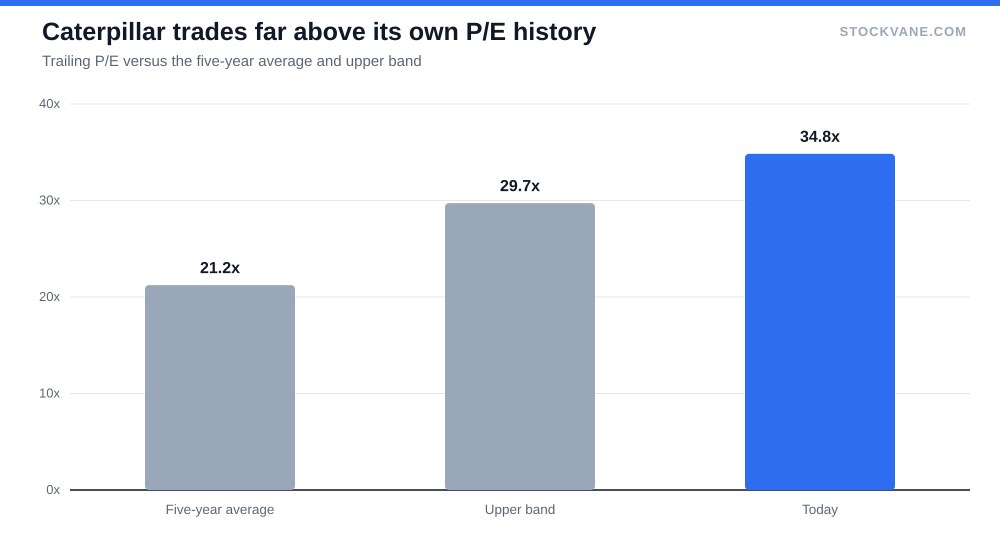
The valuation tab shows the trailing P/E at about 35, against a five-year average near 21 and an upper band around 30. Caterpillar is trading well outside anything it has done in half a decade. The forward multiple of 28.6 is lower, but only because it assumes earnings jump by about half. Divide today’s price by that forward P/E and you get a required EPS near $28, against $18.81 last year.
Here is the arithmetic I find more useful than either multiple. Hold the price at $809 and ask what earnings per share it takes to make the stock look ordinary.
| If the stock traded at | EPS needed at today’s price | Change from FY2025 EPS |
|---|---|---|
| 30 times earnings | $27 | +43% |
| 25 times earnings | $32 | +72% |
| 21 times (five-year average) | $38 | +103% |
Revenue growth of 24% and a margin that gets back to 20% would take EPS a long way toward the first row. It would not get there quickly enough for the second or third unless the margin overshoots its old peak. I hold that view loosely on the pace. Backlogs in this business are long, and orders can carry pricing that has not yet reached reported margin, so a sharp recovery is not far-fetched. It is simply not in the numbers yet.
The sell side is split too
You would expect analysts to be more bullish than a cautious investor, and on price targets they are. The average target of $1,010 sits about 25% above the current price, and even the lowest target, $882, is above where the stock trades.
| Metric | Value | Context |
|---|---|---|
| Operating margin, FY2025 | 16.5% | Down from 20.2% in FY2024 |
| Diluted EPS, FY2025 | $18.81 | Down 15% year over year |
| P/E, trailing | 34.8x | Five-year average 21.2x |
| 52-week range | $455 to $1,071 | Recent price about $809 |
| Analyst ratings | 47% buy, 53% hold | 15 analysts covering the stock |
| Average price target | $1,010 | About 25% above the recent price |
The ratings tell a more careful story. According to the analyst consensus, only 47% of the 15 analysts covering the stock rate it a buy, and 53% say hold. That is an unusual combination: targets that imply upside from people who will not quite call it a buy. My reading is that the sell side likes the demand and the backlog but is not ready to underwrite a full return to a 20% margin until it appears in a reported quarter.
I share that hesitation. It is the same gap between the story and the evidence that makes me cautious.
The last time margins peaked
The data I have goes back far enough to see one earlier cycle. Caterpillar’s operating margin sat near 15% in 2018 and 2019, a record for that stretch, and then fell to about 11% in 2020. It recovered to nearly 15% by 2022, then jumped to 19% and 20% in the next two years. So the recent peak is five points above the old one, and nobody should be surprised that a business this cyclical gives some of it back.
Whether it gives back most of it is the real question. Management’s case is that pricing discipline and a richer mix of services and power equipment have raised the floor. That is plausible, and I cannot verify it from the statements alone. What I can say is that the stock has more than quadrupled since October 2021, when it closed near $188, and that a move of that size usually needs the higher margin to be permanent.
The market keeps rewarding the reports
I would be doing the other side a disservice if I skipped this. Caterpillar has risen on each of its last four earnings days, by roughly 12%, 3%, 10% and 6%, and only about 1.6% of the float is sold short, which is low. Nobody is leaning against this stock. Whatever the margin says, the market is listening to the backlog.
I do not read that as a reason to buy. A stock that has gone up on four straight reports is a stock where good news is expected, and the reaction to a merely fine quarter can look very different. It is a reason not to fight the trend with a short, and that is not what I am proposing.
The price I would wait for
I am not arguing that Caterpillar is a bad business or that the rally is a bubble. The demand is real, the backlog is large, and a company can grow into a rich multiple. What I am arguing is that at $809 you are paying for the recovery before you have seen it.
Waiting is not free, but it is cheap. The dividend yields about 0.75%, roughly $6 a share a year, so you give up almost no income by staying out. That is the practical difference between a stock like this and one where you get paid to be patient.
There are two things that would change my mind. The first is evidence: two consecutive quarters in which operating margin holds at 18% or better on rising revenue would tell me the 2025 slide was a cost spike and not a new normal. The second is price. A pullback toward the low $700s would bring the forward multiple near 25 and leave more room for the recovery to be wrong.
Until one of those happens, I would treat the A as a description of the past and let other people pay for the future.
Gavin Thorne has invested in U.S. stocks for six years and previously worked at a large publicly traded internet company. He writes about income-oriented strategies, including cash-secured puts, and about how he reads company data. This article reflects his personal research process and is for informational purposes only. It does not constitute investment advice.