
I have always filed Amgen under boring, and in an income portfolio that is meant as a compliment. Boring, to me, means the dividend arrives on schedule and the thesis needs no defending. So when the shares dropped about 14% below their 52-week high of $447, my first question was not whether to buy. It was whether boring had quietly become expensive.
The short answer is that it has not. Amgen trades at 24.0 times trailing earnings, below both its own five-year average of 26.6 and the drug-industry average of 29.7, and it yields about 2.5%. My longer answer is that the price is fair for a steady grower, and I would want a lower one before I got excited. Here is how I get there.
Growth that does not need a story
The financials tab shows revenue of $36.8 billion for 2025, up 10%, after a 19% jump in 2024 that came mostly from the Horizon acquisition closing. June-quarter sales were $10.05 billion, up 9.5%, after $8.62 billion in March, up 5.8%. Over the last eight quarters, growth has landed between roughly 6% and 12%, apart from a 23% spike in the third quarter of 2024, when the year-earlier comparison still left out the acquisition.
A chip designer would grow faster and a utility slower. For a company selling more than $10 billion a quarter, that middle lane is a comfortable place to be, and it explains why the multiple sits near the middle of its own five-year range.
The mix underneath matters more than the total. Repatha, the cholesterol drug, sold $953 million in the second quarter, up 37% from a year earlier, according to Amgen’s own report. Prolia, the osteoporosis drug that faces multiple biosimilars, fell 32% to $759 million, with volume down 20% and net selling price down 12%. One product is growing into the space the other is losing. Repatha is about 9.5% of revenue and Prolia about 7.5%, so neither decides the year, but the trade between them decides whether growth stays near 10% or slips toward 5%.
The earnings line looks noisy for a reason
If you only read the EPS row, you would think something broke.
Diluted earnings fell 39% in 2024 to $7.56, then rose 88% in 2025 to $14.23. No business swings that hard. What moved was one-time items and acquisition accounting. Net margin went from 12% in 2024 to 21% in 2025 on almost the same operating activity.
The number I trust more is gross margin, which was 75.7% in 2022, dipped as the acquired products came in, and sits at 67.2% now. It has not recovered fully, and I think that is a useful piece of humility. Some of the old profitability may not come back, because the newer drugs cost more to make and sell than the older ones did.
What the multiple asks you to believe
On the valuation tab, the trailing P/E of 24.0 sits at about the 51st percentile of Amgen’s own five-year range, so it is neither cheap nor expensive against its history. Dividing today’s price by that multiple gives trailing earnings of about $16.10 a share. The forward P/E of 22.7 implies about $17.0, only around 6% higher.
What reassures me is how low that hurdle is.
A mid-single-digit rise in earnings is about what 6% to 10% revenue growth and stable margins can deliver, so the price does not depend on a heroic quarter. Most of the stocks I look at ask for much more.
| Trailing P/E | Implied price | Yield at that price | What it would mean |
|---|---|---|---|
| 20x | $322 | 3.04% | Priced for slower growth and Prolia erosion |
| 22x | $354 | 2.77% | Close to the forward multiple |
| 24.0x (now) | $386 | 2.54% | Below the five-year average |
| 26.6x (5-year average) | $428 | 2.29% | Back to its own history |
The table shows what different multiples would mean for the share price and the yield. At Amgen’s five-year average multiple the stock would be worth about $428, and at 22 times, roughly where it might sit if growth slows, about $354. I think that spread, from $354 to $428, is the honest range for a company like this over the next year, with the current price near the middle.
The dividend is covered, with less room than the yield implies
Amgen pays $2.52 a quarter, up from $2.38 last November, a 5.9% raise. Over the last twelve months it paid $9.80 a share, a 2.54% yield at today’s price. The dividend history page shows the last three payments at that new level.
A yield is only as good as the cash behind it. Amgen paid out $5.1 billion in dividends in 2025 against free cash flow of $8.1 billion, so the dividend took about 63% of the cash the business generated. On earnings the payout looks like 61% of trailing EPS, or 69% of the 2025 figure. Neither is alarming, though both leave less room for big raises than the yield suggests.
There is a second claim on that cash. Amgen carries about $54.6 billion in debt, $50.0 billion long term and $4.6 billion due within a year, against $9.1 billion of cash. Interest cost $2.76 billion in 2025, about 30% of operating profit. Free cash flow also fell from $10.4 billion to $8.1 billion, down 22%. I would not call that a warning by itself, since debt has been shrinking, but a payout that takes 63% of cash and a debt bill that takes another slice is a reason I keep my expectations for dividend growth in the mid-single digits.
Where the analysts and the model land
Of the 16 analysts covering it, 56% rate Amgen a buy, 31% a hold and 12% a sell, and the average target of $413 is about 7% above the price. The full range is wide, from $230 to $460, which is 40% below and 19% above where the stock trades today. Individual calls are listed on the analyst page. In early September, Scotiabank kept a Buy with a $450 target, Citi held at $405 and Truist stayed at Hold, so the disagreement is real and not a formality.
StockVane’s own quant model grades the stock a B, with a score of 72 out of 100, up from a C at 68 on September 8. The rating history shows the change came as the stock steadied, which is what a price-driven model is designed to reward. I read that as neutral and not as an endorsement.
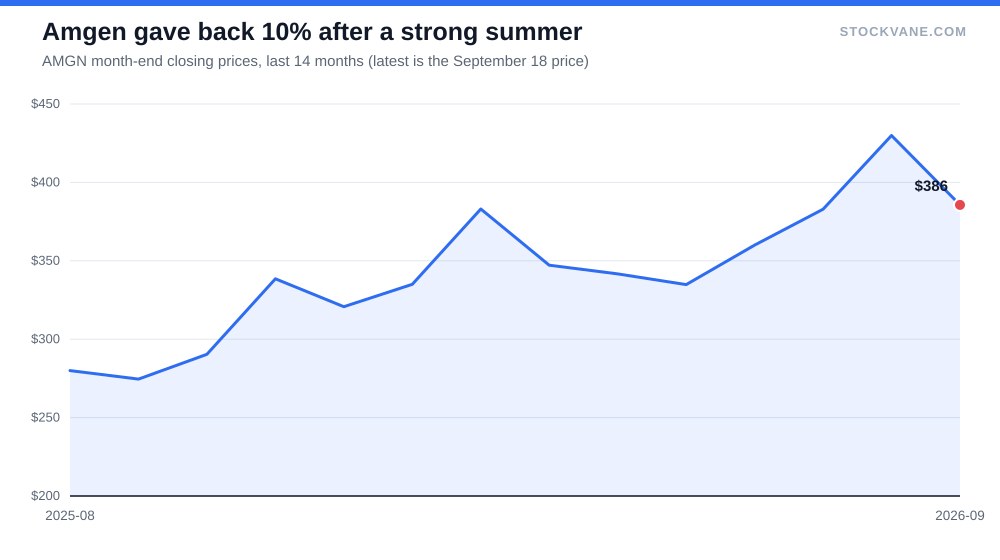
A year ago the shares closed near $275, so they are still up about 40% over twelve months, well ahead of the roughly 10% revenue growth of 2025. Part of that gain is the market paying more for each dollar of earnings, which is why I stop at fair value and do not call the stock cheap. It closed August near $430 and has given back about 10% since. Short interest is only about 2.4% of the float, so this is not a crowded bet against the company. It looks more like a holder base taking some profit after a run from $275 a year ago.
How the stock behaves on report days
Amgen’s last four earnings reports moved the shares +4.6%, -4.7%, +8.2% and +7.8% the next day, newest first. Three of the four were gains, and none was the kind of 10% shock that turns a quiet holding into a headache. For an income position I care about that more than most people do. A stock that reprices by mid-single digits on results is one where a put seller or a dividend holder can sleep through the print, and where a bad quarter does not force a decision. That may change, especially if Prolia declines faster than expected, but the pattern so far supports the steady-grower label.
Ways this goes wrong
Biosimilar erosion in Prolia could go on longer than expected. Enbrel, another 5.8% of sales, is an older franchise I would not assume keeps growing, and other legacy drugs face the same kind of pressure. The company’s own obesity candidate, MariTide, is still in clinical development, with new studies starting this year, so any value assigned to it today is a bet on trials that have not finished. I would not pay a penny for it.
I also do not know how much of the 2025 profit rebound is permanent. If the one-time items that flattered 2025 turn out to be bigger than I think, then the trailing P/E of 24.0 is lower than it should be, and the stock is more expensive than it looks.
What I would wait for
For income, I would rather be paid to wait than pay the current price outright. At about $327 the trailing yield reaches 3%, and at 22 times earnings the stock is near $354. Either one is a level where I would take a position without much hesitation. I described the method in my primer on selling puts, and the point is that the premium lowers the effective cost while you wait for a better entry.
At $386 I would call Amgen fairly priced and stop there. A margin of safety would put my entry near $354, the 22-times level in the table, and I would rather wait for it than talk myself into the current price. The next thing I check is whether Prolia’s volume decline slows in the September-quarter report.
Gavin Thorne has invested in U.S. stocks for six years and previously worked at a large publicly traded internet company. He writes about income-oriented strategies, including cash-secured puts, and about how he reads company data. This article reflects his personal research process and is for informational purposes only. It does not constitute investment advice.