
Ask ten people at a backyard barbecue which fund a beginner should buy and you will hear “just get SPY” or “just get QQQ” in the same confident tone, as if the two were the same thing with different letters. They are close cousins. They are not twins, and the gap between them is measurable in the price data we already have.
Our read is simple. SPY is the more honest answer to “what is the market,” and QQQ is a deliberate bet on one corner of it. Which one belongs in your account depends less on which has done better lately and more on what you already own, and on how you will behave when a fund drops 15% in a few weeks.
What the two indexes contain
SPY tracks the S&P 500, which holds roughly 500 large U.S. companies across every major sector and weights them by market value. A committee picks the members, and it looks at size, liquidity and profitability, so the index is not a mechanical list of the biggest names. Banks, insurers, energy producers, health care and industrial companies all sit alongside the technology giants.
QQQ tracks the Nasdaq-100, which is the 100 largest non-financial companies listed on the Nasdaq exchange. That single word, non-financial, removes every bank and insurer from the fund by design. What is left leans heavily toward technology, communication services and consumer discretionary names.
We would put it this way. SPY tries to be a map of the U.S. corporate economy. QQQ is a map of the part of it that trades on one exchange and happens to include the companies that have driven most of the index gains of the last decade. Neither description is a criticism. They are different jobs.
The price gap you can measure
Fund behavior shows up directly in the price data. As of September 18, 2026, SPY trades near $761.69 and QQQ near $721.45. Measured from each fund’s 52-week low, SPY is up about 21.7% and QQQ is up about 30.0%. That means QQQ has climbed roughly 1.39 times as far as SPY over the same stretch.
The other half of that story is the range. SPY’s 52-week high sits about 24.2% above its low. QQQ’s sits about 34.7% above. A wider range means a bumpier ride, and in both directions. A $10,000 position that started at each fund’s low would be worth about $12,165 in SPY and about $13,000 in QQQ today. If the timing had been the reverse, and you bought at the high, the first has given back about 2.0% since, the second about 3.5%.
That is a small sample, one year, and we do not know exactly when each fund made its low, so treat these as a rough measure of how far each moves and not as a forecast. Still, it agrees with what the holdings would predict: the fund with more of its weight in fast-growing, higher-multiple companies moves more in both directions. Our S&P 500 valuation piece covers what the broad index is asking investors to pay, which matters more for SPY than any single stock.
Where the overlap hides
The common assumption is that owning both funds is a way to diversify. It mostly is not. The largest positions in QQQ are also among the largest in SPY, and because both funds weight by market value, the giants get the most money in each.
| Company | SPY weight | QQQ weight | Half SPY, half QQQ |
|---|---|---|---|
| Nvidia (NVDA) | 7.9% | 8.7% | 8.3% |
| Apple (AAPL) | 7.0% | 7.8% | 7.4% |
| Microsoft (MSFT) | 5.1% | 6.0% | 5.6% |
| Amazon (AMZN) | 4.1% | 4.4% | 4.2% |
| Alphabet Class A (GOOGL) | 3.4% | 6.1% | 4.8% |
| Five names combined | 27.6% | 33.0% | 30.3% |
Across the five largest shared names, SPY puts about 27.6% of its assets, and QQQ puts about 33.0%. Hold them half and half and you own roughly 30.3% in those five, with Nvidia alone near 8.3% and Apple close behind. Even a 20% slice in QQQ pushes the combined figure to about 28.6%. You are not adding a new group of companies. You are turning the dial on the same ones, and the dial only goes up.
Across the top ten holdings, the concentration difference is larger. Fund listings put QQQ’s top ten at about half of the fund, and SPY’s top ten at about 39% as of mid-2026. That is the number that matters when a handful of mega-cap stocks have a bad month.
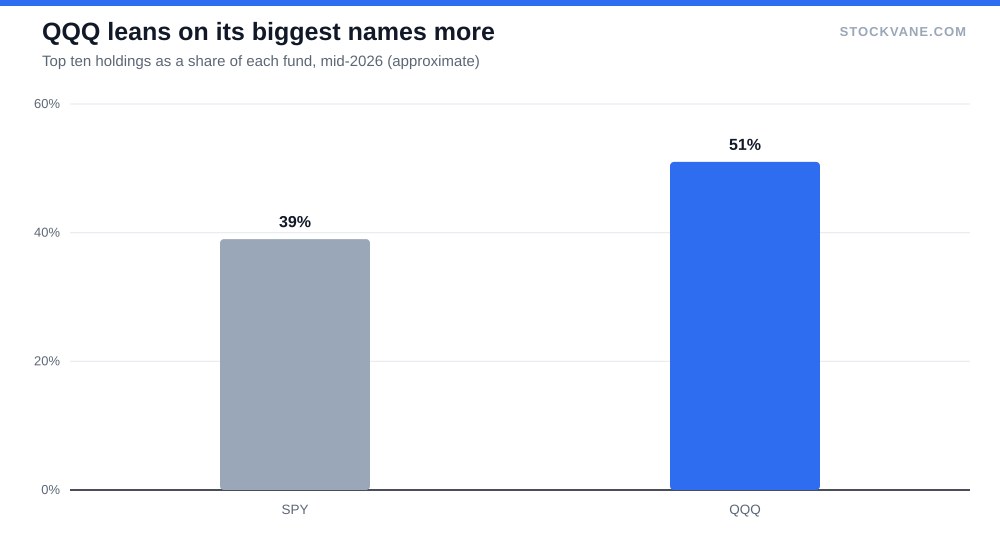
The weights in that table and chart come from public fund listings on different dates, so the comparison is approximate. The point survives the rounding. In both funds a few companies decide a lot of the result, and QQQ lets them decide more.
What the higher risk looks like in practice
A fund that is more concentrated in growth companies has a specific weakness: it does well when investors will pay up for future earnings and badly when they stop. That is not a flaw. It is the cost of the exposure.
Think about what that means in a year when interest rates rise or a few large companies disappoint on earnings. SPY still feels it, because the same giants sit at the top, but banks, energy producers and health care companies cushion part of the fall. QQQ has no such cushion. Its financial sector is zero, its health care and energy slices are small, and its result depends on how technology and communication companies trade. For an investor with a long horizon and a steady income that is acceptable. For someone who will need the money in three years, it deserves a harder look before the purchase, not after the first bad quarter.
| SPY (S&P 500) | QQQ (Nasdaq-100) | |
|---|---|---|
| Holdings | About 500 companies, all sectors | 100 non-financial Nasdaq-listed companies |
| Financial sector | Included | Excluded by design |
| Top ten weight (mid-2026) | About 39% | About half |
| Price (approx.) | $761.69 | $721.45 |
| 52-week range | $626 to $777 | $555 to $748 |
| Gain from 52-week low | 21.7% | 30.0% |
| From 52-week high | -2.0% | -3.5% |
| Expense ratio (approx.) | About 0.09% | About 0.18% net |
The table is the shortest version of the trade-off. QQQ carries more of its weight in a smaller set of companies, has no financial sector at all, costs a little more per year and has moved further from its low. SPY spreads the money across more industries, including several that do well when technology does not.
If you want a longer look at how a triple-strength version of the same index behaves when the trend turns, our review of TQQQ walks through the drawdown math. It is not a recommendation to use it, but it shows how sharply the Nasdaq-100 can fall.
Cost matters less than people say
QQQ charges more than SPY. State Street lists SPY at about 0.09%, and Invesco’s fund listing puts QQQ at roughly 0.18% net, though you should check the current figure on each provider’s page because these change. On a $50,000 balance that is about $45 a year for SPY and $90 for QQQ, a gap of around $45.
We would not choose a fund on that difference. If QQQ outruns SPY by even one percentage point in a year, the $45 is small change. If it lags by a point, the fee is not the reason. The bigger cost in this decision is behavioral: owning a fund that swings 35% from low to high and selling it at the bottom costs far more than any expense ratio.
There is a structural difference too. SPY is built as a unit investment trust, which means it cannot reinvest dividends between payouts, so cash can sit uninvested for a few weeks each quarter. In a market that rises most of the time that is a minor drag, and it is one reason some investors prefer other S&P 500 funds with lower fees. The same index in a different wrapper is worth a look if you are optimizing for cost alone, and for trading volume SPY remains the deepest.
Who should own which
If you have one account and want a single fund, we think SPY is the safer default. It is broader, it holds companies in industries that behave differently from technology, and its 52-week range is narrower on the data above. You give up some upside in the years when technology leads. You also give up some pain.
QQQ makes sense as a second position, sized on purpose. Someone who already owns SPY, or a broad total-market fund, and wants extra exposure to technology and growth can add a slice of QQQ and know exactly what they are buying. What does not make sense is buying QQQ as a “diversifier” because it holds different tickers on the screen. The additional ticker is not additional risk spread.
For newer investors, our guide to investing with little money covers how to think about a first fund before comparing two of them.
What I would check first
Before you buy either fund, open the top ten list of everything you already hold, including your 401(k) target-date fund and any single stocks. Add up how much of the money is in the same five or six companies. If that number is already above a quarter, a second Nasdaq fund is a decision about concentration, not about diversification, and you should make it knowing that.
Our view is that a broad fund like SPY is the right core for most people, and that QQQ deserves a small, deliberate slot only after you have looked at that overlap. If you catch yourself picking QQQ because it has been the stronger of the two for a year, that is a reason to look harder, not a reason to buy.
Financial disclaimer: The content on StockVane is for educational and informational purposes only and should not be construed as professional financial advice. Stock market investing involves risk of loss.