
One share of SPY, the fund that tracks the S&P 500, costs $761.69 today. If you have $200 to invest this month, that is about 26% of a single share, and most people assume it is too small to matter. It is not. Fractional shares let you buy that 26% slice, and it still gives you a small piece of roughly 500 of the largest U.S. companies.
I want to walk through how someone with a few hundred dollars and no experience should think about this. It will not make you a stock picker or get you rich quickly. It ends with a plan you can run on autopilot, built on account types, funds and habits that hold up for decades. Nothing here is personal advice, and every investment can lose money.
Why a small start beats a late start
Most people who put off investing are waiting to have more. The arithmetic argues against it. Put $100 a month into a broad stock fund that earns 8% a year, and after 40 years you have about $349,000. Start ten years later and you end up with about $149,000. Same monthly amount, same return, and a $200,000 difference that comes almost entirely from the ten years of growth you skipped.
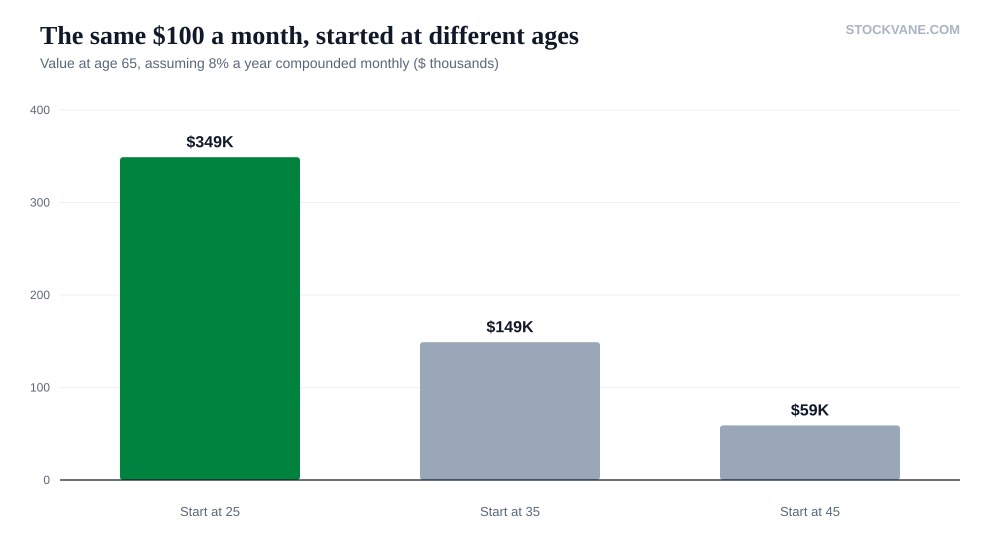
The 8% is an assumption, not a promise, and real returns come in lumps. Some years the market is down 20% and some years it is up 25%. But the direction of the result does not change if you use 6% or 10%. Time in the account matters more than the size of the deposits, which is why a modest habit begun now tends to beat a larger one begun later.
Step 1: know what you can actually invest
Before you open anything, get three numbers straight: your monthly take-home pay, your monthly essential spending, and your emergency fund. The emergency fund should hold three to six months of essential costs in cash and not in stocks. If your safety net is invested and the market drops 30% in the same month your car breaks down, you are forced to sell at the worst possible time.
Whatever remains after essentials and the emergency fund is what you can put to work. For many beginners that is $50 to $200 a month. That is fine. At this stage the habit matters more than the amount, and you can raise it as your income rises.
Step 2: open the right account
For most people in the U.S. with earned income, the first account is a Roth IRA and not a plain brokerage account. You put in money you have already paid tax on, it grows, and qualified withdrawals in retirement come out tax-free. The 2026 contribution limit is $7,500, or $8,600 if you are 50 or older, and single filers can contribute the full amount with income up to $153,000, with the allowance phasing out by $168,000, according to the IRS announcement of 2026 limits.
If your employer offers a 401(k) match, take the match first. A dollar-for-dollar match is an immediate 100% return on that money before any market movement, and nothing in the stock market reliably beats it.
Fidelity, Charles Schwab and Vanguard all offer Roth IRAs with no account minimums and no annual fee, and Fidelity and Schwab let you buy fractional shares. If you prefer an app-based broker, our review of Moomoo after using it and our comparison of IBKR Lite and Pro cover the fees and tools that matter for a small account.
Step 3: understand what you are buying
A stock is a slice of ownership in one company. A bond is a loan to a government or a company, which pays interest and returns your principal at the end. Bonds swing less than stocks and usually return less over long periods, so they matter more as you get closer to needing the money. An exchange-traded fund, or ETF, is a basket of stocks or bonds that trades like one share.
For someone starting with little money I would begin with ETFs and not individual stocks. The reason is concentration. If you own one company and it falls 40%, your account falls 40%. If you own a fund holding 500 companies and one of them falls 40%, the fund barely moves. Diversification is the rare case in investing where you lower risk without giving up expected return, which is why it is the usual place to start.
Step 4: a simple three-fund menu
You do not need twenty funds. Most of the diversification benefit comes from owning a broad U.S. fund and a broad international fund, and past that you mostly add complexity. Three low-cost Vanguard funds cover the ground:
– VOO tracks the S&P 500 and charges about 0.03% a year, or 30 cents per $1,000 invested. – VTI covers the whole U.S. market, roughly 3,600 companies, at about 0.03%. – VXUS holds companies outside the U.S., more than 8,700 of them, at about 0.05%.
Expense ratios and holdings counts change slightly over time, so confirm them on the fund page before you buy. A simple portfolio could be 70% VTI and 30% VXUS, added to monthly and left alone. Whether U.S. stocks are expensive right now is a fair question, and our look at whether the S&P 500 is overvalued covers it, but it matters much less than staying invested.
| Monthly contribution | After 30 years at 6% | After 30 years at 8% | After 30 years at 10% |
|---|---|---|---|
| $50 | $50,000 | $75,000 | $113,000 |
| $100 | $100,000 | $149,000 | $226,000 |
| $200 | $201,000 | $298,000 | $452,000 |
That table is the whole reason the monthly amount matters. Moving from $50 to $200 a month roughly quadruples the ending balance, and for many people the extra $150 is a spending choice more than an income limit.
Step 5: let a schedule make the timing decision
Every beginner asks when to buy. The honest answer is that timing matters far less than people think, and you can remove the question completely. Dollar-cost averaging means investing a fixed amount on a fixed date, such as $100 on the first of each month, whatever the market is doing. When prices are high, the $100 buys fewer shares, and when they are low, it buys more.
Dodging the drops is harder than it sounds. The S&P 500 fell about 34% in five weeks in early 2020 and was back at new highs within months. It lost roughly 19% in 2022 and recovered after that. Someone who bought every month through both never had to decide anything. You can test different amounts and time horizons with our dollar-cost averaging calculator.
If you receive a lump sum, such as a bonus or a tax refund, the same logic applies with one wrinkle. Investing it all at once has historically come out ahead more often than spreading it out, because markets rise more often than they fall. Spreading it over three to six months is still a sensible choice if a sudden drop would make you panic. Pick the method you will actually stick with, because a plan abandoned after the first bad month is worth less than an imperfect one you keep.
Most professional fund managers also trail a plain index fund over long periods, according to S&P’s regular SPIVA scorecards. That is not a knock on the industry. It is a reason a beginner does not need to search for a manager who will win.
Step 6: the mistakes that cost years
Four behaviors do most of the damage to beginners. The first is selling in a crash. Every large decline of the last few decades was followed by a full recovery, but the people who sold near the bottom locked in the loss. The second is checking the account daily, which pushes people toward trading and emotional decisions. Monthly is enough, and quarterly is fine.
The third is chasing whatever did best last year. The hot sector of one period is often the laggard of the next, and buying after the run means paying the top price. The fourth is waiting for a crash to start. Cash held for a better entry tends to sit while prices keep climbing, and it is rare to see a decline coming in time to use it.
Fees deserve a mention too. On $100,000 invested for 30 years at a hypothetical 8% before costs, a fund charging 1% a year would end near $761,000, while one charging 0.03% would end near $998,000. That is a difference of about $237,000 from a fee that looks trivial on a statement.
The one-page plan
Put it together and the plan fits on a page. Build a cash cushion first. Open a Roth IRA, and take any employer match before it. Buy one or two broad, low-cost funds. Set a fixed amount to go in every month, and turn on automatic investing so you do not have to decide each time.
After that, the job is to leave it alone. You will be tempted by hot stocks and by headlines about crashes, and the most useful thing you can do with both is nothing. If you later want to pick individual companies, I explain how I approach that in a separate guide, but I would only do it with a small slice of the money, after the core plan has run for a while.
My advice, if you have $200 and a steady paycheck, is to open the account this week and set up the monthly transfer. Which of the three funds you pick matters less than making the transfer automatic.
Financial disclaimer: The content on StockVane is for educational and informational purposes only and should not be construed as professional financial advice. Stock market investing involves risk of loss.
Sources: How to read a company's 10-K (SEC Investor.gov) (https://www.investor.gov/introduction-investing/investing-basics/glossary/10-k) · Price-to-earnings ratio (SEC Investor.gov glossary) (https://www.investor.gov/introduction-investing/investing-basics/glossary/price-earnings-pe-ratio)