
When AMD reported its June quarter on August 4, revenue came in at $11.5 billion, up 50% from a year earlier, and the shares were down about 7% on the report. A stock that has climbed 262% off its 52-week low has to clear a higher bar than good results.
I remain skeptical of AMD’s valuation, and the results keep showing that the operating story is better than skeptics allowed. That is an awkward place to stand. The bears were wrong about growth and, in my view, are still right about the price, so I will take those two questions one at a time.
What the bears got wrong
Look at the revenue line on the financials tab. AMD grew sales 14% in 2024 and 34% in 2025, to $34.6 billion. The June quarter was up 50%, after 38% in the March quarter. Growth has sped up for two straight quarters, which is hard to square with a company coasting on an AI headline.
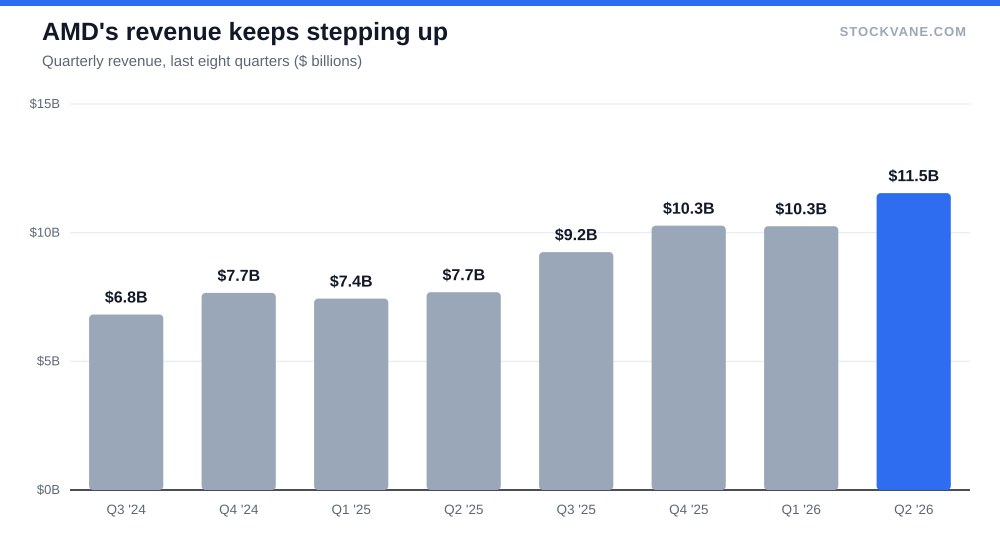
The mix changed too. Data center brought in $6.72 billion in the June quarter, about 58% of revenue, and AMD says that segment more than doubled from a year ago, up 107%. Client and gaming was $3.84 billion and embedded was $0.98 billion. A business that once lived on PC and console cycles now earns most of its money selling to cloud providers.
Profit followed. Gross margin was 53.2% in the latest quarter against 49.5% a year earlier, and operating profit rose from $1.48 billion in March to $1.99 billion in June, an operating margin of about 17% against 14% one quarter earlier. Net margin in 2025 was 12.5%, and in the June quarter it was near 20%, though I would not extrapolate that, since quarterly net income includes items outside the core business.
Management guided the September quarter to $13 billion, plus or minus $300 million. That would be about 13% growth over June. It also said it is starting to ship Helios, its first full rack-scale AI system, this quarter to customers including Meta, OpenAI and Oracle. OpenAI’s 6-gigawatt supply agreement, announced last October, is the kind of commitment that turns a promising product into a planning number.
Where the AI chip story is real
I do not think AMD is about to unseat Nvidia. Nvidia’s software ecosystem is a decade deep, and customers who spend hundreds of millions on training runs rarely want to be the first to switch. But AMD does not have to win the training market to grow. Inference, where trained models serve users, is where price and power efficiency matter most, and it is where the gap in software matters least. I looked at how the broader group is positioned in our piece on semiconductor stocks beyond Nvidia, and the conclusion there is the same: room for a second supplier is not the same as parity.
The PC and console business still supplies about a third of revenue, $3.84 billion last quarter. That gives AMD a base that pure AI chip suppliers lack, and it also ties part of the results to consumer demand cycles, which move on their own schedule. The customers who need a second source for AI are the biggest ones, and they have money. That is a durable reason for demand. It is also a concentrated one. A handful of buyers account for most AI accelerator orders, and if one of them slows spending, the effect on AMD is larger than the effect on a company with a diversified customer list.
The price is where the argument lives
Now the other half. On the valuation tab the trailing P/E is 143.5, and price-to-sales is 20.4, against a five-year average of 9.9. The forward P/E of 58.6 assumes earnings rise to about $9.55 a share from about $3.90 trailing, roughly two and a half times as much. That is a large jump to have baked in.
The chart shows how quickly the price got here. The shares were near $203 at the end of March and $516 at the end of May, a 154% gain in two months. They slid 18% from the June close of $581 to $476 in July, then recovered to about $560. A stock that moves like that is trading on expectations and sentiment more than on quarterly results.
To see what it would take to justify the price, take the September guidance, multiply by four for an annual run rate of about $52 billion, and ask what the stock costs at different net margins.
| Net margin on run-rate revenue | Implied annual net income | Implied P/E at current price |
|---|---|---|
| 15% | $7.8 billion | 117x |
| 20% | $10.4 billion | 88x |
| 25% | $13.0 billion | 70x |
| 30% | $15.6 billion | 59x |
Even at a 30% net margin, more than double what AMD earned in 2025, the stock trades near 59 times that run rate. At the 20% it earned in the latest quarter, it is about 88 times. At this price investors are paying for revenue well above current guidance and for margins AMD has not held for a full year. It could happen, and I would want to see it before paying for it.
What the analysts and the model are saying
Of the 33 analysts covering AMD, 85% rate it a buy and none rate it a sell. The analyst page shows an average target of $654, about 17% above the price, and a low target of $540, just 4% below. The high target is $1,250. With the lowest target within 4% of the price, the debate is over how far above it the results must come.
| Metric | Value | Context |
|---|---|---|
| Price (approx.) | $559.82 | 52-week range $155 to $585 |
| P/E (TTM) | 143.5x | Five-year average 51.4x |
| Price-to-sales | 20.4x | Five-year average 9.9x |
| Analyst ratings | 85% buy, 15% hold | 33 analysts; average target $654 |
StockVane’s quant model grades AMD an A with a score of 97, up from a C at 63 on September 8. That reflects a stock that has been rising, which is what a price-based model rewards. It says nothing about whether the multiple is fair.
How the peers price growth
The comparison that bothers me most is with the other big AI chip names.
| Company | Trailing P/E | Forward P/E | Latest quarter revenue growth |
|---|---|---|---|
| AMD (AMD) | 143.5x | 58.6x | 50% |
| Nvidia (NVDA) | 28.1x | 18.1x | 106% |
| Broadcom (AVGO) | 45.6x | 24.5x | 86% |
| Micron (MU) | 23.0x | 6.8x | 346% |
AMD has the slowest revenue growth in that group and the highest multiple by a wide margin. Nvidia trades near 28 times trailing earnings on 106% growth, Broadcom near 46 times on 86%, and Micron near 23 times on growth of 346%. AMD is at 143 times on 50%. Some of that gap is a low earnings base, since AMD’s profit is still recovering, and the forward P/E of 58.6 narrows it. Even so, investors are paying more for each point of AMD’s growth than for any of its peers, which is a strong statement about how much they expect its margins to expand.
I cannot tell you whether the market is right. Peer multiples in this group have moved together for two years, and the whole cluster could reprice at once if AI spending guidance changes. What the table does show is that AMD has the least room for disappointment.
The cash behind the story
Free cash flow was $6.7 billion in 2025, about 19% of revenue, up from $2.4 billion in 2024. Research and development took $8.1 billion, about 23% of sales, which is the price of staying competitive with a company as large as Nvidia. AMD ended 2025 with $10.6 billion of cash and short-term investments against $3.0 billion of long-term debt, so financing is not the constraint. The company can fund its roadmap. What it cannot do is buy back the multiple if growth cools.
How it has reacted to news
The last four earnings reports moved the shares -7.0%, +18.6%, -17.3% and +2.5%, newest first. A 17% drop after a report and an 18% gain after the next one is a stock where the reaction depends more on guidance and positioning than on the quarter itself. A quarter that beats can still bring a sell-off if the guidance disappoints, and the reverse happens too. If you own it, expect that kind of swing again. I would not be surprised by either direction, and I do not have a reliable way to predict which.
Two smaller signals are worth a line. Short interest is only about 2.6% of the float, or roughly two and a half days of trading volume, so this is not a crowded bet against the company. And on September 15 a headline reported that an AMD officer sold about $48 million of common stock. Insiders sell for many reasons, and one sale after a 262% run is not a verdict. I would only start to worry if the selling became a pattern while the stock kept rising.
What has to be true from here
The bull case needs revenue to keep growing well above 40% and margins to keep widening while the biggest customers hold to their purchase plans. Miss one and the multiple looks stretched. Miss two and it looks like a mistake.
My view is that AMD is a better company than its critics allowed and a more expensive stock than its fans admit. Neither of those is a reason to ignore it. It is a reason to size the position for a stock that can fall 18% in a month without anything breaking. At $560 I would rather own too little of it than too much.
Financial disclaimer: The content on StockVane is for educational and informational purposes only and should not be construed as professional financial advice. Stock market investing involves risk of loss.
Sources: Price-to-earnings ratio (SEC Investor.gov glossary) (https://www.investor.gov/introduction-investing/investing-basics/glossary/price-earnings-pe-ratio) · Earnings reports (SEC Investor.gov glossary) (https://www.investor.gov/introduction-investing/investing-basics/glossary/earnings-report)