
What is a 7% discount on a stock you already like worth to you? Most investors have such a price in mind and wait for it in silence. They place a limit order, or they just watch the ticker, and if the shares never get there the wait produces nothing. Selling a cash-secured put is a way to get paid while you wait, and it is one of the few options strategies I think a careful retail investor can use without needing a finance degree.
It is also easy to oversell. The pitch usually comes with a green profit-and-loss screenshot and a promise of monthly income. What it leaves out is that you are agreeing to buy a stock on a bad day, at a price you picked in advance, whatever the news is that morning. Below I cover how the trade works, how often a put would actually have been tested over the past year, and where beginners get hurt. Nothing here is personal advice, and options carry a risk of loss.
What you are promising when you sell a put
A put you sell is a promise. You are telling the market that if the stock closes below a price you choose (the strike) on a date you choose (the expiration), you will buy 100 shares at the strike. In return someone pays you cash today, called the premium. If the stock stays above the strike, the promise expires, you keep the premium and nothing else happens. If it falls below, you buy the shares at the strike, and the premium you collected lowers your real cost.
“Cash-secured” means the money to buy those shares is already sitting in your account, so a $93 strike needs $9,300 set aside for each contract. That is the responsible version. It is the only one I would suggest here, because a put sold with borrowed money can turn a bad month into a margin call. If you want to see how the ticket looks in a real brokerage account, our walkthrough of a cash-secured put on IBKR goes through it step by step.
A worked example with made-up numbers
Real premiums change daily, so I will use round numbers to show the arithmetic. Say a stock trades at $100 and you would be glad to own it at $93. You sell one 30-day put with a $93 strike for $1.50 a share, which is $150 for the contract, and set aside $9,300.
| Where the stock finishes | Sell the $93 put | Buy 100 shares at $100 instead |
|---|---|---|
| $110 (up 10%) | Keep the $150 premium, a 1.6% return on $9,300 | Gain of $1,000 |
| $100 (unchanged) | Keep $150 | Gain of $0 |
| $93 (down 7%) | Keep $150, no assignment | Loss of $700 |
| $91.50 (down 8.5%) | Assigned at $93; break-even after the premium | Loss of $850 |
| $85 (down 15%) | Assigned at $93; cost $91.50 after premium, loss of $650 | Loss of $1,500 |
| $80 (down 20%) | Assigned at $93; loss of $1,150 | Loss of $2,000 |
Two things stand out in that table. The first is that the premium makes you whole down to $91.50, eight and a half percent below where the stock started, which is a cushion but not a shield. The second is the top row. If the stock rallies 10%, the person who bought shares earns $1,000 and you earn $150. Put selling gives up the big win in exchange for getting paid to be patient, and that is a fair trade only if patience is what you actually want.
The 90% claim that will not die
You will hear that 90% of options expire worthless and that selling them is therefore easy money. The commonly cited figures from the Options Clearing Corporation and CBOE say something different. Roughly 10% of contracts are exercised, about 50% to 60% are closed out before expiration, and about 30% to 35% expire worthless, as summarized in this options-statistics explainer. Those numbers include every kind of contract, from lottery-ticket calls to hedges, so they say very little about your particular put.
The number that matters for a put seller is narrower. How often does a stock you would like to own fall below a strike you might pick? That we can measure.
How often a put actually gets tested
We took a year of daily closing prices for six large, familiar stocks and asked a simple question. Across every 21-trading-day window (about a month), how often did the stock finish at least 5% or 10% below where it started? A put struck 5% below the market would have been in the money at expiration in those windows.
| Stock | Worst 21-day drop | Windows down 5% or more | Windows down 10% or more | Trailing P/E |
|---|---|---|---|---|
| Coca-Cola (KO) | -6.7% | 3% | 0% | 26.5x |
| Johnson & Johnson (JNJ) | -8.3% | 5% | 0% | 31.3x |
| JPMorgan (JPM) | -11.1% | 10% | 1% | 15.0x |
| Apple (AAPL) | -10.8% | 18% | 0% | 38.5x |
| Microsoft (MSFT) | -18.3% | 29% | 14% | 27.5x |
| Amazon (AMZN) | -17.7% | 29% | 13% | 20.4x |
The results split into two groups. Coca-Cola and Johnson & Johnson rarely dropped more than a few percent in a month. Coca-Cola’s worst 21-day decline was 6.7% and it was down 5% or more in only about 3% of windows. Microsoft and Amazon were another story. Microsoft finished at least 5% lower in about 29% of windows, at least 10% lower in about 14%, and its worst month was down 18.3%.
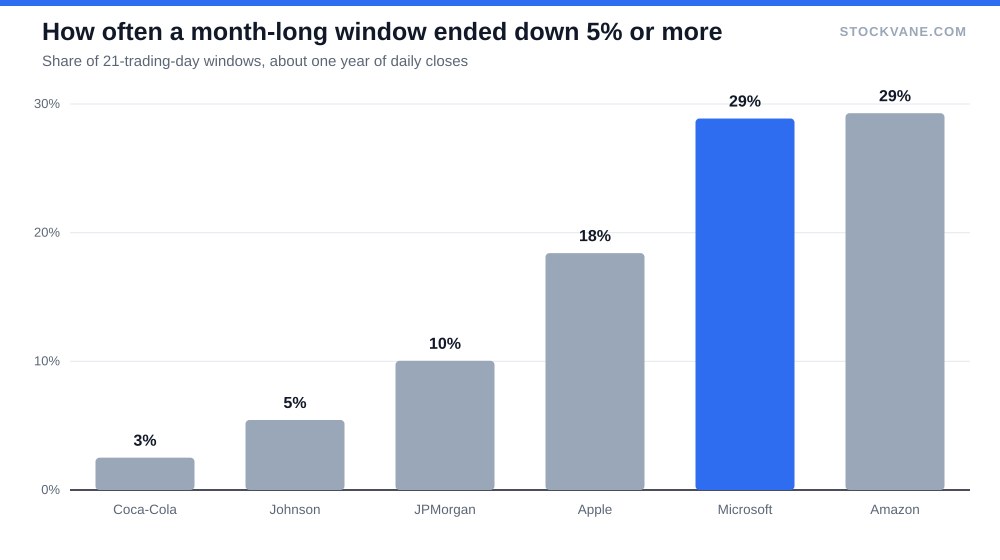
Read the table with care. The sample is one year and the windows overlap, so it is a snapshot and not a forecast. It records where each stock ended a window and misses how far it dipped along the way, which matters if you close early. And these six were chosen because they are well known, which probably flatters the average stock.
Even so, the pattern is consistent with what option pricing should tell you. Stocks that move more pay bigger premiums because they hit strikes more often. A large premium is not free money. It is the market’s estimate of how likely you are to end up owning the shares.
Choose the stock first, then the strike
If I could give one rule, it would be to pick the company before you look at any option chain. The question is whether you would still want to own it if the market fell 15% next week. That is the real test, because it is the scenario in which the put gets exercised.
That means looking at the business and the price before the premium. Checking a stock’s valuation page tells you whether you would be buying at a multiple near its historical average or near its high. A stock at 15 times earnings with a strike 7% lower is a different position from a stock at 45 times earnings with the same strike, because the second one has more room to fall if sentiment shifts. Microsoft’s valuation history is worth a look next to the price swings in the table above, because a stock that moves that much needs a strike chosen with more care.
Earnings are the gap you cannot manage
The most dangerous stretch for a put seller is an earnings report, because prices can jump overnight and you cannot close the position at a fair price in between. After Apple’s June-quarter report, the shares fell 7.4% in a single day, from $333.14 to $308.64, even though revenue rose 16%. A put struck 5% below the pre-report price would have been in the money the next morning.
You can avoid that by choosing an expiration before the report or a strike far enough below to survive a surprise. Reading the calendar matters as much as reading the chain, and our guide to reading an earnings report covers what to look for. Some sellers do hold through earnings on purpose, but then the premium is paying for a bigger risk than it looks.
The ways this goes wrong
The first failure is selling puts on a stock you have no real wish to own, because the premium looked good. When it drops you are assigned a company you never wanted, at a loss, with no reason to hold. The second is size. A single assignment should never make one company a large part of your account. If one name would become 30% or 40% of your money at assignment, the position was too big before you placed it.
The third is chasing volatility. When markets get jumpy, premiums rise because the market expects bigger moves, and it can feel like a gift. Sometimes it is one. Sometimes it is a warning that the stock is about to test the strike. The fattest premium on the chain is usually there for a reason.
Finally, there is the honest limit of the strategy. It works best on sturdy companies in orderly markets and works worst in a sharp crash, when every stock you would want to own falls at the same moment. I do not know when the next one comes, and neither does anyone else.
What happens after assignment
Assignment is not the end. You own shares at a cost that is already below the strike, and many investors then sell covered calls against them, collecting more premium until the shares are called away or they decide to keep holding. The cycle of selling a put, being assigned, selling a call, and starting again is often called the wheel. It is a reasonable way to keep working a position, but it does not fix a bad stock choice, and it caps your upside if the shares recover fast.
For index funds the logic is similar with less single-company risk. Our look at selling puts on VOO covers that version and what yield to expect from it.
A first trade that is small enough
Here is how I would start, with the caveat that everyone’s situation differs. Choose one company you already follow and would be glad to own. Pick a strike you would be happy to pay, roughly 5% to 10% below the market, and an expiration about a month out that comes before its next earnings date. Sell one contract, keep the full cash in the account, and treat a possible assignment as the plan and not the accident.
Then sit through a full cycle before you add anything. In my view the discipline matters more than the cleverness here: never sell a put on a stock you would not want to hold. If the premium is the only reason you like the trade, skip it.
Financial disclaimer: The content on StockVane is for educational and informational purposes only and should not be construed as professional financial advice. Stock market investing involves risk of loss.
Sources: Dividends (SEC Investor.gov glossary) (https://www.investor.gov/introduction-investing/investing-basics/glossary/dividend) · Price-to-earnings ratio (SEC Investor.gov glossary) (https://www.investor.gov/introduction-investing/investing-basics/glossary/price-earnings-pe-ratio)
Pingback: 5 Costly Mistakes Retail Investors Keep Making With Tesla Stock – StockVane