
Oil, an inflation report, an IBM warning, a Chinese AI model and a revised chip-spending forecast all arrived inside five trading days last week, and the tape read them as one story. They are not one story, and pulling them apart is the most useful thing a recap can do.
The S&P 500 finished Friday at 7,457.69, down 1.6% for the week. Nasdaq Composite lost 2.9%, the Dow 0.9%. Semiconductors took the heaviest damage, with the PHLX Semiconductor Index slipping into a bear market. I take the daily path first, then the drivers behind it, then next week’s calendar.
The scoreboard
| Index | Friday close | Weekly change |
|---|---|---|
| S&P 500 | 7,457.69 | -1.6% |
| Nasdaq Composite | 25,520.24 | -2.9% |
| Dow Jones Industrial Average | 52,146.42 | -0.9% |
| PHLX Semiconductor Index (SOX) | Bear market | SMH down more than 17% in July |
Where the pain sat is visible in the gap between the three indexes. Price-weighted and light on chips, the Dow lost less than 1%. Nasdaq, with the biggest chip and AI weights, lost more than three times as much. A blend of both should land in between, and the S&P 500 did.
For scale on the chip selloff, the VanEck Semiconductor ETF (SMH) has fallen more than 17% so far this month, according to the market wire on Friday. Drops of that size seldom have one cause; a crowded position usually meets several reasons to sell at once.
How the week unfolded
The index did not fall in a straight line. It lost ground Monday, gained it back Tuesday and Wednesday, and then gave up more than that over the last two sessions. A week that ends down 1.6% after two green days reads differently from five straight red ones.
| Day | S&P 500 close | Change | What moved |
|---|---|---|---|
| Monday, July 13 | 7,515.34 | -0.79% | Iran shipping blockade, oil surge, chip selloff |
| Tuesday, July 14 | 7,543.59 | +0.38% | Cooler June CPI; IBM warning; Warsh testimony |
| Wednesday, July 15 | 7,572.40 | +0.38% | BlackRock earnings; Buffett comments |
| Thursday, July 16 | 7,533.77 | -0.51% | Moonshot AI model; TSMC spending forecast |
| Friday, July 17 | 7,457.69 | -1.01% | Semiconductor rout deepens; SOX in bear market |
Oil set the tone on Monday. President Trump said he was reinstating a blockade on Iranian shipping through the Strait of Hormuz, crude jumped, and the fear that came with it was inflation running hot enough to keep the Federal Reserve tightening. SK Hynix fell about 9% and dragged other memory names down with it. The S&P closed at 7,515.34, off 0.79%.
Relief came Tuesday. June consumer prices rose 3.5% from a year earlier, below the 3.8% economists expected, helped by a large drop in gasoline. The S&P gained 0.38%. The same day IBM fell 25.2% after warning that second-quarter sales would land near $17.2 billion against a consensus of $17.85 billion. Fed Chair Kevin Warsh was also on Capitol Hill for his first testimony as chair, telling the House Financial Services Committee that the latest improvement in inflation is not “mission accomplished.”
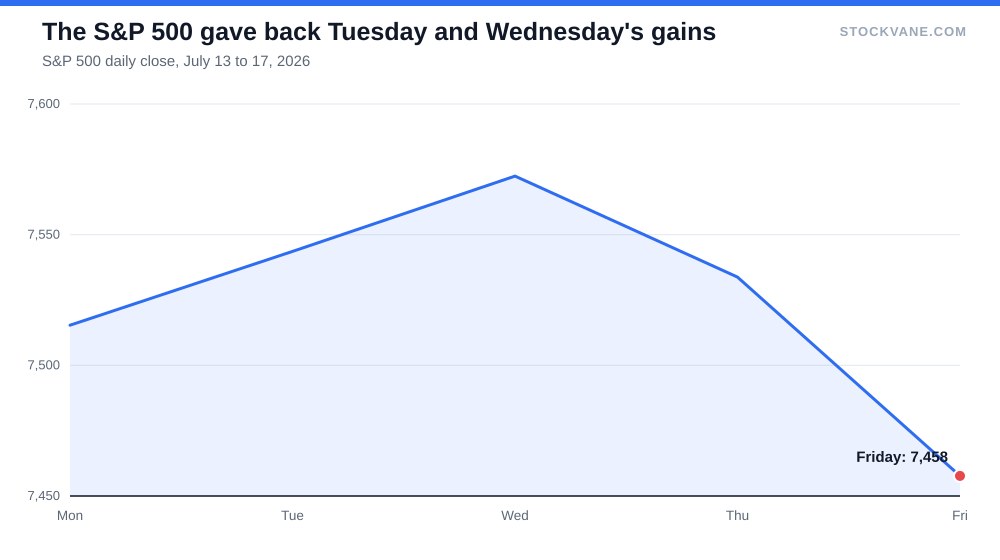
Another 0.38% followed on Wednesday. BlackRock reported earnings of $13.91 a share against about $12.69 expected, on $7.08 billion of revenue, and the stock rose 6.6%. Warren Buffett told CNBC’s Becky Quick that “it’s tough to find values when everybody is preferring gambling,” a remark that reads differently in a week when chips are the crowded trade. Thursday and Friday then undid the gains, and by the close the index was back below Monday’s level, about 0.8% under where it had ended the first session of the week.
Three stories tangled together
Three of these belong together as explanations for the chip selloff, and each has a different weight.
Oil and Iran come first because they are the only driver that touches everything. Higher oil feeds inflation expectations, and inflation expectations feed the rate outlook, which is why a shipping announcement on Monday moved chip stocks. I laid out that chain in my piece on why the Fed is stuck, and the same logic applies here. The risk is broad, not sector specific. It is also the one I can say least about, because the path of a blockade is a political decision and not a data series.
The second is the Moonshot model. On Thursday the Chinese startup Moonshot AI unveiled a model it says narrows the gap with the best U.S. systems. Chip stocks fell hard, and the SMH slid nearly 4% on the day, with Arm down more than 5%. I do not know how good the model really is, and the benchmark claims are the company’s own. What I can say is that the same day Taiwan Semiconductor raised its capital spending forecast to $60 billion to $64 billion from $52 billion to $56 billion, after a quarter that beat expectations. The same fact supports two readings: heavy spending proves demand, or it shows how much has to be earned back.
Then there is positioning. Chips had been the trade of the year, and a trade that crowded needs little to reverse. The chart below makes the point: Nvidia fell 3.9% for the week, but Intel fell 13.5% and Micron 13.3%. The damage was heaviest in the names where expectations and ownership were both highest.
Who moved, and who did not
The table below uses closing prices for the week ended July 17. Note that Netflix fell on Friday after reporting Thursday evening, so that was an earnings reaction and not a market move. Travelers was the best performer on the list after reporting Friday morning. Alphabet is the row I would look at twice. It fell 4.4% on Thursday alone, which tells you the worry about AI spending reached past the chip makers to the companies buying the chips, and that is why its report on Wednesday carries so much weight this time.
| Stock | Move | When | Context |
|---|---|---|---|
| IBM | -25.2% | Tuesday | Second-quarter sales warning; down 26.0% for the week |
| BlackRock (BLK) | +6.6% | Wednesday | Reported before the open; EPS $13.91 vs. about $12.69 expected |
| Travelers (TRV) | +9.2% | Friday | Reported before the open |
| Netflix (NFLX) | -7.3% | Friday | Reported Thursday after the close |
| Alphabet (GOOGL) | -4.4% | Thursday | Chip and AI names sold off; reports next Wednesday |
| Intel (INTC) | -13.5% | Week | Reports next Thursday after the close |
| Micron (MU) | -13.3% | Week | Memory names hit by Monday’s SK Hynix drop |
Take the IBM number: 25% in a day for a company this size is rare. The stock closed the week down 26%, and it had not yet given its full report, which was scheduled for the following Wednesday. I would not guess at how it reads until it does. A warning that says enterprise clients are shifting budgets toward AI infrastructure is not an obviously good or bad signal for the semiconductor names, since it is the same demand story seen from the customer’s side. Our Nvidia quote page shows how the stock that sits at the center of that trade has held up against it.
Next week’s calendar
The title of this recap points to Fed testimony, and I want to be plain about it: Warsh already testified this week, on Tuesday before the House and Wednesday before the Senate Banking Committee, so the question for next week is how the market absorbs what he said, not what he will say. For scheduled data I would keep it simple: weekly jobless claims on Thursday, and not much else that I would build a view around. The earnings calendar is the busier one.
| Day | Notable reporters (session) |
|---|---|
| Tuesday, July 21 | Danaher, 3M, General Motors, Northrop Grumman (before the open); Chubb, Capital One (after the close) |
| Wednesday, July 22 | AT&T, GE Vernova, Philip Morris, CME Group (before the open); Alphabet, Tesla, IBM, Texas Instruments, ServiceNow (after the close) |
| Thursday, July 23 | RTX, Union Pacific, Lockheed Martin, Comcast (before the open); Intel (after the close) |
| Friday, July 24 | American Express, Verizon, NextEra Energy (before the open) |
Alphabet and Tesla both report on Wednesday after the close, alongside ServiceNow, Texas Instruments and IBM, and Intel follows on Thursday. That cluster lands in the middle of the chip debate. Alphabet’s capital spending comments will be read as a verdict on whether the AI buildout still has a return, and Texas Instruments and Intel will be read as a check on whether the semiconductor drop was an overreaction. It is the kind of week where the guidance language matters more than the headline earnings number. If you want a refresher on which line to read first, my guide to reading an earnings report covers that.
What this does to a chip-heavy portfolio
Say you hold a growth-tilted portfolio with a lot of chip and AI names. This week probably hurt more than the S&P’s 1.6%, since the Nasdaq lost almost twice as much and SMH lost more than that. Here is the arithmetic: if 30% of a portfolio sat in chip stocks that fell 11%, roughly what AMD did, those holdings alone cost 3.3 points of return before anything else moved. That is a rough illustration and not anyone’s actual account, but it shows why a 1.6% headline number can understate what a concentrated investor felt. The question I would ask is whether anything about demand for AI infrastructure changed, or whether a scary headline arrived on top of an overheated group.
My read is that nothing in the reported numbers changed this week. Taiwan Semiconductor’s quarter beat and its spending forecast rose. No hyperscaler cut its plans. The Moonshot model is a competitive data point, but it is not an earnings miss. I read it as a sentiment and positioning reset, and the Alphabet and Intel reports can prove me wrong. The S&P 500 valuation piece covers how much room the broader market has if the reset spreads beyond chips.
What would change my mind next week
I would change my view if Alphabet or a peer cuts capital spending guidance, or if Intel or Texas Instruments describe weaker demand than the selloff assumed. Either would tell me the drop was more than positioning. I would also change it if oil kept rising, because that is the one driver that reaches everything else.
If none of that happens, I would call this a chip reset and not a market event. The S&P’s 1.6% understates it, though. The concentrated holders took losses of 10% or more in single names, and the first real test of whether that was overdone comes Wednesday after the close, when Alphabet and Texas Instruments report within hours of each other.
Financial disclaimer: The content on StockVane is for educational and informational purposes only and should not be construed as professional financial advice. Stock market investing involves risk of loss.
Sources: Federal Reserve monetary policy (https://www.federalreserve.gov/monetarypolicy.htm) · Earnings reports (SEC Investor.gov glossary) (https://www.investor.gov/introduction-investing/investing-basics/glossary/earnings-report)