
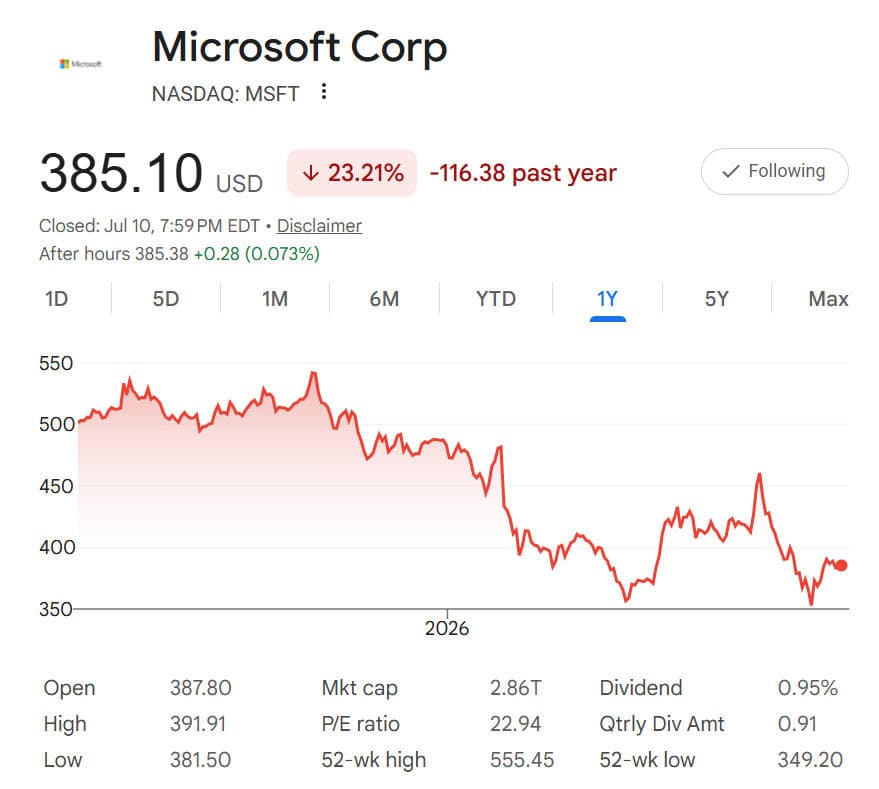
I’ve owned Microsoft stock long enough to remember when the joke about it was “boring monopoly software company that prints cash and never surprises anyone.” That joke aged about as well as a floppy disk. In 2026, MSFT is down roughly a quarter from its highs, retail traders on StockTwits are simultaneously calling it “dead money” and “the most obvious buy of the decade” within the same 24-hour window, and the company is spending capex numbers that sound like they were dictated by a typo. Let’s actually walk through what’s going on, with real numbers, because vibes alone won’t tell you whether this is a value trap or the buying opportunity every bull keeps insisting it is.
Where the Stock Actually Sits Right Now
Let’s start with the boring-but-essential part — the numbers you’d want in front of you before reading a single hot take. Check MSFT stock rating in SeekingAlpha Premium.
| Metric | Value (as of July 10, 2026) |
|---|---|
| Share price | $384.10 |
| Market cap | ~$2.85–2.89 trillion |
| 52-week range | $349.20 – $555.45 |
| YTD performance (2026) | Down roughly 23–25%, the weakest of the “Magnificent Seven” |
| Trailing P/E | ~22.8–23x |
| Forward P/E | ~18x |
| Dividend yield | ~0.92–0.93% |
| Beta | 1.13 |
| Shares outstanding | ~7.43 billion |
Notice something odd here: this is a company trading at a forward multiple lower than plenty of unprofitable software names, and it’s down more than the S&P 500’s gain for the year — while remaining, according to Wall Street, comfortably one of the most-loved large caps on the planet. That tension is basically the entire story of this article.
The Last Confirmed Earnings — Not the Hype, the Actual Numbers
As of today, Microsoft’s most recently reported quarter is fiscal Q3 2026, covering the three months ended March 31, 2026, released April 29. The upcoming fiscal Q4 report — the one everyone’s currently speculating about — doesn’t land until July 29. Here’s what actually happened last time, no forecasting involved:
| Fiscal Q3 2026 (ended March 31, 2026) | Result | YoY Change |
|---|---|---|
| Revenue | $82.9 billion | +18% (+15% constant currency) |
| Operating income | $38.4 billion | +20% (+16% constant currency) |
| Net income (GAAP) | $31.8 billion | +23% |
| Diluted EPS (GAAP) | $4.27 | +23% |
| Analyst EPS estimate going in | $4.06 | Beat by 5.18% |
| Capital expenditures | $30.88 billion | +84% |
| Shareholder returns (dividends + buybacks) | $10.2 billion | — |
That EPS beat is exactly the kind of number that should be driving a stock higher, not lower. Instead, the market shrugged, and then kept shrugging for months. This is the part of the story that separates “reading the headline” from “actually understanding the setup,” so let’s get into why.
Why a Company Beating Estimates Is Still Down 25% This Year
I’ll spare you the suspense: it isn’t really about Microsoft’s core business underperforming. It’s about how much Microsoft is spending to stay in the AI race, and how nervous that’s making a market that’s already jumpy about AI valuations generally.
The capex number above — $30.88 billion in a single quarter, up 84% year over year — is the crux of it. CFO Amy Hood has guided toward roughly $190 billion in capital expenditures across calendar 2026. That is an eye-watering figure for any single company in history, and investors are split on whether it’s visionary infrastructure-building or a spending war nobody can actually win. Layer on top of that a New York Times report suggesting OpenAI’s expected IPO could slip into 2027 — relevant because Microsoft holds roughly a 27% stake in OpenAI worth an estimated $135 billion, making it a de facto proxy for OpenAI sentiment — and you get a stock that trades like a leveraged bet on AI enthusiasm rather than a steady enterprise software compounder.
Add a few more irritants to the pile: reports that Starbucks is developing in-house AI tools partly to reduce reliance on Microsoft and IBM software, ongoing securities class-action filings related to disclosures about Copilot functionality issues, and a round of layoffs that includes roughly 3,200 Xbox division jobs — about a fifth of that unit’s staff — as part of a broader gaming reorganization. None of these individually sinks a $2.8 trillion company. Together, they’ve created a drip-drip of bad headlines landing on top of a stock that was already digesting a brutal rotation out of software and into semiconductors.
What Retail Investors Are Actually Saying (Not What I Wish They’d Say)
This is the part most “analysis” articles skip, and it’s honestly the most entertaining part of researching this piece. Retail sentiment on MSFT has been genuinely split — not mildly split, split like a family group chat during a holiday dinner.
| Platform / Source | Sentiment Signal | What It Looked Like in Practice |
|---|---|---|
| StockTwits | Flipped from “neutral” to “bearish” during a sharp June sell-off | 24-hour message volume spiked 740% as retail piled in to vent |
| Reddit (aggregate, incl. r/investing) | Swung from neutral (58) to bullish (64) within a single trading day, with r/investing hitting 88 | A popular thread argued the stock was cheaper than the April 2025 tariff crash despite trailing EPS being up roughly 30% |
| Prediction markets (Polymarket) | Skeptical near-term | Implied only about an 11% chance MSFT would close above $450 by end of June |
| Wall Street analysts | Overwhelmingly bullish, in stark contrast to retail mood swings | Roughly 42–53 of 50–56 covering analysts rate it Buy or Strong Buy; average price target near $552–561, implying 40%+ upside from current levels |
What strikes me here isn’t that retail is bullish or bearish — it’s that retail sentiment has been whipsawing on an almost daily basis while the analyst community has stayed remarkably, almost suspiciously, unified in its bullishness the entire time. When you see that kind of gap, it usually means one side is pricing in near-term fear and the other is pricing in a multi-year thesis, and both can technically be “right” depending on your holding period. One retail comment I came across summed up the bear case about as bluntly as it gets: the poster predicted a retest of $350 and openly doubted Microsoft would still be a top-tier player in five years. I don’t share that view, but I’d rather show you the actual range of retail opinion than pretend everyone on the internet agrees with me.
The Bull Case, Stripped of Marketing Language
Underneath the noise, a few numbers make the bull case harder to dismiss than the stock chart alone suggests. Microsoft’s AI-related revenue run rate reportedly hit around $37 billion, up roughly 123% year over year. Azure growth has been tracking near the high-30s to 40% range, and HSBC’s pre-earnings note projected Q4 FY26 revenue near $89.3 billion, up 16.8% year over year — ahead of the company’s own guidance. Microsoft is also sitting on a contracted revenue backlog reported around $627 billion, which is the kind of number that doesn’t show up in a quarterly headline but matters enormously for anyone trying to model out three to five years of cash flow.
Full-year analyst estimates for fiscal 2026 sit around $16.76 in EPS, up nearly 23% from fiscal 2025, with fiscal 2027 estimates projecting further growth to roughly $19.29. If those numbers hold up even roughly, today’s price starts looking less like a falling knife and more like a company the market temporarily decided to stop paying up for, capex sticker shock and all.
My Actual Take, For What It’s Worth
I’ve been doing this long enough to distrust any stock story that’s 100% clean in either direction, and MSFT in mid-2026 is not clean in either direction. The bear case isn’t imaginary — $190 billion in annual capex is a real number with real execution risk attached to it, and “OpenAI IPO delayed” headlines aren’t nothing when a quarter of your AI upside narrative runs through that stake. But the bull case isn’t hopium either — an 18x forward multiple on a company still growing revenue by double digits, with a $627 billion backlog and Azure growing near 40%, is not the valuation profile of a company the market usually leaves behind for long.
If I’m being honest about my own bias, I bought more on the dip below $370, and I’ll be watching the July 29 earnings call — specifically Azure’s growth rate and any softening in capex guidance — more closely than I’ve watched a Microsoft earnings call in years. That’s not a recommendation, just an admission that I’m not neutral here, and you should weigh everything above accordingly rather than taking my word for where this goes next.
The honest summary: Microsoft’s fundamentals haven’t broken, but the market’s patience for “spend now, monetize AI later” stories has clearly gotten shorter in 2026, and MSFT is currently the poster child for that shift. Whether that’s a gift or a warning depends entirely on how much faith you’re willing to put in a five-year AI thesis versus a five-week price chart — and those two timeframes are, right now, telling you almost completely different stories.
Financial Disclaimer: The content on StockVane is for educational and informational purposes only and should not be construed as professional financial advice. Stock market investing involves risk of loss.