
Interactive Brokers the company trades at 36.9 times trailing earnings, up from a five-year average of 24.7. That is not a fact about which app has nicer charts. It is a reminder that IBKR is a real, profitable brokerage with a stock price of its own, $92.87, and a set of numbers Moomoo’s parent, Futu, reports separately. I mention it because most “Moomoo vs IBKR” write-ups compare marketing pages. I opened funded accounts on both and used them for weeks before writing a word of this.
The gap between the two shows up less in what each platform can do and more in how they make you behave. Moomoo gets you trading in minutes. IBKR gets you trading correctly, eventually, if you put in the time. Neither claim is a compliment on its own.
| Metric | Value | Context |
|---|---|---|
| Price (approx.) | $92.87 | 52-week range $59 to $99 |
| P/E (TTM) | 36.9x | Five-year average 24.7x |
| Price-to-sales | 3.6x | Five-year average 5.2x |
| Analyst ratings | 67% buy, 33% hold | 9 analysts; average target $109 |
| Dividend yield | 0.35% |
The first session tells you almost nothing
Moomoo’s onboarding is built to remove hesitation. Big candlestick charts, a funding prompt, a buy button that is never more than one tap away. I placed a small trade nine minutes after opening the app for the first time, without reading a single help article. That speed is the whole pitch, and it works.
IBKR does the opposite on purpose. The account application alone asks about trading experience, employment, and net worth in more detail than Moomoo asks in its entire onboarding flow. The desktop platform, Trader Workstation, opens to a wall of watchlists, order tickets and risk fields that assume you already know what a stop-limit order does. My first session was mostly spent finding where things were, not trading them. For the account-type decision on its own, the IBKR Lite vs Pro breakdown is worth reading before you apply.
Where the ease pays off, and where it costs you
Moomoo’s charting is good, better than apps twice its price would suggest. Indicators load fast, layouts save the way you left them, and the social feed, trending tickers, other users’ watchlists, gives you a sense of what is active without digging. Over a few weeks that same feed became the thing I trusted least about the app. It nudges you toward names that are moving, not names you had a reason to own, and I caught myself opening a position because it was on the trending list rather than because I had a thesis.
IBKR never does that. There is no social layer, no trending shelf, nothing designed to catch your attention. The tradeoff is that nothing helps you either. If you do not already know what you are looking for, complex order types and multi-currency ledgers included, TWS gives you no shortcuts.
The number that does not narrow: margin
Fee tables for basic stock trades are close enough between the two that comparing them line by line wastes your time. Margin is the exception. IBKR has run some of the lowest margin rates in the industry for years, and it shows in accounts that borrow against their holdings or sell options against cash collateral. Moomoo’s margin rates run meaningfully higher, which matters if you carry a balance for more than a few days and barely matters if you never touch margin at all.
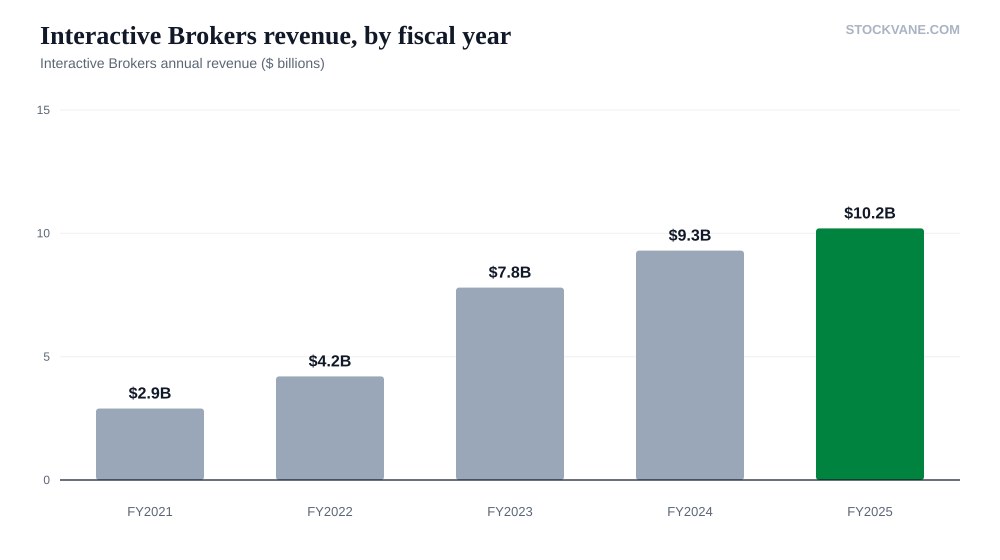
Interactive Brokers can afford competitive rates partly because of what its own income statement looks like: $10.2 billion in revenue for 2025, with an operating margin of 86%, one of the highest of any public brokerage. That is not a reason to use the platform. It is context for why the fee structure holds up instead of getting quietly worse the way thinner-margin brokers sometimes do.
Moving money and holding positions
Funding Moomoo is close to instant and asks almost nothing of you. Funding IBKR involves more verification steps and, the first time, felt like applying for a small loan. Once both accounts were live, the difference in the day-to-day experience shrank. Deposits post, withdrawals clear, neither platform gave me a reason to worry about my own money.
Where it did not shrink was position management. On Moomoo, adjusting a stop or scaling out of a position is two or three taps. On IBKR, the same action can be done four different ways, through the order ticket, the chart, a hotkey, or the mobile app, and figuring out which one you prefer takes longer than it should. Once you pick one, it is faster than anything Moomoo offers, because IBKR lets you skip confirmation screens Moomoo insists on. Fast and simple are not the same thing, and IBKR proves it. The same low margin rate that makes stop-and-scale trading cheap to run also makes IBKR the more natural home for selling cash-secured puts against a cash balance; the cash-secured puts course walks through that setup in more detail than fits here.
The quarter that explains why IBKR keeps adding features
Interactive Brokers grew revenue 21% year over year last quarter to $3.0 billion, and net margin for the trailing year sits at 43%, extraordinary for a brokerage. That kind of profitability is what funds the constant stream of new order types, new markets and new reporting tools that make TWS feel bottomless. It is also, honestly, part of why the platform never gets simpler: there is no commercial pressure to strip anything out when the business is working this well. 5.9% below its own 52-week high of $99, the stock is not cheap relative to its own history, so I would hold off on buying it for that reason alone. The earnings power behind the platform is real, though, and it is the reason IBKR can keep undercutting on margin rates while still turning a profit most software companies would envy.
The quarterly path behind that margin is not a straight line, and it is worth seeing before you assume the profitability is a permanent feature. Moomoo does not publish comparable numbers as a standalone brokerage, since Futu reports at the parent level across markets, so I am not going to pretend I can hold it to the same test. What I can say from using it: the simplicity is a different product built for a different kind of session, not a budget version of a real platform.
Who I would put where
Beginners and people who trade occasionally get more out of Moomoo in the first six months than they would get out of IBKR in the first six months, full stop. The charts teach you to read price action, the low friction keeps you from quitting out of frustration, and the fees on plain stock trades will not bother you either way. Our full Moomoo review goes deeper on that experience alone.
Anyone trading multiple markets, running margin, or doing anything with options beyond buying a single call should be on IBKR, and should expect the first month to feel harder than it needs to. That difficulty is not a design flaw. It is what happens when a platform is built for people who already know what they want, rather than for people discovering it. The IBKR Mobile guide is the fastest way to get functional on the app version without opening the desktop client first.
I still have both accounts open. I use Moomoo to glance at charts on my phone during the day. I use IBKR for anything I actually plan to hold. That split has not changed in months, and I do not expect it to.
What neither platform tells you upfront
There is a cost to both approaches that shows up only after you have used the account for a while, and neither company puts it in the onboarding flow. Moomoo’s speed makes overtrading easy in a way that is hard to notice from inside the app; a platform built to remove friction from placing a trade has, by construction, also removed friction from placing a bad one. I caught myself checking positions more often on Moomoo than on IBKR simply because checking was more pleasant, and more checking tends to produce more trading, whether or not the extra trades were good ideas.
IBKR’s cost runs the other direction. The platform’s depth means there is almost always a better-configured order type or a cheaper routing option you have not found yet, and the temptation is to keep optimizing the setup instead of actually trading. I lost more time in my first two weeks reading TWS documentation than I lost money on any single position, which is its own kind of inefficiency even if it never shows up on a statement.
The number I would check before funding either account
Not the commission schedule. The margin rate, if you think you will ever use margin, and the account minimum, if you will not. Those two numbers separate the platforms more honestly than any feature list, and unlike a promotional bonus, neither one expires at the end of the month. Check both before you fund anything, because switching brokers later costs more in time and paperwork than either platform’s fee schedule will ever cost you in a single year.
Financial disclaimer: The content on StockVane is for educational and informational purposes only and should not be construed as professional financial advice. Stock market investing involves risk of loss.
Sources: Dividends (SEC Investor.gov glossary) (https://www.investor.gov/introduction-investing/investing-basics/glossary/dividend) · Dividends tax topic (IRS) (https://www.irs.gov/taxtopics/tc404)