I’ve been trading through enough Middle East flare-ups over the past 15 years to know the pattern by heart. Oil spikes, bond yields jump, growth stocks get hammered, and everyone on financial Twitter starts calling it “the next 2008.” Most of the time it fades in a week. This week felt different because it stacked a geopolitical shock right on top of an earnings season that was already nervous about AI spending. Let me walk you through what actually happened, because the headlines this week were a mess of half-truths.
The Thursday Selloff: What The Numbers Actually Show
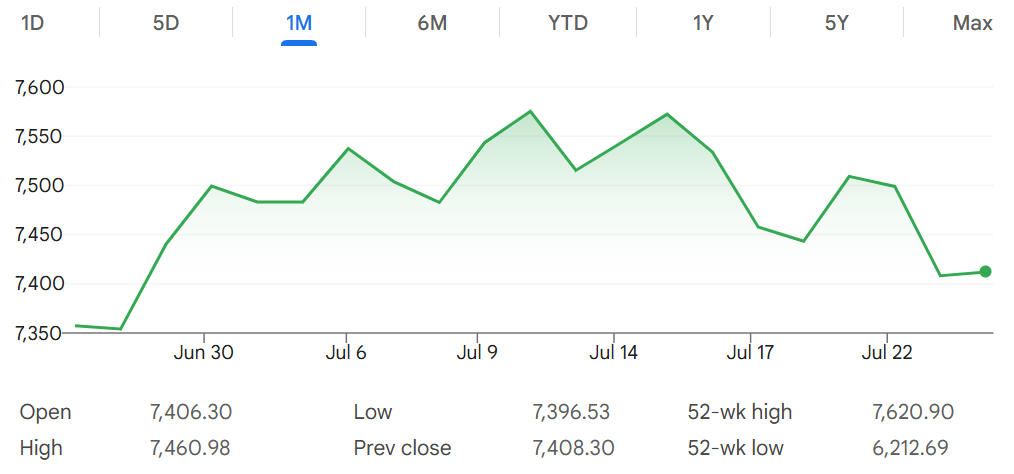
Thursday, July 23, was the ugly session. The Dow dropped 506.93 points, or 0.97%, closing at 51,711.65. The Nasdaq took the worst of it, down 2.15% to 25,137.69. The S&P 500 fell 1.21% to 7,408.30, its sharpest single-day drop in a month. More than 3,400 individual stocks finished in the red.
Here’s the breakdown that actually matters if you’re holding any Mag Seven names:
| Stock | Thursday Move | Why |
|---|---|---|
| Tesla (TSLA) | -14.52% | Q2 earnings badly missed, opex growing faster than revenue |
| Alphabet (GOOGL) | -7.13% | Raised 2026 capex guidance to $205 billion, spooked investors on AI ROI |
| Amazon (AMZN) | -4.57% | Dragged down by broader tech capex worries ahead of its own earnings |
| Meta (META) | -3.36% | Same AI spend anxiety, plus profit taking ahead of next week’s report |
| Microsoft (MSFT) | -2.24% | Sector-wide rotation out of megacap tech |
| Nvidia (NVDA) | -1.56% | Held up relatively well given it isn’t reporting this cycle |
The Magnificent Seven as a group shed roughly $797 billion in market cap in a single session. I’ve watched this index for years and that’s one of the bigger one-day wipeouts I can remember outside of an actual crash event.
Two Separate Fires Burning At Once
This is where I think a lot of coverage got lazy and just blamed “the Fed” or “oil” as one blob of a reason. There were genuinely two independent stories colliding on the same day.
Story one: the Middle East. Houthi forces struck two Saudi oil tankers with missiles and drones, framing it as retaliation for a Saudi blockade of Yemen. Then President Trump told Axios he was seriously weighing a “large scale” strike on Iran, one he described as bigger than the prior “Operation Midnight Hammer” campaign, and said Iran “hasn’t suffered enough pain yet.” That combination sent Brent crude above the psychologically important $100 a barrel mark for the first time since May 22, up more than 6.9% on the day. WTI jumped 5.9% to settle near $91.95.
Oil spiking that fast does two things to equity markets. It raises inflation expectations, and it raises rate expectations. The 2-year Treasury yield, which tracks Fed policy most closely, jumped to 4.370%. The 10-year hit 4.714%, the highest level since early 2025. And the 30-year has now spent multiple consecutive sessions above 5%, the longest such stretch since the 2007 financial crisis. That’s not a small technical detail, that’s the bond market pricing in a genuinely higher-for-longer regime.
Story two: AI capex fatigue. Alphabet’s guidance hike to $205 billion in 2026 capital spending landed the same day as Tesla’s earnings miss, and investors decided enough was enough on companies burning cash faster than they’re proving out returns. I wrote about this AI spending debate back when Nvidia and AMD were still riding pure momentum, and what I’m seeing now is the market finally demanding receipts instead of promises.
These two stories reinforced each other. Higher oil pushed rate expectations up, which raises the discount rate on future cash flows, which makes expensive growth stocks even more vulnerable exactly when the market was already questioning their spending discipline. That’s a nasty one-two punch and it’s why Thursday hurt more than a typical single-catalyst selloff.
The Friday Reversal Nobody Expected
Here’s the part I actually find more interesting than the crash itself. Friday, July 24, the market basically shrugged part of it off. The Dow gained 0.46% to close at 51,947.25. The S&P 500 eked out a 0.05% gain to 7,411.98. The Nasdaq was the outlier, still down 0.64% to 24,975.82, dragged by chip stocks after the Philadelphia Semiconductor Index dropped 4.25%.
Apple was the standout, up 3.53%, alongside IBM at 3.65% and Salesforce at 4.29%, which pulled the Dow ahead of the other two indexes.
What flipped sentiment was Pakistan’s foreign ministry publicly calling on the US and Iran to de-escalate and return to technical-level talks, while also condemning Houthi threats to shipping in the Red Sea. Reports that Pakistan was quietly working to pave the way for renewed US-Iran negotiations pulled oil down hard. WTI’s September contract fell 3.12%, Brent dropped 3.88%. Even with that Friday pullback, Brent still finished the week up 9.85% on net, which tells you the underlying risk premium hasn’t actually gone away, it just cooled off by a few degrees.
I want to be honest about something here because I’ve been burned by this exact pattern before. A one-day diplomatic headline is not the same thing as a resolved conflict. Trump had not walked back his comments about Iran. The Houthi situation in the Red Sea is unresolved. What we got Friday was a relief bounce on hope, not on facts changing on the ground.
What I’m Watching Next Week
Next week is genuinely loaded, more than any single week I’ve flagged for StockVane readers this quarter.
The FOMC meets Tuesday and Wednesday, July 28 and 29, with the rate decision landing at 2:00pm ET on the 29th and Chair Kevin Warsh’s press conference thirty minutes later. This is not a Summary of Economic Projections meeting, so there’s no fresh dot plot, just the statement and the Q&A. The Fed held its benchmark rate at 3.50 to 3.75% at the June meeting, its fourth consecutive hold, but the tone of that statement was notably hawkish. With oil now feeding into inflation expectations, some desks were pricing close to a one-third probability of a hike at this meeting even before Friday’s calmer tape, and futures markets have been leaning toward a possible move as soon as September given how sticky inflation risk looks with $100 oil in the mix.
Layer on top of that the fact that Microsoft and Meta both report earnings Wednesday after the close, the same day as the Fed decision. That is going to be an extremely loud 24 hours. Apple and Amazon follow Thursday. If AI capex commentary comes in hot again after what happened to Alphabet and Tesla this week, don’t be surprised by more volatility exactly when the Fed is also trying to say something coherent about rates.
Intel, for what it’s worth, gave the market one genuine bright spot this week. Q2 revenue came in at $16.128 billion, up 25% year over year and well above the roughly $14.4 billion analysts expected, with data center and AI revenue up 59%. The stock jumped double digits after hours. I mention this because it’s proof the AI capex story isn’t uniformly bearish, it’s becoming a stock picker’s market where execution and actual order visibility matter a lot more than the “just spend more” narrative that carried 2024 and 2025.
My Read Going Into The Week
If you’re managing a portfolio through this, here’s how I’m framing it for myself. The geopolitical risk premium in oil is real but headline-driven, meaning it can reverse fast on diplomatic news the same way it spiked fast on military threats. I don’t try to trade that directly, it’s too binary. What I do watch is how it feeds through to yields, because that’s the more durable transmission mechanism into equity valuations.
The AI capex skepticism, on the other hand, feels stickier to me. That’s not a headline that reverses overnight, that’s investors recalibrating how much benefit of the doubt they’re willing to extend to companies with ballooning spend and no clear near term payoff. Watch how Microsoft and Meta frame their guidance next Wednesday. If they lean into more spending without tightening the story on returns, I’d expect the market to punish it the way it punished Alphabet this week.
As for the Fed, I don’t think a hike next week is the base case, but the fact that it’s even being discussed as a real possibility tells you how much the oil shock has shifted the policy debate in just a few days. That’s worth sitting with regardless of what Warsh actually says on Wednesday.
I’ll be back with a full breakdown after the FOMC decision and the Big Tech earnings roll in. This is shaping up to be one of the more consequential weeks of the quarter.