
On May 20 Intuit fell 20.0% in a single session after its fiscal third-quarter report. Nothing in the business had shrunk that week. Revenue was still growing at a low-to-mid teens rate, margins were still widening, and the company was still earning more per share than at any point in its history.
That gap between what the company reports and what the stock pays for it is the whole story here, and it points the opposite way from what the headline suggests. The AI pitch has been backed by numbers. The multiple, though, has not “caught up” in the sense of rising to meet them. It has collapsed. Intuit trades at $303, 56.5% below its 52-week high of $697, on a trailing P/E of 18.4 against a five-year average of 55.3.
My thesis is narrow. The operating case for Intuit is intact and the earnings line supports it, but the market is no longer paying for the AI narrative at all, so the stock now depends on whether growth holds in the low teens rather than on any re-rating story. That is a very different setup from the one a year or two ago, and it is cheaper.
What the pitch has to show, and what it does show
Start with what was promised. Intuit has said for two years that AI agents inside TurboTax, QuickBooks and its small-business platform would lift growth and cut the cost of serving customers. A pitch like that is easy to make and hard to verify, so the test is simple: does revenue grow, do margins widen, does EPS follow?
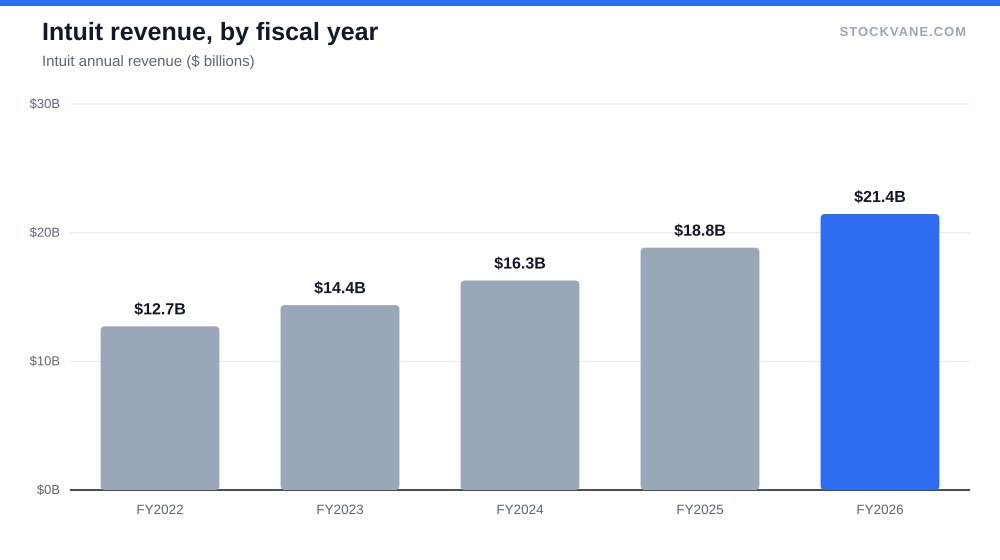
Revenue went from $12.7 billion in fiscal 2022 to $21.4 billion in fiscal 2026. The financials tab puts operating margin at 20.1% in fiscal 2022, 21.9% in 2023, 23.6% in 2024, 26.2% in 2025 and 28.8% in fiscal 2026. That is a new high, and it followed a dip in fiscal 2022 and has widened four years running.
One correction to the way this is usually framed. Growth did not reaccelerate. It ran 13% in fiscal 2024, 16% in 2025 and 14% in fiscal 2026, so the latest year is a step down from the prior one, off a base that is now larger than $21 billion. A company adding roughly $2.6 billion of revenue in a year is doing something hard, but it is not speeding up.
| Metric | Value | Context |
|---|---|---|
| Price (approx.) | $303.19 | 52-week range $252 to $697 |
| P/E (TTM) | 18.4x | Five-year average 55.3x |
| Price-to-sales | 3.8x | Five-year average 10.0x |
| Analyst ratings | 59% buy, 32% hold | 22 analysts; average target $388 |
| Dividend yield | 1.58% |
Diluted EPS tells the same story with more force. It reached $16.46 in fiscal 2026 from $7.28 in fiscal 2022, which is 2.3 times as much in four years. Revenue grew 1.7 times over the same stretch. Earnings compounded faster than sales because the margin did the extra work: operating income climbed from $2.56 billion to $6.2 billion. Gross margin, meanwhile, went from 78.1% in fiscal 2023 to 80.2%, so the mix is not being paid for by cheaper unit economics.
I read that combination as evidence that the AI spending is not simply added cost. If the assistants inside the product were expensive to run and did not sell anything, gross margin would be falling. It is rising.
Where the business is exposed
Two things keep me from calling this a clean win.
The first is concentration. The United States is 92% of revenue, and the small-business and mid-market segment (Global Business Solutions) is about 60% of the total against roughly 40% for the Consumer group. Consumer is where TurboTax lives, and it is the piece most exposed to a free filing option, to a weak tax season, or to a rival tool that does the same job for less. A slowdown there would not be offset quickly by the business platform.
The second is what happened on May 20. The 20.0% drop after the fiscal third-quarter report is the largest earnings-day move in the last four reports; the others were a gain of 4.0% in November 2025, a gain of 3.7% in February 2026 and a decline of 3.2% after the August 25 report. Intuit’s average earnings-day move over that history is 7.7%, so the May reaction was well outside the range that investors had priced. The quarterly table on the financials tab is seasonal, because tax revenue lands in the January-to-April window, so a weak quarter can read worse than the full year justifies. But a one-day loss of a fifth of the value says the market found something it did not like in guidance or in the pace of customer additions, and our data does not say which. I will not assign a cause I cannot document.
The August report was calmer. Fourth-quarter revenue was $4.4 billion, 14% above the year before, and the stock slipped 3.2% on the day. Not a crisis, and not a relief.
The multiple did not catch up. It came down.
This is the part the title gets backwards, so it is worth being careful.
Intuit’s trailing P/E of 18.4 sits at roughly the 3rd percentile of its own five-year range, which ran from 40.2 to 70.3. The forward P/E is 15.0. Price to sales is 3.8 against a five-year average of 10.0, and price to book is 4.3 against 9.0. The valuation tab shows all three gauges near the bottom of their ranges, and the industry averages on the same page (a P/E of 25.9 and a price to sales of 5.0) are both above where Intuit trades.
Put dollars on it. At the five-year average multiple of 55.3 times this year’s EPS, the stock would be about $910. At today’s price, $303, you are paying about a third of that. Even a return to 25.9, the industry average, on forward EPS of $20.16 implies about $522. You do not need the old premium to be justified for the shares to be undervalued. You only need the company to stop being priced as though its earnings were about to shrink.
So why has it happened? Because “AI works” and “AI is safe for incumbents” are different claims. The fear that sits behind a multiple compressing from the 50s to 18 is that generative tools will make tax preparation and bookkeeping cheap enough that the moat erodes. Intuit’s own numbers cannot disprove that fear, because it is about the future. What they can do is show that the fear has not yet arrived in the income statement. Fiscal 2026 gross margin rose, operating margin rose, EPS grew 20%. If the threat were showing up in pricing power, those lines would soften first.
Analysts split on the same point. Of 22 covering the stock, 59% rate it a buy, 32% hold and 9% sell. The average target is $388, which is 28% above the price, the high is $550 and the low is $275. Even the most cautious target sits 9% below the current price, so the lowest analyst is not calling for much more downside than that. That does not tell me the stock will rise. It tells me the sell side has not capitulated in the way the price has.
What I am not covering
I have not modelled TurboTax unit volumes or the split between assisted and self-service filers, because our data carries segment revenue but not customer counts. Nor do I have a source for the specific product claims about agents that Intuit has made on earnings calls, so I have kept this to the reported financials. Anyone who wants to argue for the AI thesis or against it should start with the customer and retention numbers in the company’s filings, which are not here.
What would prove me wrong
The bearish reading is that the multiple is right and the earnings are peak. On that view the expansion of margin from 20.1% to 28.8% has been harvested and there is nothing left to give, so growth in the low teens with flat margins produces EPS growth in the single digits, and 18 times is fair. The market’s forward numbers do not agree: forward EPS of $20.16 implies 22% growth, which is faster than revenue and assumes margin keeps widening. If that assumption fails, the forward P/E of 15.0 is not cheap. It is roughly fair.
Short interest is small, at 2.9% of float, which means this is not a crowded bearish trade waiting to reverse. The quant grade on the site has moved from C to E over recent weeks, which is a signal about price momentum and estimate trends and not about the business, and I would not lean on it either way.
The fiscal 2027 EPS I would hold it to
The forward figure is $20.16. If Intuit prints fiscal 2027 EPS at or above $20, growth in the low teens on revenue and a roughly 29% operating margin will have held, and 15 times earnings will look like a mistake the market corrected. If EPS lands under $19 while margin slips below 28%, the AI case will have produced revenue but not profit, and the shares can stay cheap for a long time. I would want the November-to-January tax-season data before deciding, and the May report again, since that is the quarter that did the damage.
Financial disclaimer: The content on StockVane is for educational and informational purposes only and should not be construed as professional financial advice. Stock market investing involves risk of loss.
Sources: Dividends (SEC Investor.gov glossary) (https://www.investor.gov/introduction-investing/investing-basics/glossary/dividend) · Dividends tax topic (IRS) (https://www.irs.gov/taxtopics/tc404)