
The title says the multiple does not believe FedEx has fixed itself. On the database’s own history, that is only half right. FedEx trades at 16.4 times trailing earnings, and its five-year average is 15.5. The stock sits 1.06 times its own average, in the 71st percentile of its range, which is not what disbelief looks like.
The disbelief is in a different comparison. The industry average P/E in the same data is 20.2, so FedEx is priced at a 19% discount to its peers. Whether that discount is a mistake or a fair charge depends on what “fixed” means, and the fiscal 2026 numbers are more specific about that than the headline.
I will make the argument in three parts: what the restructuring actually delivered, what the price already reflects, and the one figure that would show me I am wrong.
What the restructuring delivered
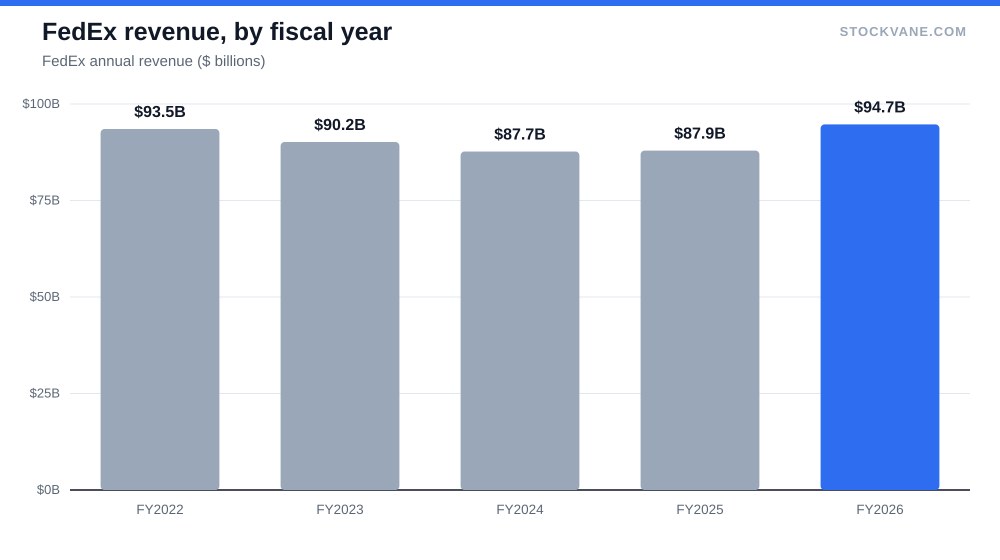
Start with revenue, because it is the number the restructuring was not meant to lift. FedEx booked $93.51 billion in fiscal 2022 and $94.7 billion in fiscal 2026, a gain of 1.3% over four years. Between those two points it slid to $90.16 billion, then $87.69 billion, then $87.93 billion before the fiscal 2026 rebound of 8%.
Operating income tells the more interesting story. It was $6.52 billion in fiscal 2022 and $6.6 billion in fiscal 2026, up 1.5%. The company carried essentially the same profit on essentially the same sales, after passing through a low of $5.34 billion in fiscal 2023.
The operating margin path, from the financials tab figures: 7.1% in fiscal 2021, 7.0% in 2022, 5.9% in 2023, 7.2% in 2024, 6.9% in 2025 and 7.0% in 2026. Fiscal 2023 was the trough at 5.9%. Since then it has stayed between 6.9% and 7.2%. The database’s EBIT margin runs on a different basis and reads 7.1% for 2026, so I use the operating figure throughout.
Gross margin agrees with the operating line: 21.38% in fiscal 2021, 21.57% in 2022, 21.26% in 2023, 21.61% in 2024, 21.60% in 2025 and 21.8% in 2026. Cost cutting did not lift it much. What the numbers show is a company that stopped losing margin, which is a smaller claim than making it.
That matters for how I read the title. “Fixed itself” holds if the standard is the bad year. It does not hold if the standard is fiscal 2021, when FedEx earned $19.45 a share and net income of $5.23 billion. Diluted EPS for fiscal 2026 is $18.55, 4.6% below that peak, and net income of $4.4 billion is well short of the 2021 figure.
A quarter that supports the repair
The most recent quarter is the strongest evidence for the bull case. Revenue was $25.0 billion, up 13% from a year earlier and 4% above the prior quarter. The four quarters of fiscal 2026 read $22.24 billion, $23.47 billion, $24.00 billion and $25.01 billion, with year-over-year growth of 3%, 7%, 8% and 13%. Every quarter grew faster than the one before it.
Annualised, the latest quarter is $100.0 billion of revenue. That would put fiscal 2027 near $100 billion if it merely holds. I read this as a business that has moved from flat to growing, but I cannot say from the database how much came from volume, how much from rates and how much from fuel surcharges. Any of them could reverse.
The revenue base is concentrated. The Federal Express segment supplies $82.27 billion, or 86.9% of the total. FedEx Freight contributes $8.80 billion, or 9.3%, and corporate and eliminations make up the remaining 3.9%. A recovery therefore means the express network is holding its own, since a 9% segment cannot lift the total.
The last earnings reaction was small: +0.8% on 2026-03-19, against an average earnings-day move of 1.7%. That is a quiet stock around its reports, and it makes the next one, on October 28, more of an open question than the price suggests.
Where the price stands
FedEx closed at $303.65, 11.4% below its 52-week high of $343 and 71% above the low of $178. That is a big recovery for a stock that was near $178 within the last twelve months. The market value is $71.9 billion.
Look at the other valuation gauges on the valuation tab and the picture is calmer. Price to sales is 0.8, against a five-year average of 0.7 and an industry average of 1.0. Price to book is 2.3, below its own average of 2.4 and well below the industry’s 3.6. P/E is the only gauge above its history, and only by a little. Its five-year band runs from 13.0 to 18.0, so 16.8 sits in the upper half of that range, 17.6 on forward earnings sits just under the ceiling, and a stock at the top of its band has to keep earning its place there.
Now the number that makes me hesitate. Forward EPS is $17.26, against trailing EPS of $18.55. That implies a -7% decline, and it puts the forward P/E at 17.6, higher than the trailing figure. The market, in other words, is being asked to pay 17.6 times next year’s expected profit, and next year’s expected profit is lower.
I do not know why the forecast is below the trailing number. The database does not say, and I would be inventing a reason if I picked one. But it changes the framing: the discount to the industry is real on trailing numbers and narrower on forward ones. Set 17.6 beside the industry’s trailing 20.2 and it is still a discount, only a smaller one.
For comparison, Costco at 50 times earnings is a company where the price assumes years of growth before it pays back. FedEx sits at the other end of that spectrum. Buyers here are paying for a business that has stopped shrinking and are giving it very little credit for growth.
| Metric | Value | Context |
|---|---|---|
| Price (approx.) | $303.65 | 52-week range $178 to $343 |
| P/E (TTM) | 16.4x | Five-year average 15.5x |
| Price-to-sales | 0.8x | Five-year average 0.7x |
| Analyst ratings | 89% buy, 5% hold | 19 analysts; average target $360 |
| Dividend yield | 1.91% |
What analysts and holders are doing
Nineteen analysts cover the stock, and 89% rate it a buy. The average target is $360, which is 19% above the price. The high target is $425, 40% above, and the low is $160, which is 47% below. When the lowest target is nearly half the current price, the range is telling me that the disagreement is about the earnings path, not the current quarter.
Short interest is 2.0% of float, or about 3.5 days of average volume to cover. That is not a crowded bet in either direction. The dividend is $5.80 a share over the last twelve months, a yield of 1.91%. The quantitative grade on the stock is B, up from C on September 15.
The risk to my reading
The main risk is simple: a single strong quarter can be a timing effect. If the 13% growth came from a shift in shipments between quarters, or from a fuel-price pass-through, the next print will reverse it and margins will look like fiscal 2023 again. At 16 times earnings, the price has no room for that.
The second objection is the EPS point already noted. Fiscal 2026 earnings are 4.6% below fiscal 2021. If the market wants to see FedEx exceed its old peak before calling it fixed, the stock has more work to do, and forward EPS of $17.26 points the wrong way.
One condition would prove me wrong outright: quarterly revenue growth falling back below 3%, the rate of the first quarter of fiscal 2026, while operating margin stays under 7%. That combination would say the recent acceleration was borrowed from the future. It would also take away the argument that the market is too slow to notice, because a multiple of 16 on shrinking sales is not cheap.
What I am leaving out is service quality, labor contracts, capital spending and the split of profit between the ground and air networks. The database has none of it in a form I trust.
If you prefer to be paid for waiting through a report like this rather than buying outright, the mechanics are in our guide to selling put options. I am not suggesting a strike here, because the quarter on October 28 will move the numbers.
The line I would check on October 28
The number I would watch is operating margin in the first fiscal 2027 quarter. If it prints at or above 7% on revenue growth above 8%, the repair is a fact and the 17.6 forward multiple is cheap against the industry’s 20.2. If margin slips below 6.5% while revenue keeps rising, the restructuring gave FedEx a floor and nothing more, and the 71st-percentile P/E is the fair reading of the stock. I lean toward the first outcome, and I would change my mind at 6.5%.
Gavin Thorne has invested in U.S. stocks for six years and previously worked at a large publicly traded internet company. He writes about income-oriented strategies, including cash-secured puts, and about how he reads company data. This article reflects his personal research process and is for informational purposes only. It does not constitute investment advice.
Sources: Dividends (SEC Investor.gov glossary) (https://www.investor.gov/introduction-investing/investing-basics/glossary/dividend) · Dividends tax topic (IRS) (https://www.irs.gov/taxtopics/tc404)