
Put $10,000 into Costco at $895.31 and you own about 11.2 shares. Those shares earned $222 over the last twelve months, an earnings yield of 2.2%. The rest of the price is a bet on what that $222 becomes.
The title of this post says 50 times earnings, and I should be exact about it. The trailing P/E in our data is 45.0 today, and 41.3 on forward EPS of $21.66. Fifty times trailing EPS would be $994, which is 11% above the current quote; the stock reached its 52-week high of $1,095 at about 55 times today’s trailing EPS. So a 50 multiple is what the stock has worn near its high, and 45 is what it wears now. The premium has come down, but only some.
My thesis is that Costco is an excellent business priced as though nothing can go wrong, and that at 45.0 times earnings the return over the next five years depends far more on the multiple than on the company.
What the business earns
Revenue was $275.2 billion in fiscal 2025, up 8% from $254.5 billion. Go back further and the series reads $166.8 billion in fiscal 2020, then growth of 17%, 16%, 7%, 5% and 8%. That is strong for a company this size, but the trend since the pandemic surge has been a slower grind, not an acceleration.
Gross margin is 12.8%, up from 12.6% the year before, or about $35 billion of gross profit on the year. Operating income was $10.4 billion, 3.8% of revenue. Our database also carries an EBIT margin series that reads 4.0%, and I use the operating-income figure because it can be recomputed from two numbers you can see. Either way, this is a company keeping four cents of each revenue dollar as operating profit. Net income was $8.1 billion, up from $7.4 billion, a 3% net margin.
Small margins are the point, and they are also the trap. A retailer that earns four cents on the dollar has thin room to absorb a bad year in costs, and it rarely needs to. What it has is scale, and scale shows up in the earnings line: diluted EPS went from $9.02 in fiscal 2020 to $18.21 in fiscal 2025, roughly 15% a year, and 10% in the last year. The Costco financials page has the full series.
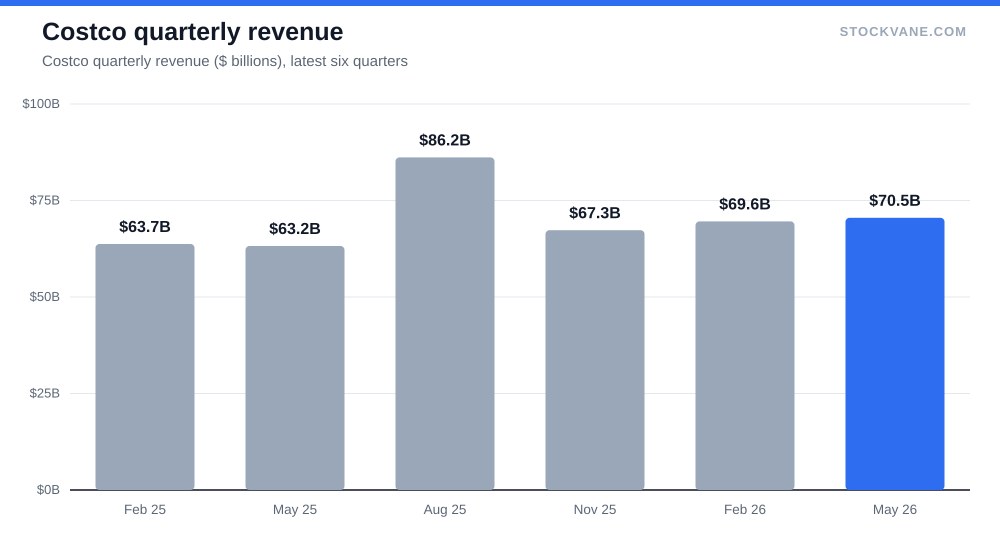
The most recent quarter is where the growth picture improves. Revenue of $70.5 billion was up 12% from a year earlier, after quarters of 8% and 9%. A single quarter does not reset a trend, but it is the first faster print in the run, and it explains part of why the stock has not fallen further.
| Metric | Value | Context |
|---|---|---|
| Price (approx.) | $895.31 | 52-week range $840 to $1,095 |
| P/E (TTM) | 45.0x | Five-year average 46.9x |
| Price-to-sales | 1.4x | Five-year average 1.3x |
| Analyst ratings | 68% buy, 26% hold | 19 analysts; average target $1,084 |
| Dividend yield | 0.60% |
What 45.0 times earnings has to deliver
Costco’s market value is $397.1 billion. Divided by $10.4 billion of operating income, that is 38 times. For a grocer-adjacent business with a 12.8% gross margin, that is a software-sized multiple, which is what the title means. Price to sales, on the valuation page, is only 1.4, against a five-year average of 1.3 and an industry average of 1.1, so on revenue the stock looks ordinary. The gap between the two views is the margin: sales are large and profit is thin, so the P/E is where the price lives.
Against its own history the stock is not stretched. The current P/E of 45.5 compares with a five-year average of 46.9, near the 42nd percentile of a band running from 39.9 to 54.0. The industry average in our data is 35.4. My reading is that this is a fair answer to “is Costco expensive versus its history?” and a poor answer to “is Costco expensive?” Both can be true at once: the multiple has been high for years, so being at its own average tells you little about whether it will be paid next year.
Here is the arithmetic that matters. If EPS grows at a steady rate for five years and the stock then trades at some multiple, what does the shareholder earn? Starting from trailing EPS of $19.88:
| EPS growth to 2031 | Exit at 30x | Exit at 40x | Exit at 50x |
|---|---|---|---|
| 8% a year | -0.4% | +5.5% | +10.3% |
| 10% a year | +1.4% | +7.4% | +12.3% |
| 12% a year | +3.3% | +9.4% | +14.4% |
Read the middle of the table. At 10% EPS growth, which is roughly what fiscal 2025 delivered, a stock that exits at 40 times returns +7.4% a year and one that exits at 30 times returns +1.4%. Holding at 50 times returns +12.3%. That is the honest range for the middle row, from about +1.4% to +12.3%, and the exit multiple moves the answer far more than the growth rate does: at 8% growth the 30x column is -0.4%. Twelve percent growth at 30 times still returns +3.3% a year.
The table ignores the dividend, which at a 0.60% yield ($5.37 paid over twelve months) adds little (the trade-off between a yield like that and a growing payout is the subject of High Dividend Yield vs Dividend Growth). It also ignores buybacks, which our data does not show. Analysts, for what it is worth, expect implied EPS growth of 9%% over the trailing figure, in line with my middle row.
The counter-case and the risk to my view
The best argument for paying up is that Costco has earned it. Revenue has grown every year in the series. Operating margin has crept from 3.3% in fiscal 2020 to about 4% now, and gross margin from 12.15% in fiscal 2022 to 12.8%. A business that earns more per dollar of sales every year for five years deserves a premium to the average retailer, and the stock’s own five-year P/E band, from 39.9 to 54.0, shows that the market has agreed for a long time.
The premium can also last longer than I expect. My view is that a 45x multiple needs about 10% earnings growth to be neutral and more than that to be rewarding, and the company has delivered 10% or better in four of the last five fiscal years. This is a calculation, not a forecast.
What would prove me wrong is a concrete thing: EPS growth running at 12% or better for several years with the multiple holding above 40. In the table that is the bottom row, and at a 40 exit it pays about +9.4% a year. Nothing in the last five years excludes it. The risk to my stance is therefore plain: I lose if earnings compound faster than the multiple shrinks, and I lose more slowly than a holder would if the reverse happens, because I am not the one owning it at 45.
The risk to the business runs the other way. With four cents of operating profit per revenue dollar, a one-point squeeze on gross margin, from 12.8% to about 11.8%, would take roughly a quarter off the $10.4 billion of operating income if costs elsewhere stayed put. That is arithmetic on our figures, not a forecast that it will happen, and Costco’s margins have moved the other way for three years.
Where the market disagrees
19 analysts cover the stock and 68% rate it a buy, a much weaker consensus than the near-unanimous ratings some large caps enjoy. The average target of $1,084 is 21%% above the price. The range is wide: the highest target is $1,275 (42%% above), and the lowest is $781, 13% below the current price. That is a disagreement about the multiple, not the business. It is the same question I asked of JPMorgan at a record high, only there the answer was 15 times earnings instead of 45.
Our quant grade for Costco is D, down from C in recent weeks. Short interest is 1.7% of float, about four days of average volume, so nobody is shorting this in size. I read the quant grade as a valuation and momentum signal: the stock is 18.2% below its high and only 7% above its low of $840.
I am not covering membership renewal rates or warehouse openings. They matter, but our database does not carry them and I would be quoting from memory.
How it compares
Two comparisons sit nearby in our own coverage. Walmart Trades Like a Software Company makes a similar point about a bigger and lower-margin retailer, and the same test applies: what the multiple needs the earnings to do. Visa’s toll-road question is the far end of the scale, where a 66% operating margin supports a P/E of 31. Costco, at about 4%, is asking for a higher multiple on one-sixteenth of the margin. That is why I would treat the two very differently.
What Thursday’s report has to carry
Costco reports fiscal fourth-quarter results on 2026-09-24. The average one-day move on report day is 2.1%, and the last one, on 2026-05-28, was -3.9%. The market rarely punishes a Costco report hard, which means the report matters less than the price.
The number I would check is revenue growth against the year-ago quarter of $86.2 billion, which grew 8%. Another 8% would be $93.1 billion; 12%, matching the last quarter, would be $96.5 billion. Above 10% and the case for a 45x multiple holds together. Below 8%, I would not defend it, and I would want a lower price than $895 before adding.
Gavin Thorne has invested in U.S. stocks for six years and previously worked at a large publicly traded internet company. He writes about income-oriented strategies, including cash-secured puts, and about how he reads company data. This article reflects his personal research process and is for informational purposes only. It does not constitute investment advice.
Sources: Dividends (SEC Investor.gov glossary) (https://www.investor.gov/introduction-investing/investing-basics/glossary/dividend) · Dividends tax topic (IRS) (https://www.irs.gov/taxtopics/tc404)