
Walmart used to be the stock you bought when you wanted to sleep at night, not the stock you bought to get rich. That changed somewhere in the last three years, and I don’t think enough people have registered what it means that Walmart now trades at close to 39 times trailing earnings, a multiple that used to belong to software companies, not a grocery and general-merchandise chain that still does the overwhelming majority of its business inside a physical store. I want to walk through why that repricing happened, what has to keep being true for it to hold, and why I think the market has gotten ahead of the actual pace of change here.
The bull case is real, and I want to state it fairly
Walmart’s advertising business, Walmart Connect, has gone from a rounding error to a real profit center, riding on top of foot traffic and purchase data that almost nobody else in retail can match at this scale. Membership income from Walmart+ and Sam’s Club keeps compounding quietly in the background with almost no incremental cost once a member signs up. E-commerce, which used to be a drag on margin because of delivery costs, has turned a corner as the company leans on its store network as a fulfillment layer instead of building separate warehouses from scratch. Put an advertising business, a membership business, and a marketplace business inside a low-margin retailer, and you get a blended margin profile that looks less like a grocery chain and more like a platform. That is the thesis, and it is not a fantasy. Operating margin has widened for real over the past several years, for structural reasons, not because of one good quarter.
I also don’t want to pretend this is some over-hyped meme stock. Walmart’s market capitalization sits above $840 billion, it carries an investment-grade balance sheet, and same-store sales growth has stayed positive through periods when plenty of other retailers were reporting outright traffic declines. This is a company executing well. I am not disputing the execution.
Here’s my problem: the multiple assumes the transformation is basically finished
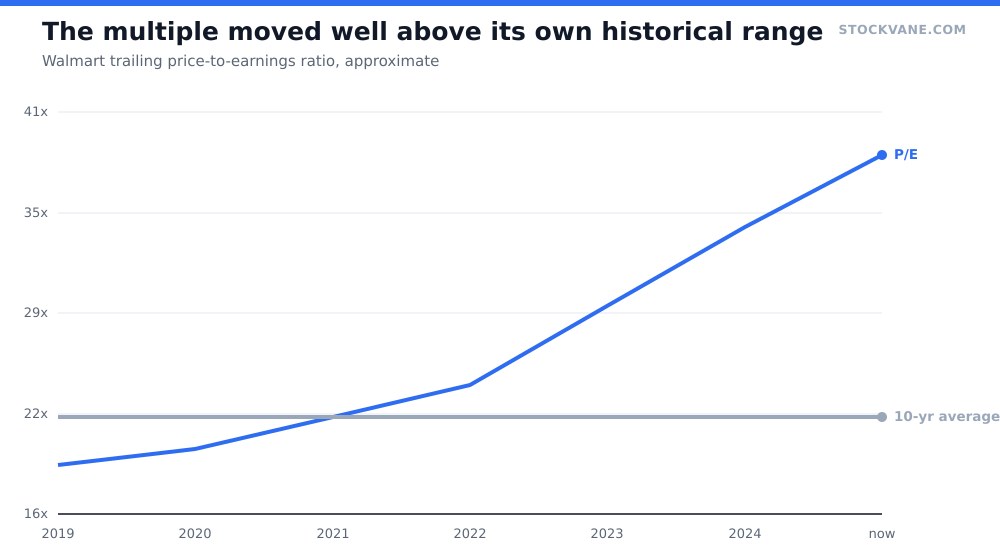
A retailer trading at a mid-to-high 30s P/E is being priced as though the advertising and membership businesses are already the dominant driver of earnings, when in practice they are still a minority of the profit pool sitting on top of a core retail business that grows revenue in the mid-single digits most years. I went back and looked at where the multiple sat historically: for most of the last decade, Walmart traded in a band roughly between 18 and 24 times earnings, a level that made sense for a company growing revenue at 3-5% a year with thin, grinding margin improvement. The move to the high 30s happened over a relatively short window, and it happened because the market decided to price the future ad and membership mix today rather than as it actually shows up on the income statement.
StockVane’s own Quant Rating currently has Walmart at a D, and the reason isn’t that the business is bad, it’s that the rating weighs valuation against the growth and quality inputs, and right now the valuation input is doing a lot of the dragging. I’ve made the mistake before of dismissing a rating like that because the story sounded good (I did it with a very different kind of stock in 2021, and paid for it), so when StockVane’s own data and my own read of the multiple point the same direction, I take that seriously rather than explaining it away.
| Metric | Walmart (WMT) | Large-cap retail peers | S&P 500 |
|---|---|---|---|
| P/E (trailing) | ~38.5x | ~24x | ~23x |
| Dividend yield | ~0.9% | ~1.4% | ~1.3% |
| Price/Book | ~8.6x | ~5x | ~4.5x |
| 52-week range | $98.06 – $134.83 | , | , |
What would actually justify paying this much
I’m not saying the multiple can never be justified. It can, if the mix shift happens faster than the market is currently modeling, meaning advertising and membership income grow from a low-double-digit share of operating income toward something closer to a quarter or a third within the next several years, while core retail margin holds steady rather than getting competed away by the value push from grocery-focused competitors and the relentless price matching Walmart itself has to do to defend market share. That is a plausible path. It is not the base case, and it is definitely not something you should assume happens on schedule, because retail mix-shift stories almost always take longer than the initial enthusiasm implies. Amazon’s own advertising build took the better part of a decade to become a headline profit driver, and Amazon had structural advantages in ad tooling that a traditional retailer had to build from a much earlier starting point. Walmart is not starting from zero, it has real scale and real purchase data, but “not starting from zero” and “already there” are different claims, and the multiple increasingly prices the second one.
The other thing that would justify the multiple is a real, sustained acceleration in international growth, particularly in India through the Flipkart and PhonePe stakes, where Walmart has real optionality that isn’t showing up cleanly in consolidated numbers yet. If that business scales the way some bulls expect, it becomes a second growth engine layered on top of the US ad-and-membership story. I think this is the more interesting long-dated bet in the stock, and it gets almost no attention relative to how much analysts talk about Walmart+ penetration.
The Amazon comparison everyone makes, and why it’s incomplete
Every bull case for Walmart’s ad-and-membership transformation eventually points to Amazon as proof it works, and it’s a fair comparison up to a point. Amazon’s advertising business grew from nothing into one of the largest ad platforms in the country, and its Prime membership base became one of the stickiest subscription products in retail, both of which reshaped how the market values the whole company. But Amazon built that ad business on top of a marketplace where third-party sellers were already competing for placement on product pages, which gave Amazon a natural, high-intent advertising surface from day one. Walmart’s advertising opportunity is real, but it’s built on top of a physical grocery-and-general-merchandise business where the natural ad inventory (in-store screens, app placements, sponsored search on walmart.com) is smaller and less contextually loaded than a marketplace checkout flow with millions of competing sellers bidding for the same shelf space.
That doesn’t mean Walmart Connect can’t get large. It means the ceiling is probably lower relative to total company revenue than Amazon’s ad business ended up being relative to Amazon’s, simply because the underlying commerce surface is structured differently. Walmart has been closing part of that gap by building out its own marketplace, letting third-party sellers list on walmart.com the same way they do on Amazon, which does create more of that competitive-bidding ad inventory over time. But that marketplace effort started years after Amazon’s and is still a fraction of the size, which is worth remembering every time someone waves the Amazon comparison around as settled proof of where Walmart’s ad revenue is headed.
Walmart’s US marketplace seller count has grown into the hundreds of thousands over the past few years, a real and fast-growing number, but still a small fraction of the millions of active sellers on Amazon’s marketplace, which is the gap that actually matters for how quickly the ad-inventory ceiling closes rather than the seller count in isolation.
What I’d actually watch instead of the headline comps
Same-store transaction counts matter more to me here than same-store sales dollars, because Walmart has been getting some of its growth from higher average ticket sizes driven by grocery inflation passthrough rather than pure volume, and that is a less durable source of growth once inflation normalizes. I’d also watch the advertising revenue growth rate specifically, disclosed separately in the segment breakdowns, because a deceleration there would be the first sign that the multiple-justifying story is losing momentum before it shows up anywhere else. And I’d watch gross margin in the US segment on a trailing basis, since that is where the value-retailer price war actually gets fought.
If you already own Walmart from a lower cost basis, I don’t think this is a reason to sell a wonderful business over a valuation quibble; compounding machines are hard enough to find that you don’t want to trade out of one lightly. If you’re looking at Walmart fresh at today’s price expecting the historical grocery-and-general-merchandise multiple with an AI-adjacent growth kicker on top, I think you’re paying for a transformation that is real but not yet as far along as the price suggests. I’d rather buy the story after a normal pullback resets the multiple closer to the mid-20s than pay full freight for a best-case mix shift that has to play out roughly on schedule to work.
For a fuller read on how the ad-and-membership arithmetic actually feeds through to the upshot, Walmart’s segment-level financials are worth sitting with directly rather than taking the narrative version secondhand, and if you want to see how the stock’s valuation has actually moved over time rather than trust my summary of it, the valuation history is on the same page.
Financial disclaimer: The content on StockVane is for educational and informational purposes only and should not be construed as professional financial advice. Stock market investing involves risk of loss.