
Seventy-five times trailing earnings for an aerospace manufacturer that still cannot hit its own delivery targets should stop you before you scroll past it. It should also make you suspicious of the number itself. The ratio is about 71 on the latest snapshot and was closer to 75 when the valuation page last refreshed, and either way the honest explanation is that the earnings under it are not what they look like.
Boeing reported net income of $2.2 billion for 2025. It did not earn that by building airplanes. The business lost $5.4 billion at the operating line, and the profit came from selling something. If you take one idea from this piece, take that one: the P/E ratio on Boeing measures a one-time event, not the company.
What is inside the $2.2 billion
The financials tab makes the gap easy to see. Revenue was $89.5 billion, up 34%, the strongest sales growth since 2018. Operating profit was a loss of $5.4 billion. And then a very large number arrives below that line.
| Line, fiscal 2025 | $ billions | What it is |
|---|---|---|
| Operating profit | -5.42 | The airplane, defense and services businesses combined |
| Gain and other income | +10.82 | Mostly the gain on selling the digital aviation business |
| Interest and other charges (implied) | -2.77 | Backed out of the pre-tax figure; mainly interest on debt |
| Pre-tax profit | +2.64 | What is left before taxes |
| Net income | +2.24 | The number that produces the 71 times P/E |
The large positive number is the gain on the sale of Boeing’s digital aviation business, which includes Jeppesen and ForeFlight, to the private equity firm Thoma Bravo for $10.55 billion in cash. The company reported a gain of about $9.6 billion on the deal. Take it away and 2025 was a loss, not a profit. I explain how to read a bridge like this in my guide to reading an earnings report, and Boeing is a clean example of why the habit matters.
What the sale cost
Selling Jeppesen and ForeFlight raised cash that went toward paying down debt, which was the point. It also handed over a recurring, high-margin software business, the kind of revenue that would have helped steady earnings while the factories recovered. That is a trade of future profit for present balance-sheet strength. It is a defensible trade, and it means the quality of Boeing’s earnings from here depends even more on the planes it builds.
The business underneath
Strip the gain out and the operating picture is a company that is improving from a terrible base. The operating loss of $5.4 billion in 2025 compares with $10.8 billion the year before. Operating cash flow was positive at about $1.1 billion, against an outflow of $12.1 billion in 2024. Free cash flow was still negative at $1.9 billion, which is a long way from a normal industrial, and a long way better than a year earlier.
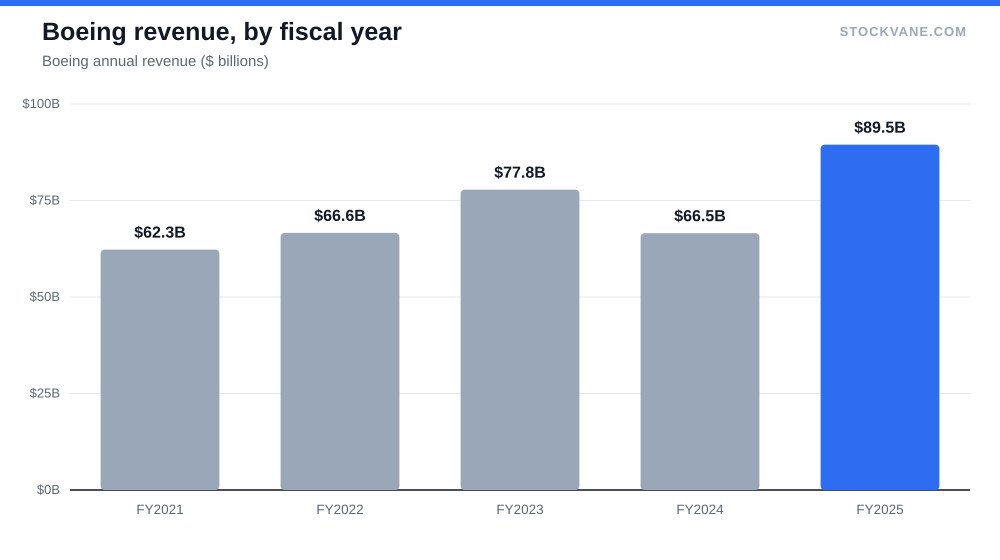
I read that as a company still in the repair phase. The plane maker that spent years burning cash is now roughly breaking even on cash and losing money on paper, and the direction is right. But an improving loss is still a loss, and a P/E ratio has nothing useful to say about it.
Where 2026 stands
The second quarter gives a better view of the underlying run rate. Revenue was $24.6 billion, up 8% from a year earlier. Boeing reported a net loss of $428 million, or 67 cents a share, and free cash flow of $631 million, positive for the quarter. Deliveries rose 14% to 171 aircraft, and the 737 line began moving to 47 a month. Backlog reached a record $715 billion.
Commercial Airplanes was $11.8 billion of second-quarter revenue, Defense, Space and Security $7.5 billion and Global Services $5.3 billion. The services business is the quiet earner here, with margins far above the other two, which is part of why its share of profit is larger than its share of sales.
The stock reacted well to both reports this year. It rose about 5.5% the day after the first-quarter report in April and about 4.8% after the one in July, following two declines of 4.4% and 1.6% after the reports in October and January. Four reports, two directions, and a price that still sits 22% below its high. It is the pattern of a stock where investors are still deciding what they believe.
What the forward multiple says
The forward P/E of 96 is worth reading as arithmetic. It implies analysts expect earnings of about $2.07 a share over the next twelve months, against about $2.78 of trailing earnings that include the gain. Both are tiny next to a share price near $198, which is why any multiple on them comes out absurd. The market is not paying for earnings this year or next. It is paying for what the earnings could become once the company builds planes at a steady rate.
Why the ratio fails and what replaces it
Look at the valuation tab and the failure is obvious. The trailing P/E is 71. The forward P/E is 96, higher, because analysts expect earnings to be lower without the gain. The five-year average P/E is negative, because Boeing lost money in most of those years. A ratio that is negative in the past and higher in the future is not measuring anything you can compare.
Price to sales works better. Boeing trades at 1.8 times sales, exactly its own five-year average, against an industry average of 5.8. That is a discount to the group, and it reflects the fact that Boeing’s profit margin is negative while its peers’ are healthy. It says the market is not paying for the current earnings. It is paying for the margin the business might reach when production is stable, and that is a very different thing.
A duopoly with a quality problem
The case for owning Boeing anyway is structural. Large commercial aircraft are a two-company business: Boeing and Airbus. There is no credible third entrant inside a decade, the customers are airlines that want more planes than either company can build, and the backlog is measured in years. That is about as good a competitive position as an industrial company can have.
What has broken is execution. The 737 MAX grounding, the door panel that came off an Alaska Airlines jet, a production cap imposed by the Federal Aviation Administration, and a machinists’ strike that shut down West Coast production for close to two months all landed within a few years. Kelly Ortberg, who came from outside the company, took over as chief executive in 2024, and the improvement in cash flow since then is the first evidence that the repair is working. It is early.
How it compares with its peers
The peer comparison shows how different Boeing’s numbers are.
| Company | Trailing P/E | Forward P/E | From 52-week high |
|---|---|---|---|
| Boeing (BA) | 71.3x | 95.8x | -22% |
| GE Aerospace (GE) | 37.5x | 34.4x | -19% |
| RTX (RTX) | 34.2x | 30.9x | -14% |
| Lockheed Martin (LMT) | 19.7x | 17.4x | -22% |
| Northrop Grumman (NOC) | 16.8x | 17.6x | -31% |
| General Dynamics (GD) | 21.5x | 19.7x | -12% |
Every other name in the group has a P/E in the teens to mid-thirties. Boeing’s is more than double the average, which tells you the peers are being valued on earnings and Boeing is not. It is also 22% below its 52-week high, so the market has not been ignoring the risks.
The production cap is a regulatory decision
For much of the last two years the Federal Aviation Administration held 737 production to 38 a month after the door panel incident. It has since allowed 42, and Boeing is working toward 47. Each step is a factory achievement and a regulatory decision at once, and every increase gives the regulator a chance to reconsider. That is why the delivery number is fragile in a way most industrial output figures are not. A single quality escape could freeze the rate for months.
Wall Street is nearly unanimous
Of the 18 analysts covering the stock, 94% rate it a buy. The analyst consensus average target is $275, about 39% above the recent price, and even the lowest target, $250, is 26% above it. That is an unusually one-sided picture, and I treat it with some caution. When almost everyone agrees, the price usually already contains the agreement, and the risk is in what they are not modeling.
How I would value it instead
I would drop the P/E and watch three things. The first is the delivery rate on the 737, which is the number that drives cash flow, margin and debt paydown. A steady climb to 47 a month and beyond, without a new quality problem, is the whole story. The second is free cash flow, which should turn reliably positive before I trust any earnings figure. The third is the defense business, where fixed-price contracts signed under earlier management have produced real losses and could do so again.
I am uncertain about the pace. Boeing’s recovery has surprised on the upside in cash flow and on the downside in quality more than once, and I would not put a date on when the earnings become clean. What I am confident about is the framework: judge it on production and cash, and treat any ratio built on 2025 net income as a curiosity.
At about $198, the price is 22% under its high and reflects a lot of doubt already. That makes Boeing a reasonable thing to study and a hard thing to call. I would want to see two quarters of positive free cash flow with the delivery rate holding before treating it as a business that earns money, and until then I would not let a ratio tell me otherwise.
Financial disclaimer: The content on StockVane is for educational and informational purposes only and should not be construed as professional financial advice. Stock market investing involves risk of loss.