
Only 2.7% of Booking Holdings’ float is sold short, and it would take about four days of average volume to cover it. Traders who think a stock is broken usually pile in harder than that. Here they mostly haven’t, and the stock still sits 24.7% below its 52-week high of $223, at $168.
The title of this piece makes a claim, so let me test it before defending it. Booking looks cheaper than it has been in years on the one window our data covers well: five years. Its trailing P/E of 19.0 ranks in the 0th percentile of its own five-year range, and its price-to-sales ratio of 4.6 ranks in the 2nd. I cannot say anything about a longer stretch than that, and I will point out below where the five-year average is misleading. My view is that the discount is real but smaller than it first appears, and that the whole argument hangs on whether earnings per share resume growth after a year in which they slipped.
What the five-year P/E average hides
The database lists a five-year average P/E of 58.7 for Booking. Taken literally, the stock trades at about a third of its usual multiple. Do not take it literally. The band behind that average runs from a negative figure to above 126, and the extreme readings come from 2020 and 2021, when travel earnings were crushed and a small profit divided into the share price produced absurd ratios. An average built on that is a statistical artifact.
The cleaner comparison is the price-to-sales ratio, which does not blow up when profits vanish. It is 4.6 now against a five-year average of 6.5, and the five-year range bottoms out at 4.7. So the stock is trading at roughly the low end of its own sales multiple, not at a third of it. That is a real discount, and about 30% below the average, but nobody should call it a bargain-bin price.
Against the market the picture is mixed. The industry average P/E in our data is 19.1, so Booking’s 19.0 is level with it, while its price-to-sales of 4.6 sits above the industry average of 3.3. An online travel platform that keeps about 98 cents of each revenue dollar after direct costs (gross margin 98.0%) deserves a premium on sales. It does not obviously deserve a premium on earnings.
The valuation tab shows the same thing if you want to check the percentiles yourself.
Earnings per share fell while the business grew
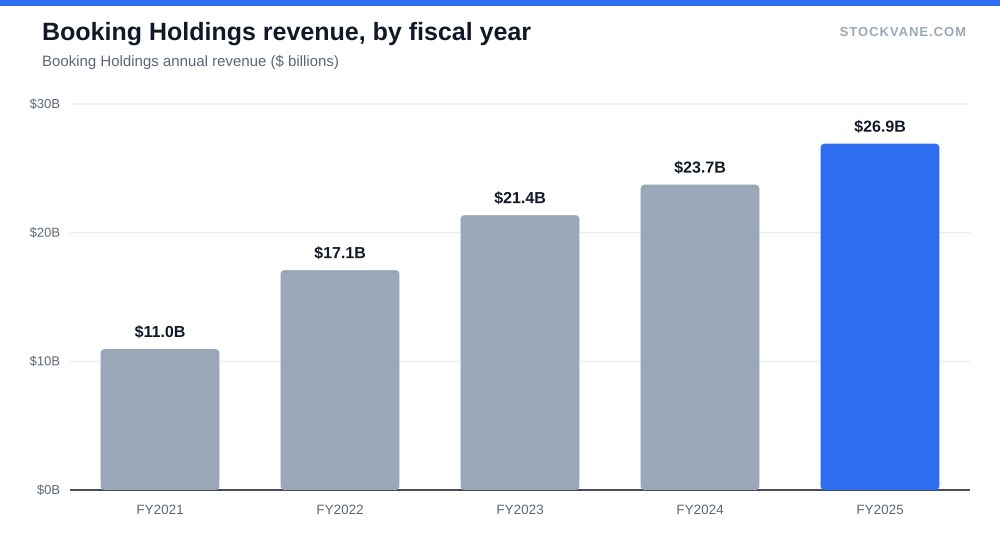
2025 revenue reached $26.9 billion, up 13% from $23.7 billion. Operating income climbed to $9.3 billion, from $7.55 billion the year before. That makes an operating margin of 34.5% against 31.8%, a gain of roughly 2.7 points. On the financials page the operating line looks strong.
Then net income went the other way: $5.4 billion against $5.9 billion, a fall of about 8%. Diluted EPS slipped from $6.91 to $6.62, or 4%. Revenue up 13%, operating income up about 23%, profit down. Something sits between the operating line and net income, and the filings, not this data set, would say whether it is tax, interest expense, currency or an investment write-down. I do not know which, and I am not going to guess.
One caution on margins. Our database also carries an EBIT margin series that reads 31.4% for the same year, down from 36.2% in 2024. That is the opposite direction from the operating margin I computed above. The two use different definitions of what counts as operating, so I am citing operating income divided by revenue throughout and leaving the EBIT series alone. If you pull margin figures yourself, be sure you compare like with like.
Why does this matter for the valuation? Because the trailing P/E of 18.6 is calculated on EPS that just fell. On the $9.00 of trailing earnings the stock costs 18.6 times. On the $10.74 that analysts expect for the coming year, it costs 15.6 times, roughly 16% cheaper. That step down requires about 19% EPS growth to materialize. It is the number the whole discount rests on.
| Metric | Value | Context |
|---|---|---|
| Price (approx.) | $167.90 | 52-week range $149 to $223 |
| P/E (TTM) | 18.6x | Five-year average 58.7x |
| Price-to-sales | 4.6x | Five-year average 6.5x |
| Analyst ratings | 81% buy, 19% hold | 27 analysts; average target $237 |
| Dividend yield | 0.96% |
Growth has slowed, and the last quarter showed it
Booking’s revenue growth over the past six fiscal years reads 61%, 56%, 25%, 11%, 13% in the years after the 2020 collapse (which itself was a 55% fall). The early numbers were a rebound from a low base. Since 2023 the company has been a mid-teens grower, not a hypergrowth one, and the latest quarter is a softer reading again: $7.4 billion of revenue in the June quarter of 2026, up 8% from a year earlier, after growth of 16% in each of the two prior reported quarters.
Travel revenue is seasonal, so the sequential comparisons in the data (the June quarter came in 33% above the March one) tell you little. The year-over-year figure is the one that counts, and it halved. I would not overreact to a single quarter, but a stock cannot be a growth stock and a stable compounder at once. When growth slows from 16% to 8% the market is entitled to pay a lower multiple.
That is the counter-case, and it deserves to be taken head-on. The bear does not need a recession. He needs only that the 8% is the new rate, that $10.74 of expected EPS is therefore too high, and that the stock deserves the multiple it now carries. Compare the Costco at 50 times earnings debate, where a premium multiple needs steady growth to defend it. At 8% revenue growth and the current margin, 19.0 times earnings is not cheap. It is fair.
The reaction to the August 4 report argues against that reading, but only a little. The stock moved +6.6% on the day, against an average absolute earnings-day move of 3.5% in the recent history. A move nearly double the norm, in the good direction, on the very report that showed 8% growth. Investors were relieved. That does not prove the growth rate stabilises.
Who is still buying, and what the discount pays you
The sell side is unified. Of 27 analysts, 81% rate the stock a buy and none a sell. The average target is $237, 41% above the price. The lowest target of $188 is still 12% above where the shares trade. A buy-rating consensus tells you about the consensus, not about the stock, and targets are anchored to earnings estimates that have to hold. I include them as a measure of sentiment, not as a forecast.
Our own quantitative rating tells a less flattering story. It moved from a C to an E in the past few weeks. Analysts lean one way and the model leans the other. I do not resolve that by picking a side; I read it as a sign that the market has already priced the risk that earnings estimates fall, and the model is registering the recent slowdown and the EPS decline.
For an owner, the yield is small: 0.96%, or $1.61 a share over the trailing twelve months. It will not carry the position. The larger return is from buybacks, and that leads to a quirk. Booking’s balance sheet shows negative equity, and price-to-book is -11.9 against a five-year average of -24.2. Years of repurchases pushed book value below zero, so the ratio is meaningless as a valuation tool. It is a capital-allocation choice, not a solvency warning, and I am mentioning it only so nobody screens for cheap price-to-book and lands on this name for the wrong reason.
Worth adding: market capitalization is $126.2 billion. On $5.4 billion of net income, that is a market value of roughly 23 times last year’s profit, which confirms the P/E arithmetic from another angle.
What I am not covering
Booking’s bookings mix, its regional exposure and its advertising line are outside the data I pulled. So is any read on the company’s spending on artificial intelligence, which I would want to see before calling the margin durable. I also have no information about why net income fell in a year of higher operating income. Those gaps are why I treat this as a valuation call with a stated condition and not a full thesis. Readers who want the framework I use for deciding whether a discount is worth acting on can find it in how I pick stocks.
The EPS line that would end the argument
Here is the test. Trailing EPS is $9.00, the figure the market is using now, and expected EPS is $10.74. If the next reported year lands near $10.74, then Booking at $168 costs about 15.6 times earnings, a discount to an industry at 19.1 and to nearly everything in its own history. The title is then right. If EPS stays near $9.00 or drops, the stock is on 19.0 times and the discount was an illusion created by an old, inflated average.
The next report is the marker. I would want to see year-over-year revenue growth back at double digits after the 8%, and net income growing, not just operating income. Two flat prints in a row, and I would drop the word cheaper from my own vocabulary for this stock.
Financial disclaimer: The content on StockVane is for educational and informational purposes only and should not be construed as professional financial advice. Stock market investing involves risk of loss.
Sources: Dividends (SEC Investor.gov glossary) (https://www.investor.gov/introduction-investing/investing-basics/glossary/dividend) · Dividends tax topic (IRS) (https://www.irs.gov/taxtopics/tc404)