
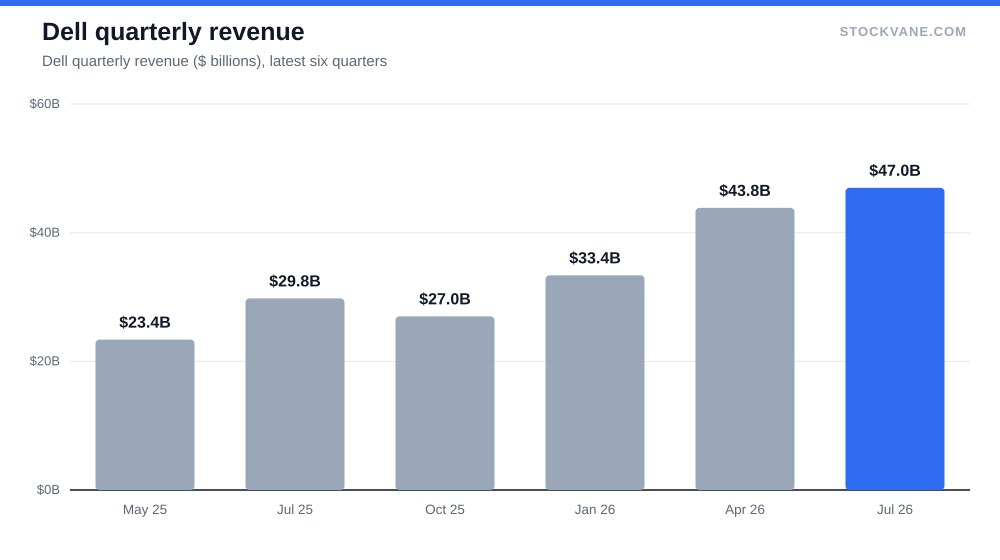
Dell has booked 90.8 billion dollars of revenue in the first half of fiscal 2027. The whole of fiscal 2026, a year that itself set a record, came to $113.5 billion. Half a year of sales is already 80% of it.
That is the part of the title that our data supports without an argument. Revenue in the quarter reported on September 1 was $47.0 billion, 58% above the same quarter a year ago. Whatever is happening in Dell’s AI server business, it is happening at a scale that shows up in the top line of a company with more than $100 billion in annual sales.
The second half of the title is the harder one. The margins on that growth are thin, and the pattern is more specific than “hardware is low margin”. We think the stock, at $568 and 4.6% below its 52-week high of $596, is pricing the revenue and ignoring what each extra dollar of it has earned. That is our thesis, and the rest of the post tests it.
What we can and cannot verify about the backlog
The backlog itself, the dollar figure of AI server orders waiting to ship, is not in the StockVane database. We are not going to quote one. What the database does hold is reported revenue, and revenue is the only evidence we have that orders turned into shipments.
On that evidence, the fiscal 2027 first half is unusual. The first two quarters brought in $90.8 billion, against $53.2 billion in the same half of fiscal 2026, an increase of 71%. The most recent four quarters added up to $151.2 billion. Sequential growth is slowing, though: the July quarter rose 7% from the April quarter, after the April quarter had jumped 31% from the one before it. The step change happened in one quarter, and growth since then has been steady rather than explosive.
The financials tab shows how sharp the turn is. Fiscal 2024 revenue fell 13.6% to $88.4 billion, then rose 8.1% in 2025 and 18.8% in 2026. Now the quarterly rate is above 50%. Oracle’s contract backlog was the subject of an earlier post of ours, and that piece dealt with a backlog the stock still wants proved. Dell is at the other end of that chain, with revenue already recognized, which is a stronger position than a promise, although it says nothing about how much more is coming.
Where does the revenue sit? In the July quarter, the Infrastructure Solutions Group, the segment that includes servers, reported $31.8 billion, or 68% of the total. The Client Solutions Group, the PC business, reported $15.0 billion, or 32%. Servers now decide the company’s results, and PCs are the smaller half.
| Fiscal year | Revenue ($B) | Growth | Gross margin | EBIT margin | Net income ($B) | Diluted EPS ($) |
|---|---|---|---|---|---|---|
| 2021 | 86.7 | 2% | 31.2% | 6.4% | 3.5 | 4.22 |
| 2022 | 101.2 | 17% | 21.6% | 7.4% | 5.7 | 7.02 |
| 2023 | 102.3 | 1% | 22.2% | 4.4% | 2.4 | 3.24 |
| 2024 | 88.4 | -14% | 23.6% | 6.1% | 3.4 | 4.60 |
| 2025 | 95.6 | 8% | 22.2% | 6.8% | 4.6 | 6.38 |
| 2026 | 113.5 | 19% | 20.0% | 7.8% | 5.9 | 8.68 |
The margin arithmetic
Now the part the title calls not great. Gross margin was 20.0% in fiscal 2026 against 22.2% in fiscal 2025, even as revenue grew 19%. In dollars, gross profit rose from $21.2 billion to $22.7 billion. That is an increase of $1.5 billion on $18.0 billion of additional revenue, so each new dollar of sales brought in about 8 cents of gross profit. The older business kept 22 cents.
That is the whole point. The added revenue is worth roughly a third of what the base revenue is worth, at the gross line. A company selling $18 billion more product and getting only $1.5 billion more gross profit is doing volume, and the volume is not creating the economics that its stock price seems to expect.
Operating income still rose, and here the detail matters. It went from $6.7 billion to $8.4 billion, a gain of $1.8 billion. Gross profit added $1.5 billion of that. The rest came from operating costs, which by our arithmetic (gross profit minus operating income) slipped from $14.6 billion to $14.3 billion while revenue grew by a fifth. Cost discipline covered the gap left by the gross margin. Two questions follow. How long can costs keep falling as revenue grows? And is the servers mix pulling the margin down further in fiscal 2027? The database has no quarterly margin data for Dell, so we cannot answer the second.
We use the database’s EBIT margin of 7.8% and not an operating income ratio calculated by hand, so that the number matches every other page on this site. Net income of $5.9 billion is a 5% net margin on that revenue. It is a decent hardware margin. It is not the margin of the stocks the AI trade usually pays these prices for.
History gives the margin some context. Gross margin was 31.2% in fiscal 2021, the table above shows it near 22% in each of the next four years, and it is at 20.0% now. The EBIT margin moved the other way over the same span, from 6.4% to 7.8%, because the company spent less to sell each dollar of product. Net income has more than recovered from the fiscal 2023 low of $2.4 billion, and diluted EPS is up from $3.24 that year to $8.68.
So the earnings record is good, and it is not the record of a business whose gross economics improve with size. That distinction is what the AI server trade is being asked to change, and no filing in our database shows it changing yet. Dell also pays a small dividend, $2.31 a share over the last twelve months for a yield of 0.41%, which is not a reason to own it.
What the price already assumes
On the valuation tab, the trailing P/E is 33.0 on $17.19 of earnings per share. The five-year average is 18.2, so the stock is at 1.8 times its own history. Forward P/E is 20.2 on consensus EPS of $28.14, a figure that implies about 64% growth from the trailing number.
Notice how far trailing EPS has run ahead of the annual figure. Fiscal 2026 diluted EPS was $8.68, and the trailing twelve months are $17.19, nearly double, because the two newest quarters are so much larger than the ones they replaced. Buyers are paying for that new run-rate. The price to sales ratio tells the same story, at 2.2 against a five-year average of 0.7.
The shares have gone from $110 to $568 across the 52-week range, up 418% from the low. A stock that has quintupled has little room for a margin disappointment, and a company whose incremental gross margin is 8 cents on the dollar is closer to a margin disappointment than its multiple admits. Yet the market has been willing to pay. The last five earnings-day moves were +15.8%, +32.8%, +21.9%, +5.8% and -8.9%. The database’s average earnings-day move for the stock is 19.1%, and that is the size of the surprise this stock can deliver in a single session.
One more number frames the risk. The July quarter’s revenue of $47.0 billion implies an annual run rate of $187.9 billion, which is 65% above fiscal 2026. If that run rate held with the fiscal 2026 gross margin of 20.0%, gross profit would be near $38 billion, against $22.7 billion. If the margin fell to 18%, it would be about $34 billion. The two-point difference is worth more than the entire fiscal 2025 to 2026 gain in gross profit, and that is why the margin matters more than the growth rate here.
Where we may be wrong
The strongest counter to our reading is that gross margin in a build-out year says little about margin at scale. Servers built for the largest customers can carry lower gross margins in the first shipments and improve as volume and supplier terms settle. If that happens, the 8 cent incremental margin is a floor and not a trend. We have no data here that rules it out, and the fall in operating costs shows management is defending profit by other means.
Analysts are not unhappy. Of 21 covering the stock, 71% rate it a buy. The average target of $598 is only 5% above the price, the high of $735 is 29% above it, and the lowest target, $500, is 12% below. That range is narrow next to a stock that has moved more than 400% in a year. StockVane’s quant grade is an A, up from a C in early September. Short interest is 2.2% of float, so no one is crowding the other side.
There is a second angle that we are not addressing: the supply chain and the power that AI data centers need. It matters for Dell’s shipment pace, and our post on power as the AI bottleneck covers the constraint from the demand side. Here we stay with the income statement.
The gross margin figure that would settle it
At $568, Dell is priced for its revenue to keep growing near the current rate and its profit to follow it. The measurable test is the fiscal 2027 annual gross margin. If it comes in above 20% while revenue exceeds $150 billion, the margin worry was overdone and the price has a case. If it falls below 18% on that revenue, the backlog was real and the returns on it were poor, and we would want to see the stock closer to the average target of $598 than to its high before treating it as anything other than a volume story.
Financial disclaimer: The content on StockVane is for educational and informational purposes only and should not be construed as professional financial advice. Stock market investing involves risk of loss.
Sources: Dividends (SEC Investor.gov glossary) (https://www.investor.gov/introduction-investing/investing-basics/glossary/dividend) · Dividends tax topic (IRS) (https://www.irs.gov/taxtopics/tc404)