
I started writing this piece sure of one thing: the market was not paying enough for Taiwan Semiconductor. After pulling the numbers, I am less sure, and that is worth explaining, because the answer depends on what you compare it to.
Every advanced chip that matters right now (Nvidia’s accelerators, Apple’s latest processors, AMD’s data center GPUs) is physically made on one company’s production lines. TSMC is not a designer fighting for share. It is the factory floor the rest of the industry rents time on. The discount I expected to find is real against some companies and gone against others, and the interesting part is where it survives.
The revenue line the AI buildout shows up in
The financials tab reports in New Taiwan dollars, which is what the business actually earns in. Revenue fell 4.5% in 2023 to NT$2.16 trillion as the post-pandemic electronics inventory glut worked through the industry, then jumped 33.9% in 2024 and 31.6% in 2025 to NT$3.81 trillion. Net income rose 46.4% in 2025 to NT$1.70 trillion, and diluted EPS reached NT$327.35.
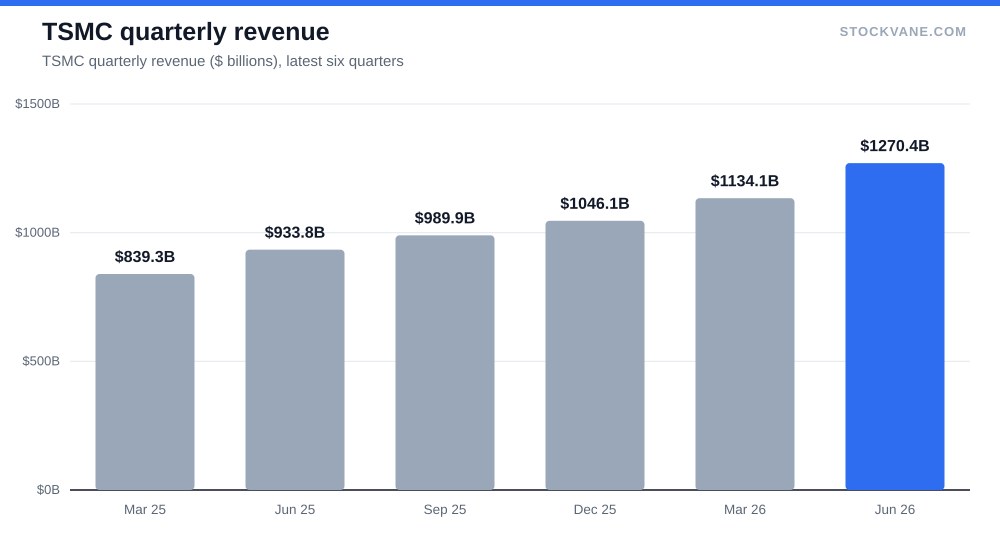
Growth has kept going this year. Quarterly revenue reached NT$1.27 trillion in the second quarter, up about 36% from a year earlier, after growth of 35% in the first. A quick note on currency: the underlying results are in New Taiwan dollars, and the shares that trade in the United States are American depositary receipts. The valuation figures below are the ADR’s own, which is what matters to a US investor, while the operating figures are the company’s own reporting.
What the growth costs
None of this is cheap to build. The cash flow statement shows the company spent about NT$1.27 trillion on property and equipment in 2025, roughly a third of revenue, and another 6.5% of revenue went to research and development. Even so, free cash flow reached NT$992 billion, about 26% of sales and 3.5 times the NT$287 billion of 2023.
I find that the most reassuring number in the file. A company that has to reinvest a third of its revenue and still generates a quarter of it as free cash is not stretching to pay for growth. It also means the business throws off real money to fund the next node without borrowing heavily, which matters in a cyclical industry where the balance sheet decides who survives a bad year.
Margins are doing as much as volume
The part of the story that gets less attention is profitability. Gross margin was 59.9% in 2025, and operating profit as a share of revenue rose from 42.6% in 2023 to 50.8% in 2025. A manufacturer earning half of every revenue dollar as operating profit is unusual, and it is the clearest sign of pricing power at the leading edge, where customers have very few alternatives.
That has an important consequence for anyone valuing the stock. Profit is growing faster than sales, which means a fair chunk of the recent gain came from margin expansion and not just more wafers. The margin can also give back, and I will come back to how much that would matter.
Dividends have followed. Per ADR, the quarterly payment rose from about $0.80 in December to $0.94 in March and June, and to $1.11 with the September payment, an increase of around 39% in nine months. At only about 0.8%, the yield gives nobody a reason to own this for income, but the direction shows how management reads its own cash generation.
The multiple next to its own history
The valuation tab shows a trailing P/E of 32.4, against a five-year average of 25.0, which puts the stock near the 83rd percentile of its own range. The price-to-sales ratio of 16.0 is about 50% above its five-year average. Against its own past, TSMC is not cheap. On forward estimates the multiple is 22.1, and the gap between the two numbers is the market saying earnings will grow about 45% again.
So the discount, if there is one, is not against the stock’s history. It is against something else.
Against everyone else
This is where the picture gets more interesting. The table below sets TSMC against other companies in the AI chip supply chain.
| Company | Trailing P/E | Forward P/E | From 52-week high |
|---|---|---|---|
| Taiwan Semiconductor (TSM) | 32.4x | 22.1x | -9% |
| Nvidia (NVDA) | 28.1x | 18.1x | -6% |
| Broadcom (AVGO) | 45.6x | 24.5x | -28% |
| ASML (ASML) | 53.2x | 30.1x | -16% |
| Applied Materials (AMAT) | 38.4x | 24.4x | -40% |
| Micron (MU) | 23.0x | 6.8x | -19% |
The industry group average for trailing P/E is 32, so TSMC sits right on it. It costs less than Broadcom, ASML and Applied Materials, all of which depend on the same buildout. It costs more than Nvidia on both measures and more than Micron. In other words, the market pays a lower multiple for the manufacturer than for the tool makers and the largest designers, and a higher one than for the leader in accelerators. There is a discount to the suppliers and none to the customer.
Two things a P/E does not show
The first is customers. A small number of very large buyers, Apple and Nvidia the most visible among them, account for a large share of leading-edge demand. That is a strength while their budgets grow, since it makes the demand predictable. It is a concentration risk if any one of them slows or moves a design elsewhere, and it is the reason a comparison with the tool makers, who sell to everyone, is not perfectly fair.
The second is the ADR itself. The shares that trade in New York are a depositary receipt for shares listed in Taiwan, and the two prices can drift apart for reasons that have nothing to do with the business. Our data does not include the local price, so I cannot say how big any gap is today. It is one more reason to treat a small percentage difference in valuation as noise and only a large one as information.
Where the discount is left
The version of the argument that still holds up is about growth. Divide the trailing P/E by the growth rate of earnings and you get a rough measure of what each unit of growth costs. For TSMC, 32.4 divided by 46.6% is about 0.7. That is a low number for a business that dominates its market, and it is why I still think the shares are not expensive for what they own.
I would not lean on it too hard. A growth-adjusted multiple is only as good as the growth rate, and 46.6% is a peak-cycle number for a company that grew 31.6% in revenue. If earnings growth slows to 20%, the same multiple looks a good deal less generous.
What a margin slip would cost
The reason I keep coming back to margins is that they carry most of the risk. If operating margin fell from 50.8% back to the 42.6% of 2023, on the same revenue, operating profit would drop about 16%. At today’s price that would lift the trailing P/E from 32 to about 39. The multiple would be the same as the market’s most expensive semiconductor names, for a company whose earnings had just fallen.
That is not a forecast. It is the scale of the sensitivity. It also explains something about how the stock trades: it has moved less than 5% on each of its last four reports, an average of about 2.9%, which is quiet for a company growing this fast. The risks that could change the picture sit in things a quarterly report rarely shows: Taiwan, customer concentration and the capital intensity of the next node.
What the analysts say
Only 7 analysts cover the ADR, and 86% rate it a buy. The analyst consensus average target of $552 sits about 27% above the recent price, and even the lowest target, $440, is a little above it. That is a thin sample compared with the 33 analysts who cover AMD, so I would not treat the consensus as a strong signal. Short interest is only about 0.6% of the float, which says nobody is betting against the company in a big way. The news feed shows Bernstein and another firm reiterating Buy ratings in early September, which fits the picture: the people who follow the stock closely like it, and there are not many of them.
| Metric | Value | Context |
|---|---|---|
| Price (approx.) | $434.67 | 52-week range $263 to $478 |
| P/E (TTM) | 32.4x | Five-year average 25.0x |
| Price-to-sales | 16.0x | Five-year average 10.4x |
| Analyst ratings | 86% buy, 14% hold | 7 analysts; average target $552 |
| Dividend yield | 0.80% |
The shares sit about 9% below their 52-week high of $478 and well above the low of $263, so the recent trend has been upward with a modest pullback. That is useful context for anyone deciding whether to act on the valuation: the price has already moved a long way, and buying now means paying for a good part of the growth in advance.
What would make the discount fair
I would call the discount fair, and stop asking whether the stock is cheap, if two things happen. Operating margin holds above 50% for two more quarters, which would suggest the pricing power is structural. And the ADR’s premium to its own history stops widening, which would say the market has finished repricing the growth.
Until then I think TSMC is a reasonable price for a business without a real rival at the leading edge, and not the bargain the headline suggests. That is a less exciting conclusion than the one I started with. It is the one the numbers support, and I would rather hold a view I can defend than one that flatters the story.
Financial disclaimer: The content on StockVane is for educational and informational purposes only and should not be construed as professional financial advice. Stock market investing involves risk of loss.