
Marriott’s entire net property line, every hotel it owns plus offices and equipment, is $2.9 billion. The company is worth $88.4 billion. That is roughly 30 dollars of market value for each dollar of property on the books, and it is the cleanest way to see what an investor is actually buying.
The valuation tab shows a price-to-book ratio of -19.5, against a five-year average of -1.5. A negative number looks like an error. It is not. Shareholders’ equity was $-3.8 billion at the end of 2025, negative for the third year running. The interesting question is not whether that is bad, since for this model it is normal, but who funds it and how far it can go.
My view: Marriott earns fees on other people’s buildings, which is why it deserves a premium multiple, but the negative equity is being widened by buybacks that now exceed free cash flow, and at 35.1 times earnings there is little room for that to go wrong. The rest of this piece tests each half of that sentence with numbers.
What “asset-light” looks like on the balance sheet
Total assets were $27.5 billion at the end of 2025. Net property and equipment was $2.9 billion, or 11% of assets. Goodwill and other intangibles were $19.2 billion, 70% of the total. Those intangibles are mostly acquired brands and contract rights, which is what a fee collector’s assets look like.
Capital spending was $604 million in 2025, 0.0% of revenue. Gross property was only $3.8 billion in total, with $947 million of accumulated depreciation against it, so the fleet is small. A company that owned its hotels would spend that much on a single large renovation cycle.
The database cannot count rooms or properties, so I am not going to give you a hotel tally. The balance sheet is enough of an answer to the title.
Growth that does not need capital
Revenue reached $26.2 billion in 2025, up 4% on $25.1 billion. Since 2022 it has gone from $20.8 billion to $26.2 billion, which is a 26% gain, though 2022 was still a pandemic-recovery year and the pace has slowed each year since: 14% in 2023, 6% in 2024, 4% in 2025.
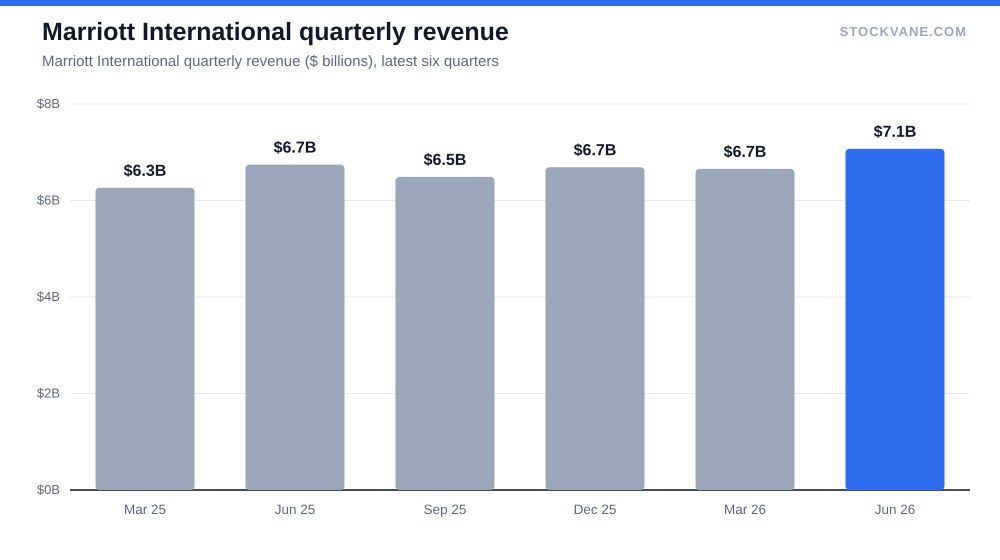
The June quarter was $7.1 billion, up 5% from a year earlier and up 6% on the quarter before. Operating income was $4.1 billion for the year, a 16% operating margin. It was $3.5 billion at a 16.9% margin in 2022 and $3.8 billion at 15.3% in 2024. I am using the operating margin throughout. The EBIT margin in the database (16.1%) is nearly the same, so nothing turns on the choice.
Diluted EPS was $9.51 in 2025, up 14% from $8.33 but still below the $10.18 of 2023. That matters for the multiple. The stock trades on 35.1 times trailing EPS of $9.66, and on 28.1 times the $12.05 that analysts expect, which implies 25% growth. A 25% jump is a large ask from a business growing revenue at 4% to 5%. It needs margin gains or a lower share count, and a lower share count is the point of the next section.
The buyback line is bigger than the cash line
Here is the part I would read twice. In 2025 Marriott generated $3.2 billion of operating cash flow and $2.6 billion of free cash flow after $604 million of capex. It spent $3.2 billion on net share repurchases and $718 million on dividends, a total of $3.9 billion. That is 151% of free cash flow.
The gap was filled with debt. Net debt issuance was $1.7 billion. This is not new: repurchases were $3.9 billion in 2023 and $3.7 billion in 2024, against free cash flow of $2.7 billion and $2.0 billion. Three years running, the company returned more than it earned in cash, and borrowed the difference.
The consequences show up in two places. Equity fell from $-0.7 billion in 2023 to $-3.0 billion in 2024 to $-3.8 billion in 2025. Treasury stock, the cumulative cost of shares bought back, rose from $20.9 billion to $27.9 billion in two years. And debt rose.
Total debt was $17.1 billion at year end: $1.2 billion current and $15.9 billion long term. In 2023 the long-term figure was $12.2 billion. Cash was only $0.4 billion, which is normal for a fee business but leaves no cushion. Net debt of about $16.7 billion is 3.5 times operating income plus depreciation (my arithmetic, not a company-reported EBITDA). That is a level lenders accept for a franchisor with predictable fees. It is also a level that does not leave room to keep spending above cash flow for many more years without a slowdown in the returns.
I do not think this is a solvency story. The company can slow repurchases at any time, and the fee stream is contractual. It is a story about what the per-share growth is made of. When a company shrinks its share count with borrowed money, EPS growth outruns net income growth. Net income rose 10% in 2025 while EPS rose 14%. The difference is the buyback.
Cash generation, in fairness, is steady rather than spectacular. Operating cash flow ran $3.2 billion in 2023, $2.7 billion in 2024 and $3.2 billion in 2025, which is a company earning about 12% of revenue in operating cash. Net income moved in the same narrow band: $3.1 billion, $2.4 billion, $2.6 billion. If you had to describe the past three years in one line, it would be stable cash with a rising claim on it from repurchases. The stability is what makes the borrowing tolerable. The rising claim is what makes it worth watching.
What the market is paying for
The dividend is a small part of the return. Marriott paid $2.74 per share over the last year, a yield of 0.81%, and $718 million in total, 28% of free cash flow. Nobody buys the stock for income. For the general trade-off see our note on yield versus dividend growth.
At $338.92 the stock sits 17.4% below its 52-week high of $410 and 33% above the low of $255. The trailing P/E of 35.1 compares with a five-year average of 37.1, a lodging-group average of 34.6 and a five-year band of 10.2 to 64.0, which puts today at the 76th percentile of its own range. Price to sales is 3.3 against 3.1 on average.
| Metric | Value | Context |
|---|---|---|
| Price (approx.) | $338.92 | 52-week range $255 to $410 |
| P/E (TTM) | 35.1x | Five-year average 37.1x |
| Price-to-sales | 3.3x | Five-year average 3.1x |
| Analyst ratings | 50% buy, 50% hold | 18 analysts; average target $391 |
| Dividend yield | 0.81% |
A premium is defensible. A fee model with 16% operating margins and 4% to 5% growth deserves more than a hotel owner would. I made a similar argument about a different premium in our Costco note, where the question was also whether the multiple assumes too much. Here the multiple is at its own average, not above it, and that is the point in Marriott’s favor.
Sentiment is balanced. Of 18 analysts, 50% rate it a buy and the rest a hold. The average target is $391, 15% above the price, with a range of $360 to $425. Even the lowest target is 6% higher. The quant score in our tool is a D, unchanged since September 14, and short interest is 2.7% of float. The reaction to the August 3 report was -7.0%, against an average move of 5.0%. Reading earnings reports for this kind of split reaction is covered in our earnings guide.
Why negative book value is not the warning
A skeptic will point at the -19.5 and say the company has spent more than it owns. That reading confuses accounting history with economic value. Book equity records what was paid in and earned, less what was returned. Marriott has returned so much, $27.9 billion of treasury stock against $18.4 billion of retained earnings, that the ledger went below zero while the fee stream kept growing. The five-year average price to book is -1.5, so the ratio was already negative before this year, and the lodging group averages 6.1. Marriott sits far from that group because its returns have outrun its retained profit.
What would prove this wrong
I would be wrong if the buyback pace can be sustained without more debt. That needs free cash flow to rise from $2.6 billion toward the $3.9 billion the company is returning, roughly a 50% increase. On $604 million of capex and 16% margins, that requires revenue growth above what it has been printing, or a lower dividend-plus-buyback budget.
The other way I would be wrong is on the multiple. If the forward EPS of $12.05 is right, 28.1 times is not expensive for this quality. The risk to that is the same one as in the debt discussion: some of that 25% growth comes from a shrinking share count, and a share count cannot shrink with borrowed money forever.
I am not covering RevPAR, room pipeline or franchise fee rates. The database does not carry them and I would rather leave those to the company’s own disclosures than paraphrase from memory.
The buyback line to watch
Watch the next repurchase figure against free cash flow. If net buybacks come in below $2.6 billion, the funding gap closes and the negative equity stops widening; that is the version of Marriott that deserves 35 times earnings. If they stay near $3.2 billion again with debt above $17 billion, the multiple is paying for financial engineering, and I would not pay it.
Financial disclaimer: The content on StockVane is for educational and informational purposes only and should not be construed as professional financial advice. Stock market investing involves risk of loss.
Sources: Marriott International SEC filings (EDGAR) (https://www.sec.gov/cgi-bin/browse-edgar?action=getcompany&company=marriott+international&type=10-K&dateb=&owner=include&count=10).