
The quote page for Honeywell shows a dividend yield of 4.55% and a trailing dividend of $9.40 a share. The dividend record in the database shows something else: $1.19, $1.19, $1.19 and then $0.70. Add those four and you get $4.27 a share, or 2.1% at today’s $206. I have used the payment record throughout this piece, because the per-share fields in the data appear to sit at about twice the declared amounts (the 2025 figure of $9.16 is exactly double the $4.58 actually paid), and a yield that overstates the income by a factor of two is not one I would hand to anyone weighing a dividend.
That data wrinkle matters less than the event itself. On the August 14 ex-date, Honeywell paid $0.70, 41% below the $1.19 it had paid for the previous three quarters, while the company is in the middle of separating into three public companies. The headline asks what happens to the dividend. My answer, in one sentence: the cut has already happened, the cash flow behind the new rate is strong (about 3.0 times covered on last year’s numbers), and the open question is not whether $0.70 is safe but how much income the three pieces will replace it with once they trade on their own.
What the ledger says
Nine dividends sit in the database since August 2024. The first, in August 2024, was $1.08. Then $1.13 for four straight payments, a step up to $1.19 that held for three, and finally $0.70. For context on why a rising payout and a high yield are different goals, our comparison of high dividend yield against dividend growth is the frame I would use here: Honeywell was a dividend-growth holding until August and is now something closer to a yield story with a smaller payment. The three-year dividend growth rate in the database, about 4.9% a year through 2025, ended in a single quarter.
At $0.70 a quarter the annual rate is $2.80, which is 1.36% of the $206 price. At the old $1.19 rate the yield would have been 2.31%. So the cut takes about 0.9 percentage points of yield off a stock that did not offer much to begin with. Anyone who bought Honeywell for income lost two-fifths of it in one payment, and the recent price does not make up for the loss: the shares closed at $206, 23.2% below the 52-week high of $269.
I can say when it happened. I cannot say why. The database holds no news item that ties the reduction to the separation, and I will not supply a cause the data do not contain. My reading is that a rebasing before a separation is the natural explanation, since the parent’s payout would normally shrink as businesses leave, but that is inference. It could equally reflect the capital needs of the split. The investor-relations materials are the place to settle that.
Coverage before the cut was already comfortable
Cover is where the case is strongest. The cash flow statement shows that in 2025 Honeywell paid $2.98 billion in cash dividends and generated $5.42 billion of free cash flow, which is 1.82 times cover. Net income was $4.77 billion, so the payout against earnings was 62%. Those are unremarkable figures for a large industrial, and neither suggests that the company had to cut.
| Item (fiscal 2025 unless noted) | Amount |
|---|---|
| Cash dividends paid | $2.98 billion |
| Free cash flow | $5.42 billion |
| Cash cover (free cash flow / dividends) | 1.82x |
| Net income | $4.77 billion |
| Payout against net income | 62% |
| Estimated annual cost at $0.70 a quarter (share count unchanged) | $1.82 billion |
| Cash cover at the new rate | 3.0x |
| Net debt (total debt less cash and short-term investments) | $22.6 billion |
Put the new rate through the same arithmetic. If the share count is unchanged, $0.70 a quarter costs about $1.82 billion a year, against $5.42 billion of last year’s free cash flow, so cover would rise to about 3.0 times and the payout on earnings would fall to about 38%. The dividend was not cut because the cash was missing. A payout that could have been sustained was lowered by choice, which is what makes the corporate action the real story.
That reading needs one caveat. The free cash flow figure is for 2025 and describes the business as one company. The businesses that stay with the parent will carry a different profit and capital-spending profile, and the database does not carry a pro forma statement for any of the three pieces.
The company being divided
Revenue reached $37.4 billion in 2025, up 8% from $34.7 billion in 2024. Profit went the other way. The database’s EBIT margin fell to 18.2% from 21.5% the year before, and net income dropped to $4.8 billion from $5.7 billion. Revenue grew and net income shrank by 17%. That combination is the background to any conversation about breaking up a company: the pieces are being asked to earn more than the whole was earning.
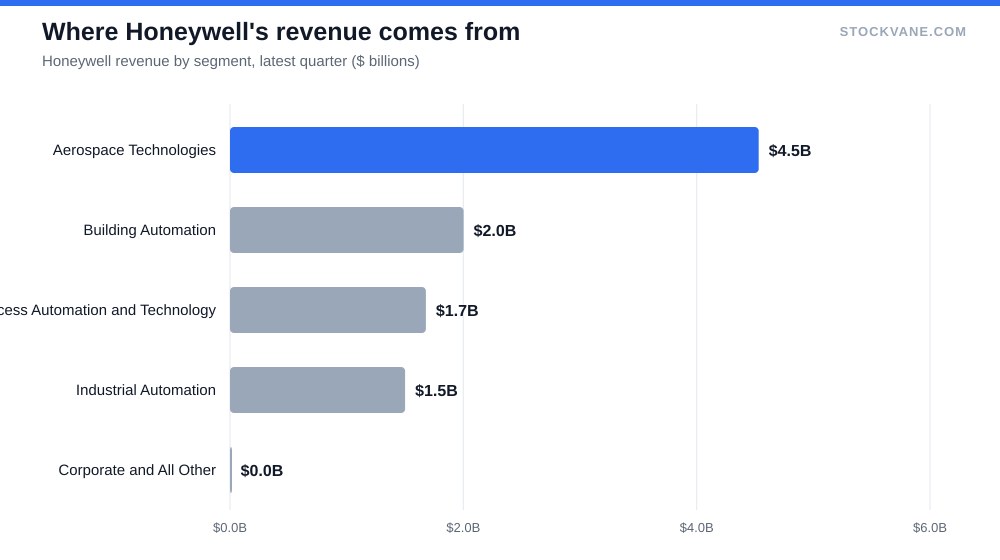
The latest quarterly report shows revenue of $9.7 billion, 4% above a year earlier. Aerospace Technologies contributed $4.53 billion of it, or 47%. The three automation lines together (Building Automation at $2.00 billion, Process Automation and Technology at $1.68 billion, and Industrial Automation at $1.50 billion) made up the remaining 53%. The database segment table lists no advanced-materials line for that quarter, so I cannot size the third company from it, and I will not guess.
For an income investor the interesting question is how those two big halves will pay. An aerospace business with a long aftermarket tail can support a steady payout; an automation business that sells into building and process customers tends to be more cyclical. That is my generalization, not a measurement, and the company’s own guidance for each dividend policy is what matters.
What the price is saying
Shares fell from a $242.32 month-end close in July to $213.53 in August and $206.46 in September, a drop of about 12% in one month and 15% since July. The July report itself drew a +5.7% move on 2026-07-23, against an average earnings move of 5.0%. I have no news item explaining August, so I will only note that the fall coincides with the lower payment and leave attribution alone.
The analyst survey is more confident than the tape. Twelve analysts have a mean target of $264, 28% above the price, and 67% rate the stock a buy. The lowest target, $250, is still 21% above the close. Our own quant score is a D, down from a B on September 15. When a 12-analyst consensus and a rules-based score disagree that widely, I would trust neither on its own. The forward P/E of 23.7 (see the valuation tab) sits just under the five-year average of 24.9, so the stock is not obviously cheap on the number that matters to the split. The trailing multiple of 8.0 in the data is a share-basis artifact and I have left it out.
Short interest is not the story. 2.0% of the float is sold short, which is low for a stock down 23.2% from its high.
Two ways to read the cut
Before choosing between them, hold the dollars in mind. The cut removes roughly $1.16 billion a year from shareholders’ pockets if the share count has not changed, which is about 21% of last year’s free cash flow that now stays inside the company. Someone decided that money is worth more there than in payouts, and that decision is the thing the two readings below try to explain.
The optimistic reading is arithmetic. The dividend cut takes $1.96 a year off each old share ($0.49 a quarter). If the two or three new companies together pay at least that, an investor who keeps every piece is whole. The gap to fill is 0.95% of today’s share price. That is a small number to earn back from separate businesses that will each pick a payout policy on their own.
The pessimistic reading is that a rebasing this large, before the split has even completed, may signal that management wants to keep cash for the separation itself. Debt at the end of 2025 was $35.6 billion against $12.9 billion of cash and short-term investments, a net $22.6 billion. That is 3.4 times the year’s $6.57 billion of operating income. Splitting a company does not retire debt; it allocates it, and the allocation will decide which piece has room to pay.
I do not think the data lets anyone choose between those two stories today. What they do allow is a threshold. Whichever one is right, the 0.95% of price is the amount that has to come back as new dividends for the cut to have cost nothing.
The payment I would look for in November
The next test is the November payment. If Honeywell holds $0.70, then the August number was a reset and the coverage arithmetic above stands. A second reduction would say the first was not the last, and I would treat the stock as an income holding no longer. If the separation completes and the parent and its new siblings together pay less than $1.19 in total per old share, the investor has lost income on the whole deal and the 4.55% figure on the quote page should be ignored. Above $1.19 combined, the cut looks like housekeeping.
Financial disclaimer: The content on StockVane is for educational and informational purposes only and should not be construed as professional financial advice. Stock market investing involves risk of loss.
Sources: Honeywell SEC filings (EDGAR) (https://www.sec.gov/cgi-bin/browse-edgar?action=getcompany&company=honeywell&type=10-K&dateb=&owner=include&count=10).