
“Safer” is a relative word, and in this comparison it is doing a lot of work. One company earned $3.85 billion last year and trades at 337 times those earnings. The other lost $541 million last quarter, spent $18.4 billion on equipment and data centers in the same three months, and has been public for barely three months. Neither one is safe. The useful question is which risk you would rather carry.
My answer is Tesla, narrowly, and for a reason that has little to do with either company’s technology. I will get to it. First the facts, because they have moved since the first reports.
Tesla’s second quarter
Tesla reported second-quarter results on July 22, and by CNBC’s account the report missed on profit while beating on revenue. Revenue was a record $28.2 billion, up 26% from a year earlier. Diluted earnings were $0.32 a share. Operating income fell to about $398 million, a 1.4% margin. Operating cash flow was $4.70 billion, capital spending was $5.79 billion, and that left free cash flow at negative $1.09 billion. The stock fell 14.5% in the session that followed, Tesla’s worst day in more than a year.
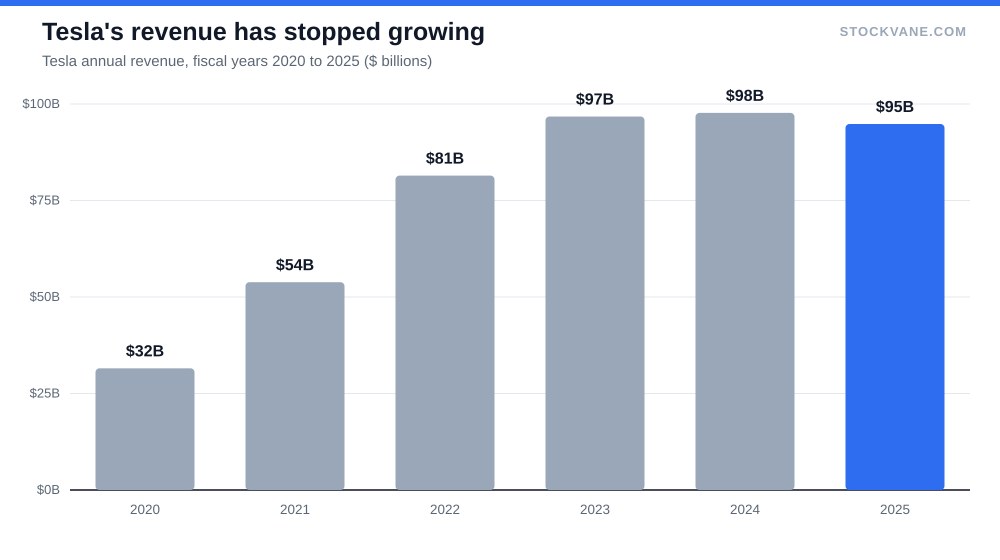
It has since recovered part of that. At about $364, the shares are roughly 19% below their December 2025 close and 27% below the 52-week high of $499. The financials tab shows why the market is nervous. Revenue was $94.8 billion in 2025, lower than the $96.8 billion of 2023, and net income of $3.85 billion was about 74% below the $14.97 billion of two years earlier. Tesla is bringing in about the same revenue as before and keeping far less of it.
| Tesla (TSLA) | SpaceX (SPCX) | |
|---|---|---|
| Latest quarterly revenue | $28.2 billion, up 26% | $7.8 billion, up 92% |
| Profit | Diluted EPS $0.32; operating margin about 1.4% | Net loss of $541 million |
| Capital spending, latest quarter | $5.79 billion (about 21% of revenue) | $18.4 billion (about 236% of revenue) |
| Free cash flow | Negative $1.09 billion | Not in the reports we reviewed |
| Share price (approx.) | $364; 52-week range $297 to $499 | About $153 in mid-September; IPO at $135; peak near $211 |
| Reaction to latest report | -14.5% the next session | Down in after-hours trading |
| P/E (trailing) | 337x | Not meaningful (net loss) |
| Analyst view | 46% buy, 46% hold; average target $402 | Not in StockVane data |
The auto business is not the small, forgotten piece some commentary implies. In the latest quarter it still produced about 89% of revenue, and the energy storage business added about 11%. The storage business is now a real contributor rather than a footnote.
SpaceX’s first report as a public company
SpaceX priced its IPO at $135 a share on June 11 in what was reported as the largest offering ever, valuing the company at about $1.77 trillion. It closed its first session at $161, up 19%. The shares then peaked near $211 and fell by roughly half into late July, to a low near $105, before recovering. In mid-September they were trading around $153, which is about 28% below the peak and about 13% above the IPO price. Our database does not yet cover SpaceX, so these prices come from published reports and should be checked against a live quote.
The first earnings report came on August 4. According to Fortune’s summary, revenue was $7.8 billion, up 92% and nearly $1 billion above what analysts expected. Starlink brought in $4.29 billion with 12 million subscribers and an operating margin near 39%. The AI segment brought in $2.6 billion, up 247%, though it lost $1.26 billion at the operating line. The company reported a net loss of $541 million. The stock fell in after-hours trading. The number that stood out was capital spending.
The number that decides the comparison
SpaceX spent $18.4 billion on capital projects in the quarter, about $15.8 billion of it in the AI segment. Annualized, that is roughly $73 billion a year, well above the roughly $49 billion analysts had modeled. Against $7.8 billion of revenue, it is a capital budget of about 236% of sales. Tesla’s $5.79 billion of capital spending against $28.2 billion of revenue is about 21%.
Both companies are spending ahead of revenue on the same bet, that heavy investment in AI infrastructure will pay for itself. The difference is how much rides on it. Tesla is funding its bet partly with a car business that still generates about $28 billion a quarter. SpaceX is funding a much larger bet with a business that generates a bit over a quarter of that, plus a $100 billion cash cushion from the IPO and a $25 billion bond offering. That cushion covers a bit over a year of spending at the current pace. That is comfortable, but it is not permanent.
For a broader look at whether this kind of spending pays off, our piece on the AI capex bubble lays out the historical parallels, including the ones I would rather not repeat.
Why the valuations cannot both be right
Tesla trades at 337 times trailing earnings, against a five-year average of 162, so investors already pay more than twice the usual multiple for profits that have fallen. The price-to-sales data tells the same story. A multiple that high does not describe a car company. It describes a bet that autonomous driving and humanoid robots will turn into large, profitable businesses. The analyst consensus is nearly evenly split, with 46% rating the stock a buy and 46% a hold. The average target of $402 sits about 10% above the current price, and the lowest target, $130, sits about 64% below it. When professionals disagree by that much, the honest reading is that nobody knows what the robotaxi business is worth.
SpaceX has no earnings to divide by, so its valuation rests entirely on growth: 92% revenue growth and a Starlink business earning real operating profit. The trouble is time. It has been public for a quarter. It has no history of how it behaves when the first thing goes wrong, and it has a schedule of share unlocks running into December, with the founder’s shares locked until the following summer. The first unlock on August 6 released more than 900 million shares and, unexpectedly, the stock rose 6% that day. Later unlocks may not be so kind. A stock with so little history also has few holders who have sat through a bad quarter, so early price moves can run larger than the business news behind them. That is a reason to treat the first six months of any new listing with extra caution, however good the first report looked.
The tests in the next reports
For Tesla, the third-quarter report expected in October has three things to prove. The operating margin has to climb back from 1.4%, free cash flow has to stop being negative, and the robotaxi program has to grow past a handful of cities with real fleet numbers attached. Any one of those would change the tone. All three missing again would make a multiple of 337 hard to defend.
For SpaceX, the tests are different. The AI segment’s operating loss fell from $2.47 billion in the first quarter to $1.26 billion in the second, and that trend needs to continue while capital spending stays near its current pace. Starlink added about 1.7 million subscribers in the quarter, so the next report should show whether that rate holds. And the unlock calendar matters more than usual, because a stock with a thin trading history reacts to supply.
Where I lack an answer
I do not know whether SpaceX’s AI segment will ever earn a return on the tens of billions going into it, and neither do the analysts who covered the quarter. Starlink is the piece I can evaluate: 12 million subscribers, $66 a month per user, a margin near 39%, and growth of 66%. The AI segment is still a plan.
I also do not know whether Tesla’s operating margin of 1.4% is a trough or a new normal. The company says the spending is building a platform. The income statement says the platform has not paid off yet, and the stock closed June near $421 and July at $311. That is not a path for someone who wants to sleep well.
Where the two overlap in your portfolio
If you own a Nasdaq-100 fund, you own both, in proportion to their size. That includes the triple-strength version we reviewed in our TQQQ breakdown, where a 14.5% single-day drop in one holding hits harder than it would in a plain index fund. SpaceX joined the Nasdaq-100 within weeks of listing, according to reports, so the exposure is not hypothetical.
If you trade Tesla around its reports, our list of costly Tesla mistakes is a useful check before the next one.
Safer is not the same as cheaper
Here is the reason I lean toward Tesla. It has more than a decade of public results, a profitable core, a segment that is growing without drama, and a fall from its highs that has already happened. Its risk is a very high multiple, and that risk is visible. SpaceX is the better-growing business and quite possibly the better long-term one. But it has three months of trading history, a net loss, a capital budget that dwarfs its revenue, and a supply of locked shares still to come. Its risks are less visible and less tested.
I would not buy either as a safe holding. If a position in a Musk company is going into a portfolio, I would size it so that a 40% to 50% drop, the kind SpaceX has already shown and Tesla has come within reach of from its high, would be an annoyance and not a problem. That is the only definition of safer that I trust.
Financial disclaimer: The content on StockVane is for educational and informational purposes only and should not be construed as professional financial advice. Stock market investing involves risk of loss.
Sources: Price-to-earnings ratio (SEC Investor.gov glossary) (https://www.investor.gov/introduction-investing/investing-basics/glossary/price-earnings-pe-ratio) · How to read a company's 10-K (SEC Investor.gov) (https://www.investor.gov/introduction-investing/investing-basics/glossary/10-k)