
Six dollars a share. That is what I was paid, in premium, to promise to buy Baidu at $80, which puts my breakeven at $74. When the ADS fell as much as 13% on August 18, it was that six dollars I thought about first, because it defines how much of a bad day the position can absorb before it costs me anything.
Four days before the report I had told readers I sold a cash-secured put on the stock, with the strike below the 52-week low and the reasoning laid out in my August preview. The report was bad. My view after reading it is that it sharpened the risk I already accepted, China-specific and structural, without adding a new one, and that I should do nothing with the put for now. The rest of this piece is why, and what would make me stop doing nothing.
What the numbers said
Baidu reported on August 18. Revenue was RMB 31.3 billion, about $4.62 billion, down 4% from a year earlier and below the roughly $4.65 to $4.74 billion analysts had expected. Earnings were $1.06 per ADS against forecasts of $1.35 to $1.46, a miss of about 21% to 27%. A 4% revenue shortfall does not explain a 13% intraday drop. The segments do.
Online marketing services, the search-ad business that has paid for Baidu’s ambitions for two decades, fell 19% to RMB 13.1 billion. It was not a single soft quarter. Ad revenue has now declined for several quarters running, and the cause looks structural: users are moving from a search box to AI chatbots and short video, and cautious advertisers are trimming budgets on top of that. Management said on the call to expect the pressure to continue through the second half. Companies rarely say that about a problem they think they can fix quickly.
| Line | Q2 2026 revenue | Change vs a year earlier |
|---|---|---|
| Total revenue | RMB 31.3B (about $4.62B) | -4% |
| Online marketing services | RMB 13.1B | -19% |
| AI-powered business, total | RMB 12.5B | +25% |
| of which AI Cloud | RMB 7.3B | about +50% |
| of which GPU Cloud | Small base | +283% |
| iQIYI streaming | RMB 6.3B | -5% |
The other side of the report is stronger. The AI-powered businesses grew 25% to RMB 12.5 billion. Within that, AI Cloud rose about 50% to RMB 7.3 billion, and GPU Cloud, which rents out raw computing capacity for training and inference, rose 283% from a small base. iQIYI, the streaming arm, slipped 5% to RMB 6.3 billion but grew a little from the previous quarter.
Put the two lines side by side. Advertising, at RMB 13.1 billion, is still slightly larger than the whole AI-powered business at RMB 12.5 billion, about 1.05 times its size. The ad line is shrinking by a fifth and the AI line is growing by a quarter. Those curves cross, but not yet, and the gap between them is where the stock has to live.
Why a 4% miss became a 13% drop
Two things turned a poor quarter into a violent day. Fitch cut Baidu’s credit rating from A to A-, citing the structural decline in search advertising. Rating agencies move slowly, so I read that as a statement that the earnings base has reset lower, not dipped.
The other was how analysts split. Barclays cut its target to $124. Bank of America trimmed to $165 but kept a Buy. When some analysts lower their numbers and others still think the stock is cheap after the cut, the argument is no longer about whether advertising is deteriorating. It is about whether the price already covers it, which is the question our August fundamentals preview posed before the numbers arrived. The average target I saw was near $166.
One operating detail belongs in the risk list. Apollo Go, the robotaxi unit, said ride volumes were affected by operational adjustments in some domestic cities for regulatory reasons. Autonomous ride-hailing is the most exciting long-term option Baidu holds, and it carries local-government risk on top of the usual execution risk. I treat it as an option, not part of my case.
The price, and why cheap is not proof
The ADS settled in the low $90s and was down roughly 35% for 2026. Forward P/E was around 14 and EV/EBITDA near 3.4. In a healthy grower those would look like a gift. Here the market is either pricing genuine structural decline or overreacting, and reasonable people are reading the same figures and reaching opposite answers. I do not think the multiple settles it. A low multiple on falling earnings can stay low for a long time, and that is the honest counter-case to my own position.
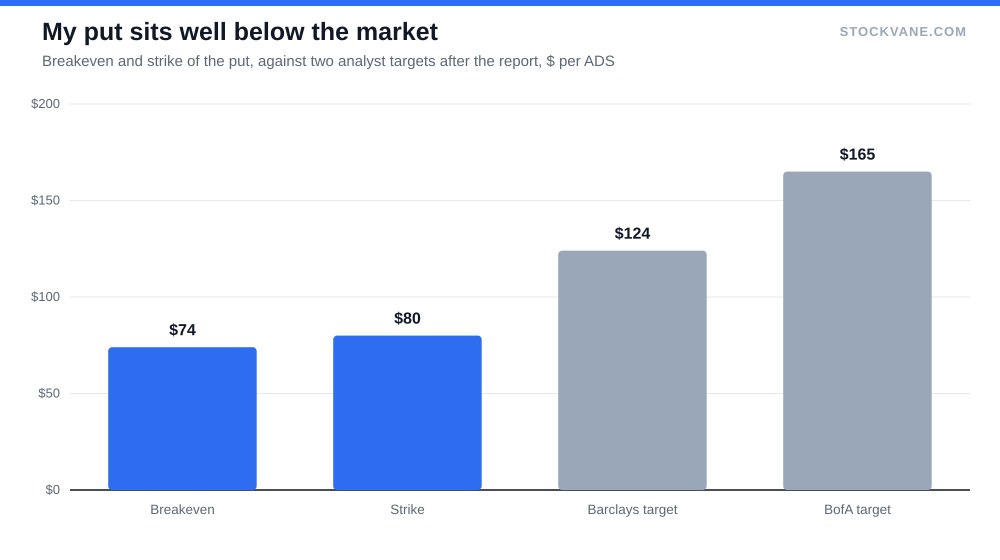
The chart above is the whole trade in four bars. My breakeven and strike sit far below both analyst targets, and even the lower target, Barclays at $124, is above the price after the drop. That gap is comfortable only if the targets mean something. Analysts had targets well above the price before this report too, and they cut them, so I lean on the strike and breakeven, which are fixed, more than on any forecast, which is not.
How I checked the position
I did the same four things I would tell anyone to do after a bad report on a position they hold.
Start with the segment, not the headline. Revenue and earnings misses tell you little until you see which line moved and whether your thesis already contained it. My thesis assumed pressure on ads. It did not assume this much.
Then read what management said about the next two quarters. “Pressure will persist” is a specific negative statement, and I take it literally.
Third, compare growth rates, not dollar sizes. GPU Cloud up 283% on a small base against ads down 19% on a large one is a race with a clock on it, not a vague sentiment about AI.
Last, go back to the entry logic, and be honest about whether you would still enter today. My thesis was never that Baidu’s ad business thrives forever. It was that the balance sheet and the AI optionality made the stock worth owning at $74 a share. That has been tested. It has not been broken. If you want to see how the payoff works before selling a put yourself, run it through the options profit calculator first.
What I am doing with the put
Nothing, for now. My strike of $80 sits roughly 13% below the low-$90s price and my $74 breakeven roughly 20% below it. Even on the worst tick of the day the stock stayed well clear of $80. My delta going into earnings was in the 0.15 to 0.20 range; it has risen with the drop, but the cushion is still wide. Each contract ties up $8,000 of cash, and if I am assigned I will own the shares at an effective $74, so the question is whether I am content to own Baidu there. The mechanics of a real BIDU put are covered in our IBKR walkthrough.
I am, at that price and with that much cash set aside. The alternatives are worse. Buying the put back at a loss to stop the discomfort, or doubling down to average into conviction, are both the kind of emotional trade I have warned readers against for years. I would rather not become the cautionary example in my own archive.
It was still not a pleasant 24 hours. Watching a stock you have strike exposure to lose 13% produces a stomach-drop that no pre-computed breakeven fully cancels. I checked the position more times that afternoon than I would admit in a column where I tell readers not to.
Some of the discomfort was information. The report told me the ad decline is broader and more persistent than I assumed, and I am marking that down in my own notes as a miss on my side, not the market’s. Being early with a valuation argument is a normal way to be wrong.
Two limits on all of this. The position is concentrated in one China-listed company, and I would not size a put like this to a number I could not afford to be assigned. And everything above is my read of one report, made the day after it, so the assessment will age.
A word on what I am not covering. I have not modeled Baidu’s cash generation or its investments in chips and data centers, because I do not have figures for them in front of me that I would trust, and GPU capacity is expensive to add. If cloud growth needs heavy spending to sustain, the segment can grow triple digits and still not repair group profit. That is a second reason I would not treat the growth rate as the only test, and it is why I would read the margin commentary alongside it.
The GPU Cloud number I would check in November
Over the next two quarters I am watching two figures and ignoring the daily quote. The first is GPU Cloud growth. If it holds anywhere near triple digits, the AI segment has a chance of filling the advertising hole before my June 2027 expiry. If it slows below 100%, the cross of the two curves moves out of reach and I would consider closing the put. The second is whether “pressure will persist” turns into a visible floor in ad revenue: a decline that narrows below 10%, from 19% now. A floor changes the risk on this position. A second leg down changes it the other way.
Financial disclaimer: The content on StockVane is for educational and informational purposes only and should not be construed as professional financial advice. Stock market investing involves risk of loss.
Sources: Price-to-earnings ratio (SEC Investor.gov glossary) (https://www.investor.gov/introduction-investing/investing-basics/glossary/price-earnings-pe-ratio) · Stock options tax topic (IRS) (https://www.irs.gov/taxtopics/tc427)