
Salesforce stock jumped 22.6% the day after its August 26 report. Our own quant score for it, as of September 20, is 28 out of 100, a D. On September 8 that score was 71, a B. One company, three weeks, and two tools that disagree about it by almost the width of the scale.
I read the disagreement as the whole story on Salesforce right now. The price says the AI worry has eased. The score says the underlying numbers, growth in the low double digits and a stock that still trades 11% below its 52-week high of $267.80, have not earned a top grade. My view: at $237.92 the market is paying for a business that can still grow 10% a year at a low-20s margin, and it is not yet paying for Agentforce doing anything more than defending that.
The number Agentforce has to move
Every enterprise software company now says its AI agents will change what it can charge per customer. Salesforce has said it louder than most, so the useful question is what the reported figures show. On the financials page, revenue for fiscal 2026 was $41.52 billion, up 10%. The year before it grew 9%, and in fiscal 2022 it grew 25% off a base of $21.25 billion.
Quarterly revenue over the last four periods runs $10.26 billion, $11.20 billion, $11.13 billion and $11.35 billion, and the growth rates are 9%, 12%, 13% and 11%. That is a company that has stopped decelerating, and it is not a company that has reaccelerated. For the AI story to justify a higher multiple, that 11% needs to become 14% or 15%. Nothing in the data yet shows that.
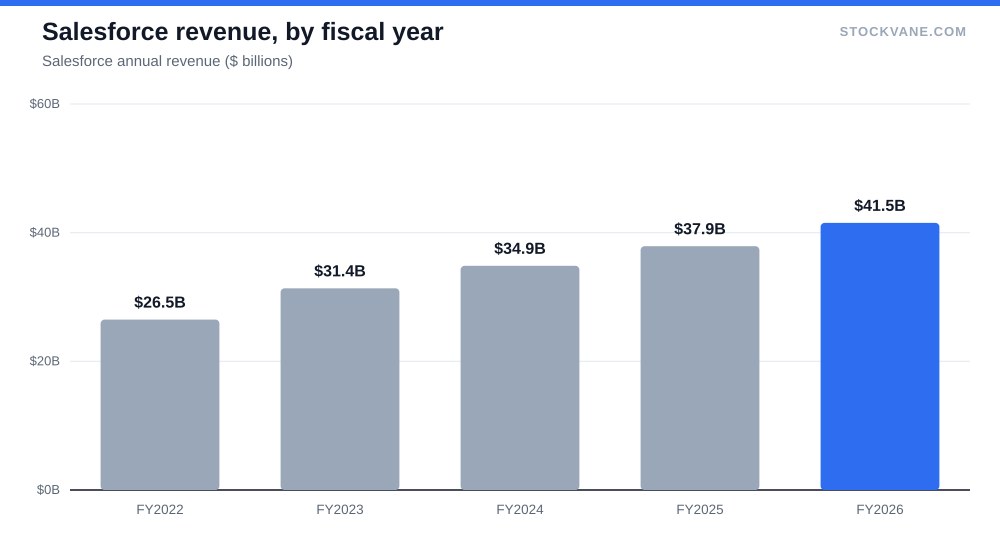
I would not blame AI for the earlier slowdown. Salesforce grew for years by buying companies, and the 25% growth in fiscal 2022 came off a base half the size. At $41.5 billion of annual revenue, adding a point of growth means adding about $415 million in sales. That is the arithmetic that limits any software company of this size, whatever technology cycle it is in.
Profit is the part that changed
Operating margin is where the last three years actually happened. Operating income was $0.46 billion in fiscal 2021, 2.1% of sales. It rose to 5.9% in fiscal 2023, then 17.2%, 20.2% and 21.5% in fiscal 2026, when operating income reached $8.92 billion and net income $7.46 billion. Earnings per share are $7.80.
That is roughly a twenty-fold gain in operating profit on revenue that a little less than doubled. I would be careful about crediting a single cause, and the database doesn’t say what drove it. My reading is that cost discipline after years of acquisition-led growth did most of it, which means the easy part of the margin story is behind the company. A margin that goes from 5.9% to 21.5% can’t repeat that path. The question from here is whether it can drift from 21.5% toward 25%, and that depends on how much agent-related computing costs the company absorbs.
At the current price the stock trades at 21.8 times trailing earnings, against 27.2 for its industry group on the valuation tab. I will not lean on the five-year average P/E, because fiscal 2023 earnings of $0.21 a share push it to 177.7, a number that means nothing. The price-to-sales ratio is a cleaner guide: 4.9 times against a five-year average of 6.7 and an industry figure of 5.2. That puts the stock near the bottom of its own five-year band.
What the revenue lines say about Agentforce
The latest quarter’s segment split is $7.19 billion under “Agentforce Apps”, $3.62 billion under “Data 360, Headless Platform, and Other”, and $525 million in professional services. Together they are 63%, 32% and 5% of the quarter.
Do not read the first line as $7.2 billion of AI revenue. I read it as a renamed bucket that still holds the traditional application clouds, since a business that generated that much from autonomous agents would show up in the growth rate, and 11% growth says otherwise. Salesforce does not break out Agentforce revenue in the data we have, so the best evidence of adoption is still indirect.
What Agentforce changes, if it works, is the pricing unit. The product is priced partly on consumption, meaning revenue can grow with how much work the agents do instead of with the number of human seats. That is a real change in the model, and it is also a source of uncertainty. Usage-based revenue is harder to forecast than a seat contract, and analysts have less history to model it on.
One more comparison helps size the margin gain. In fiscal 2024 operating income was $6.00 billion; two years later it is $8.92 billion, up about 49% while revenue rose 19%. Profit growing more than twice as fast as sales is the reason the multiple looks modest today. It is also the reason I would not count on a repeat: once margins stop expanding, earnings growth falls back toward the revenue growth rate of roughly 10%, and a stock priced for more than that has little cushion.
The moat is switching costs, not artificial intelligence
The argument that Salesforce’s data makes its agents better is directionally right and easy to overstate. A customer-service agent needs case history and purchase records, and those sit inside Salesforce for existing customers. But Microsoft’s Dynamics suite bundles with the Microsoft 365 subscription most large companies already own, and our Microsoft piece on the AI bill is a reminder that the biggest competitors have their own agent plans and their own balance sheets. HubSpot is strong in small business, where Salesforce is weaker.
Morningstar, whose research summary sits in our database, gives Salesforce a narrow moat built on switching costs, with customer retention of about 92% a year. That is a good number and, I think, the best defense the stock has. Replacing a CRM means running two systems in parallel, retraining staff and migrating data, which is slow and risky. That friction, not the quality of the AI, is what protects the 11% growth. It is a defensive moat. It keeps customers from leaving; it does not by itself make them spend more.
Every large software company with an AI plan is a candidate for the same risk: agents that let one person do the work of five reduce the number of seats sold. For a seat-based business, that is a direct threat to revenue, and the consumption model is Salesforce’s attempt to be paid on the work instead of the seat. The transition is where I think the stock can still go wrong.
Analysts, and a stock that already moved
34 analysts cover the stock: 76% rate it a buy, 21% a hold and 3% a sell. The average target is $276, which is 16% above the price. The lowest target of $160 is 33% below the price and the highest of $400 is 68% above. On the analyst page that is a wide gap, and it is the kind that appears when a stock has just had a large move and the estimates are still catching up.
| Metric | Value | Context |
|---|---|---|
| Price (approx.) | $237.92 | 52-week range $146 to $268 |
| P/E (TTM) | 21.8x | Five-year average 177.7x |
| Price-to-sales | 4.9x | Five-year average 6.7x |
| Analyst ratings | 76% buy, 21% hold | 34 analysts; average target $276 |
| Dividend yield | 0.72% |
Short interest was 3.5% of the float on August 31, about 1.5 days of volume to cover. It is not a crowded short. Salesforce pays $0.44 a quarter, a yield of 0.72%, and it does not matter to the case.
The report-day record is uneven: +22.6%, -0.8%, +4.0% and +3.7%, newest first. Averaged without regard to sign, the move is 7.8%, but that figure is dominated by one day. A single 22.6% jump is unusual for a company this size, and I would not assume it repeats. It also means anyone who bought after August 26 paid for some of the good news already.
Where I would be wrong
The bull case needs growth to move up from 11%. If it drifts back to 9%, the level of the fiscal 2025 year, then the 21.8 multiple is fair and there is no reason for the stock to close the gap to the industry’s 27.2. On the other side, if margins fall from 21.5% because of computing costs, the earnings that support the price fall with them.
I would rather own a profitable, 10%-growth software company at 4.9 times sales than a smaller AI name valued mostly on narrative. It is not a call that the stock rises from here. After a 22.6% day, the cheap-multiple argument is weaker than it was in July, and I hold it with less conviction than I did then. The parallel case in Gavin’s Oracle piece is a backlog story that asked the market to wait; Salesforce is asking for the same patience with less to show.
The test in Salesforce’s next quarter
The report after this one, likely in early December on last year’s calendar, needs revenue growth of 12% or better. That would be the first sign of a real step up from the 11% now. A number at 10% or below would say the August jump was relief, not change. Watch that one line, and I would not add to a position until it prints.
Financial disclaimer: The content on StockVane is for educational and informational purposes only and should not be construed as professional financial advice. Stock market investing involves risk of loss.
Sources: Dividends (SEC Investor.gov glossary) (https://www.investor.gov/introduction-investing/investing-basics/glossary/dividend) · Dividends tax topic (IRS) (https://www.irs.gov/taxtopics/tc404)