
Four quarters, four bigger checks. Microsoft spent $19.4 billion on property and equipment in the first quarter of fiscal 2026, then $29.9 billion, $30.9 billion and $35.8 billion in the quarter that ended in June. The year came to $115.9 billion, against $44.5 billion two years earlier. That is 2.6 times the spending in 24 months.
The stock, at $494, sits 10.1% below its 52-week high of $549 and trades on 27.5 times trailing earnings. My view is that the market has not ignored the bill so much as discounted it. The profit line has absorbed the spending so far, the cash line has not, and the fiscal 2027 numbers will show which of the two the shares end up following.
Where the money went
The capital spending figure I use is the net purchase of property and equipment on the cash flow statement. It captures the data centers Microsoft builds and buys, and it leaves out capacity the company secures through finance leases, so the true commitment is somewhat larger than the line I can show. Even on this narrower definition the trend is hard to miss.
Operating cash flow grew as well, from $136.2 billion to $182.9 billion, a gain of 34%. Credit that. A business that can lift operating cash by a third while nearly doubling its investment is not a company in trouble. But capital spending rose 80% in the same year, faster than the cash that funds it. In fiscal 2023 the spending consumed 32 cents of each operating cash dollar. In fiscal 2026 it consumed 63.
What is left is free cash flow, and it has moved the wrong way for two straight years: $74.1 billion in fiscal 2024, $71.6 billion in 2025 and $67.0 billion in 2026. Over the same span net income went from $88.1 billion to $133.8 billion. Profit rose 52% while free cash flow fell 10%. That is a wide gap for a company this size.
| Fiscal year | Operating cash flow | Capital spending | Free cash flow | Depreciation and amortization | Free cash flow / net income |
|---|---|---|---|---|---|
| FY2022 | $89.0B | $23.9B | $65.1B | $14.5B | 90% |
| FY2023 | $87.6B | $28.1B | $59.5B | $13.9B | 82% |
| FY2024 | $118.5B | $44.5B | $74.1B | $21.0B | 84% |
| FY2025 | $136.2B | $64.6B | $71.6B | $29.4B | 70% |
| FY2026 | $182.9B | $115.9B | $67.0B | $38.5B | 50% |
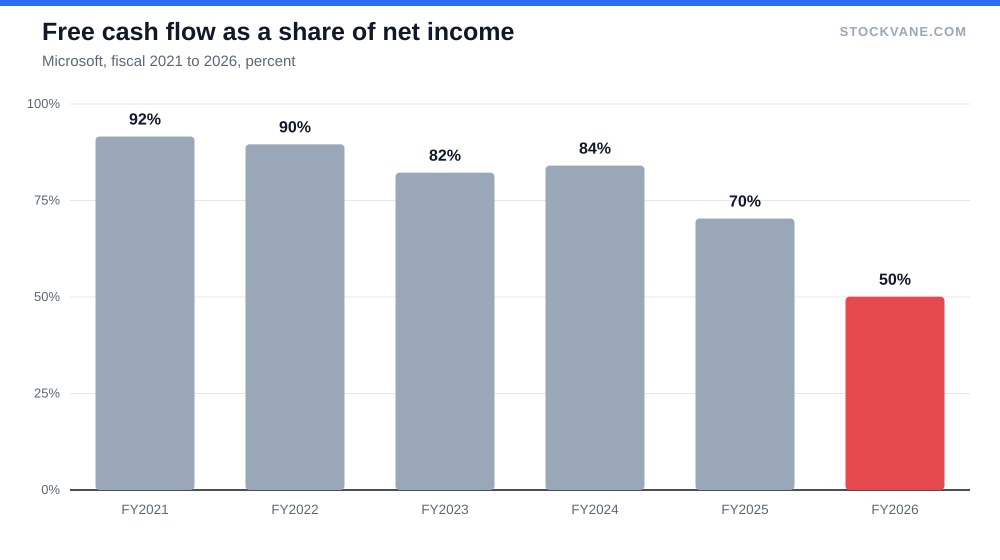
The cleanest way to see the shift is free cash flow as a share of net income. In fiscal 2021 Microsoft turned 92% of its profit into free cash, and in fiscal 2023 it still managed 82%. By fiscal 2026 the figure had dropped to 50%. Half of each reported profit dollar now goes straight back into buildings and servers, and none of that shows in the earnings per share of $17.95 that the trailing multiple is built on. That is why I check the cash statement first.
The depreciation wave has barely started
Cash leaves the moment a data center is paid for. The income statement feels it slowly, as depreciation spread over the useful life of the building and the servers. That lag is why the profit line still looks healthy. Depreciation and amortization was $38.5 billion in fiscal 2026, up from $29.4 billion a year earlier and from $14.5 billion in fiscal 2022. As a share of revenue it went from 7.3% to 11.6%.
Now compare that $38.5 billion with the $115.9 billion spent in the same year. Spending ran at 3.0 times the depreciation charge. Assets do not depreciate the day they are bought, so the charge has a long way to climb before it catches up with the cash going out. I read this as a cost that is already committed but not yet fully visible.
That is the bill.
A rough sizing helps, and I flag it as arithmetic and not a forecast. Depreciation of $38.5 billion already equals 25% of fiscal 2026 operating income of $155.2 billion. If that charge merely doubled, it would take another $38.5 billion out of operating profit, and revenue would have to grow enough to cover it just to hold the margin where it is.
So far that has worked. Operating income divided by revenue was 42.1% in fiscal 2022, 45.6% in 2025 and 46.8% in 2026, so margin has widened through the build-out. Gross margin tells the more careful story: 68.8% in fiscal 2025 and 67.9% in 2026, a slip of under a point that is small now and points the way costs are moving. These are operating profit over revenue; the database also carries an EBIT margin of 50.9% for fiscal 2026, and I quote only the first to keep one definition.
What Azure has to carry
The revenue side is where the case gets made. Revenue reached $331.8 billion in fiscal 2026, up 18% from $281.7 billion, and the latest quarter brought $90.0 billion, also up 18% on the year. The segment split shows why the cloud sits at the center. Intelligent Cloud produced $137.8 billion, or 41.5% of the year’s revenue, ahead of More Personal Computing at $54.1 billion, and behind only Productivity and Business Processes at $140.0 billion.
That is a useful reference point, with a limit. The database does not give me Azure’s own growth rate, its margin or the split of AI-related revenue, so I cannot tell you how much of the 18% growth the new capacity is earning. Revenue accelerating from 15% growth in fiscal 2025 to 18% in fiscal 2026 is consistent with capacity turning into sales. It does not prove that each new dollar of capital earns its keep. Any reader who tells you the return on this spending is known is guessing.
The main risk to the view is simple to state. If the return on capital turns out lower than the market assumes, depreciation will keep rising after revenue growth has already slowed, and the two lines will cross at the worst moment for the multiple.
Two other names in our coverage show the ends of that question. My earlier piece on the identity debate around Microsoft looked at how the market frames the company, and Oracle’s backlog post looks at what happens when contracted demand runs ahead of the balance sheet. On the supply side, Nvidia’s forecast describes who is collecting a large share of these checks.
What the market is paying
At 27.6 times earnings on the valuation tab, Microsoft trades below its own five-year average of 32.5, and the 25.1 forward multiple sits below that. Price to sales is 11.1 against a five-year average of 11.7. On both measures the stock is a little cheaper than its recent history, hardly a bargain. Fair, then.
The forward earnings estimate of $19.71 against trailing $17.95 implies growth of about 10%. Fiscal 2026 earnings per share rose 32%. That is the number I keep returning to. The market is willing to pay 27.5 times earnings for a company whose earnings estimates assume growth falls by two thirds. Either the analysts are being conservative, or they can see depreciation coming. I lean toward the second, though nothing in our data confirms it.
Sentiment is not the problem. Of 32 analysts, 97% rate the stock a buy, with an average target of $573, 16% above the price, and the lowest target at $510. Our own quant grade tells a different story, having slid from B to D in the last two weeks, and I would rather note the disagreement than pick a winner. Short interest is only 1.0% of float, so nobody is betting hard against it.
Earnings reactions add a caution. The July 29 report moved the stock +15.5%, against an average move of 8.1% over recent reports. A stock that can jump that far on one print is telling you the market’s view of the spending is still unsettled.
The case against my caution
The bull argument deserves a proper hearing, since it is the counter-case to everything above. Free cash flow of $67.0 billion still covers the $26.4 billion in dividends 2.5 times over with room to spare. Operating cash flow is the highest of the six years in our data. If the new capacity fills quickly, today’s free cash flow trough could turn out to be the price of a moat that competitors cannot afford to build.
I take that seriously. What would make it wrong is specific: free cash flow margin. It stood at 33.4% of revenue in fiscal 2021, 25.4% in fiscal 2025 and 20.2% in fiscal 2026. Another two-point drop would put it near 18%, and revenue growth back at 15% would then be carrying a much heavier load than it does today.
What I am leaving out
Every number above comes from reported statements and market data, none from management guidance.
This piece does not model lease commitments, the accounting for the OpenAI relationship or Microsoft’s own guidance for fiscal 2027 capital spending, because none of them sits in the data I can verify, and I would rather leave a gap than fill it with a guess. If you want the wider historical context, the Microsoft financials page carries the full statements, and the fiscal 2027 quarters will show up there first.
The free cash flow floor
The number I would hold Microsoft to is free cash flow margin at the fiscal 2027 report. Above 20%, and the stock’s discount to its own history looks earned; sales are outrunning the depreciation. Below 18% would put the D quant grade on firmer ground, and I would treat the current multiple as too generous.
Gavin Thorne has invested in U.S. stocks for six years and previously worked at a large publicly traded internet company. He writes about income-oriented strategies, including cash-secured puts, and about how he reads company data. This article reflects his personal research process and is for informational purposes only. It does not constitute investment advice.
Sources: Dividends (SEC Investor.gov glossary) (https://www.investor.gov/introduction-investing/investing-basics/glossary/dividend) · Dividends tax topic (IRS) (https://www.irs.gov/taxtopics/tc404)