
Airbnb booked $11.1 billion of revenue in 2024 and $12.2 billion in 2025, a gain of about $1.1 billion. Operating income over the same two years went from $2.55 billion to $2.54 billion. A billion extra dollars of sales, and $10 million less profit.
That is the sharpest fact in the file, and it complicates the tidy version of this story, which says growth slowed and margins held. Half of that is right. Half of it needs a footnote.
Here is my thesis. Airbnb’s growth has fallen from 40% to 10% in three years, and the profit margin has stayed in a 21% to 24% band through all of it, which says the business is mature and not broken. But 2025 is the first year the margin gave ground, and the stock at 37.9 times trailing earnings is priced as though it will not give more. I think that is a fair bet, not a safe one.
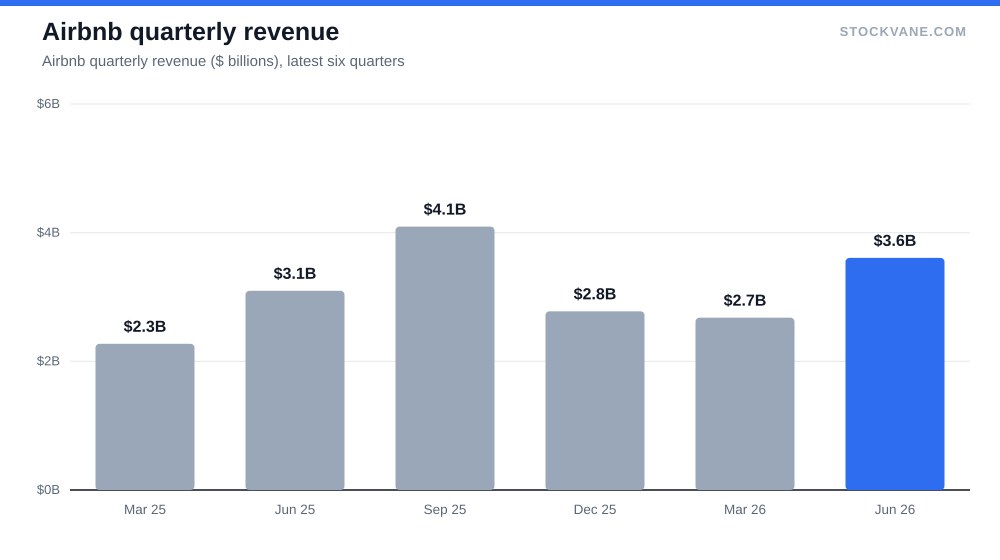
Growth: four years down, one quarter back up
The revenue line in the database reads $8.4 billion in 2022, $9.9 billion in 2023, $11.1 billion in 2024 and $12.2 billion in 2025. Year-over-year growth on that ladder is 40%, 18%, 12% and 10%. Nobody is arguing the slowdown is imaginary. Each year the comparison base got bigger and the reopening tailwind got smaller, and the rate fell accordingly.
The most recent quarter interrupts the pattern. Second-quarter 2026 revenue was $3.6 billion, up 17% from a year earlier, after +18% in the first quarter of 2026. Both readings beat the 10% full-year figure for 2025. Sequentially the June quarter was 35% above the March quarter, though that is the seasonal shape of a travel business and I would not read it as acceleration by itself.
One quarter does not reverse a four-year trend. It does mean the “growth is fading” case is being tested against a fresher number than the one most write-ups still cite. If the September quarter also prints mid-teens growth, the story changes from deceleration to stabilization at a higher base. If it drops back toward 10%, the two 2026 quarters look like timing.
The margin: what held and what did not
Using the EBIT margin in the database, Airbnb ran 24.0% in 2022, 22.0% in 2023, 23.0% in 2024 and 20.8% in 2025. That is a range of 3.2 points across a period when growth lost 30 points. Set those side by side and the decoupling is real. A slower business did not become a less profitable one.
A caution on the series, because two measures disagree. The reported operating income divided by revenue gives 22.5% for 2022, 15.3% for 2023, 23.0% for 2024 and 21% for 2025. In 2023 the operating income line in the database is $1.52 billion, which produces the 15.3%, while the EBIT margin shows 22.0%. I cannot reconcile the two from the data I hold, so for the level of margin I use EBIT and I treat the 2023 operating figure as an outlier rather than a trend. Anyone rebuilding this from the financials tab should expect to hit the same fork.
Gross margin is the steadier witness: 82.2% in 2022, 82.8% in 2023, 83.1% in 2024 and 83.0% in 2025. It has not moved more than a point in four years. Whatever is happening below the gross line, the marketplace economics, the share of each booking Airbnb keeps, are intact.
So where did the 2025 slippage come from? Gross margin was flat, so the drop from 23.0% to 20.8% sits in operating costs. Revenue rose $1.1 billion and operating income did not move. That says spending rose about as fast as the added revenue. I read this as a decision to invest, not evidence of distress, but the database has no expense breakdown, so I am inferring it and flagging it as an inference.
Profit per share tells the softer version
| Metric | Value | Context |
|---|---|---|
| Price (approx.) | $166.22 | 52-week range $111 to $193 |
| P/E (TTM) | 37.9x | Five-year average 19.1x |
| Price-to-sales | 7.5x | Five-year average 9.7x |
| Analyst ratings | 65% buy, 32% hold | 31 analysts; average target $191 |
Net income was $2.65 billion in 2024 and $2.5 billion in 2025, down about 5%. Diluted EPS moved from $4.11 to $4.03. Revenue up 10%, EPS down 2%. Anyone who says margins did not slow has to explain that pair of numbers.
The 2022 to 2023 comparison deserves its own caveat. Net income was $1.89 billion in 2022 and $4.79 billion in 2023, a jump of 153%, in a year when operating income went down. Net income above operating income by more than three times means non-operating or tax items did the lifting. That year should not be used as the base for any per-share growth claim. Measured from 2024, the base is cleaner, and it shows flat earnings on rising sales.
What the stock is paying for
Start with the arithmetic of what a buyer is underwriting. At 37.9 times trailing earnings of $4.38, the price already assumes that the flat EPS of the last two years is a pause. The forward figure of $5.58 is the market’s version of that pause ending: it requires roughly a quarter more profit per share than the trailing twelve months delivered, and it requires that quarter to arrive without another year like 2025 in the middle.
At $166, Airbnb sits 14.1% below its 52-week high of $193 and 50% above the low of $111. The market value is $99.5 billion. Trailing P/E is 37.9. Forward P/E, on $5.58 of expected EPS, is 29.8, which is 22% cheaper and implies about 27% EPS growth from the trailing figure.
The five-year average P/E in the data is 19.1, and I would not lean on it. The band it comes from runs from -47.3 to 85.5, which is what loss-making pandemic years do to an average. Price to sales is the cleaner gauge: 7.5 times now, against a five-year average of 9.7, and 6.7 on forward revenue. On sales the stock is at the 32nd percentile of its own history. On earnings it is at the 67th. The two gauges disagree, and the disagreement is exactly the margin question: sales are cheap relative to the past, earnings are not, because the earnings conversion of each new dollar has stalled.
Compare that with how another premium-multiple name gets handled. Costco at 50 times earnings makes the case that a high multiple needs steady growth in the denominator. Airbnb’s multiple is lower, 37.9 against 50, but its EPS has gone sideways for two years, so the same question applies with less room for error.
Check the valuation tab and you will see the same picture: sales multiple below the historical middle, earnings multiple above it.
The counter-case, taken head-on
The strongest evidence against my thesis is the two 2026 quarters. Growth of 18% and 17% is not a business running out of road, and the August 6 report moved the stock +17.4% the next session, against an average earnings-day move of 5.8%. A market that sees a re-accelerating platform will forgive a flat 2025 margin.
The counter-case has a weakness. Operating margin is not in the quarterly data I hold, so I cannot show that the faster growth came with margins intact. If the newer growth is being bought with marketing and product spend, as the 2025 numbers hint, the 17% is worth less than it looks. That is the specific condition under which I would be wrong to call the margin story intact: fast revenue, flat profit for a second year running.
For contrast, UnitedHealth’s margin crisis is what margin loss looks like when it is real and multi-year. Airbnb is nowhere near that. A 2.2-point slip from a 23% level is a watch item.
Analysts, positioning and the quant read
Of 31 analysts, 65% rate the stock a buy. The average target is $191, which is 15% above the price. The high is $220 (32% up) and the lowest target, $155, sits about 7% under the current price, so even the most bearish analyst is not calling for a collapse. Short interest is 2.4% of float, which is low and says the bears are not crowded in.
The quantitative score in the database moved from B to C over the last several weeks. I treat that as a mild caution about momentum and estimates, not a verdict, because the score does not tell me which input changed.
I am not covering the regulatory pressure on short-term rentals here. The news feed shows a September 9 item about EU housing rules, and I have no dated fact in the database on what it costs Airbnb, so any number I put on it would be invented.
The FY2026 margin I would not accept below 20%
The debate reduces to one figure. If full-year 2026 EBIT margin lands at 21% or better on revenue growth in the teens, then 2025 was an investment pause and the 29.8 forward multiple is reasonable for a business compounding at that speed. If it lands under 20% while revenue grows 15%, I would say incremental margins have gone negative and the stock deserves a lower multiple than it has.
The next data points are the September-quarter report and the sequential trend in operating cost. Twenty percent is my line. Under it, I would stop arguing for the margin-held thesis.
Financial disclaimer: The content on StockVane is for educational and informational purposes only and should not be construed as professional financial advice. Stock market investing involves risk of loss.
Sources: Price-to-earnings ratio (SEC Investor.gov glossary) (https://www.investor.gov/introduction-investing/investing-basics/glossary/price-earnings-pe-ratio) · How to read a company's 10-K (SEC Investor.gov) (https://www.investor.gov/introduction-investing/investing-basics/glossary/10-k)