
McDonald’s closed at $248.24 on September 18. Its 52-week low is $247.65. That is a gap of 59 cents, or about a quarter of one percent, on a stock that sits 26% below its 52-week high of $335.18.
A stock like that tends to get called defensive out of habit. The label comes from 2008 and 2009, when people traded down to a dollar menu and the shares held up while most of the market did not. What I want to know is whether the same behavior is still what the numbers show, or whether investors are paying a defensive multiple for a business whose customers have started to say no.
A landlord that sells burgers
The financials tab shows why the reputation was earned. Revenue reached $26.89 billion in fiscal 2025, up 4% on the year, after 2% growth in fiscal 2024. Operating income was $12.39 billion, an operating margin of 46%. Restaurant operators do not report margins like that. McDonald’s does, because most of its restaurants are run by franchisees who pay rent and royalties, and the company keeps the predictable slice.
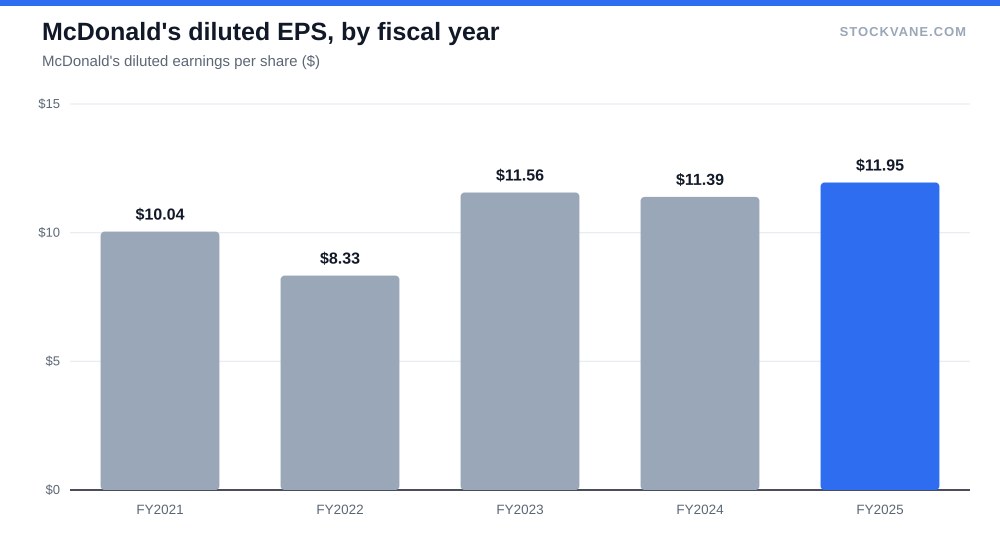
Net income was $8.56 billion and diluted EPS $11.95. Two years earlier, in fiscal 2023, EPS was $11.56. That is 3% cumulative growth in earnings per share over two years. Compared with a fiscal 2022 operating margin of 45% on revenue of $23.18 billion, profitability has barely moved in three years. So the model is not broken. It has stopped compounding at the pace the stock’s history suggests.
The dividend is the piece I would defend most. At a yield of 2.96%, the payout is about $7.35 a share, roughly 61% of fiscal 2025 EPS. That is a sturdy cover, and it will keep the streak alive through a soft patch.
Where the traffic story sits, and what I cannot see
I do not have visit counts in our database, so I will not quote a traffic figure. What the numbers do show is slow top-line growth. Two years of 2% and 4% revenue growth, in an industry where menu prices rose sharply over the same stretch, suggest that price did much of the work. I read that as a sign that the number of visits is not growing much, but it is an inference from revenue, not a measurement.
Nothing alarming shows up in the quarterly figures. The quarter that ended in June brought in $7.10 billion, up 4% on the year. Growth in the quarter before it was 9%. The question is what happens when the price increases stop lapping.
Two segments carry the results. In the latest quarter, International Operated Markets, the established countries outside the US, made $3.60 billion, or about 51% of the three-segment total. The United States made $2.83 billion, about 40%. The remainder came from the licensed markets. Most of the US bear case gets written about the smaller of those two pieces.
That split matters for the argument. If the reputation for value has slipped in the US, it may have slipped in Europe too, and the two markets do not share a labor market, a currency or a grocery price index. A recovery in traffic has to arrive in both.
What 20 times earnings is paying for
The valuation tab puts the trailing P/E at 20.2. McDonald’s own five-year average is 26.7, and the stock sits at the very bottom of that range. The forward P/E is 19.0, and the industry average in our data is 24.5.
Read on its own, that is a discount of about a quarter to the stock’s own history. It looks cheap. I am less sure. A multiple that falls from 27 to 20 without a big change in earnings is the market repricing the growth rate. Earnings per share of $11.95 against $11.56 two years earlier does not support 27 times. It supports something closer to what the stock trades at now, and possibly lower.
So my view is that McDonald’s is fairly priced for a business growing earnings at 2% to 4%, and expensive only if you assumed it would grow at the rates of a decade ago. A yield near 3% and a forward multiple of 19 is a reasonable price for stability. It is a poor price for a comeback.
Analysts are cutting, not leaving
All 24 analysts in our data cover it, with 58% at buy and 42% at hold and none at sell. The analyst page shows an average target of $312, about 26% above the price, with a low of $280 and a high of $390.
Even the lowest target is 13% above the current price. That is unusual for a stock at its low, and it tells me the targets have not caught up. Two days ago, on September 14, our news feed showed Morgan Stanley keeping a Hold rating while cutting its target and Deutsche Bank keeping a Buy while cutting its own. I cannot say why either firm acted, only that the direction of revision was down in both cases. Targets that only move after the price does are a lagging signal.
The quant rating tells a harsher story. On September 8 it was a B with a score of 72. On September 20 it was an E with a score of 13. The model leans on price behavior and valuation, so I read it as a comment on the tape. It is not a comment on the company’s earnings, and the earnings have not fallen.
| Metric | Value | Context |
|---|---|---|
| Price (approx.) | $248.24 | 52-week range $248 to $335 |
| P/E (TTM) | 20.2x | Five-year average 26.7x |
| Price-to-sales | 6.5x | Five-year average 8.1x |
| Analyst ratings | 58% buy, 42% hold | 24 analysts; average target $312 |
| Dividend yield | 2.96% |
What the forward multiple asks you to believe
Divide the price by the forward P/E and you get the earnings the market expects, about $13.06 a share over the next year. Against the $11.95 McDonald’s earned in fiscal 2025, that is a rise of about 9%. It is a bigger step than the 4% the company managed last year, and it is the assumption I would question first. Buyers at today’s price are not paying for stability alone. They are paying for a reacceleration that the last three years of results do not show.
The arithmetic is simple. Put 18 times on that $13.06 and the shares are worth about $235. Twenty-two times gives about $287, and the industry average of 24.5 times gives about $320, which is roughly where the high end of the analyst range sits. Today’s price sits between the first two, and it takes a full recovery in the multiple to justify the $312 average target. I would not say that is impossible. I would say it needs both earnings growth and a rerating, and the record gives evidence for neither.
The stock does not react much to reports
Over the last four reports, the shares moved +1.2%, -0.1%, +2.7% and +2.2% on the day. The average move was under 2% in either direction. That is a quiet record for a consumer stock, and it fits the idea that the business is predictable.
It also means the recent slide did not come from a single bad report. It came from the multiple compressing across weeks while the business kept posting ordinary numbers. Short interest tells the same story, at about 1.7% of the float. Nobody is betting hard against it. The stock is simply being sold by holders who now want a bigger yield for the same risk.
For comparison, we looked at how a different defensive name gets valued in our Costco piece. Costco trades at a far higher multiple because its growth is visible. McDonald’s is at the other end of that spectrum.
What would make me wrong
The bull case needs one thing: transactions growing again, not just the average check. If the next two quarterly releases show US comparable sales rising because more people came through the door, the discount to the five-year average will close, and $312 will look conservative.
There is also a case where I am too harsh. A 3% yield, a 46% operating margin and a share price that is already at its low is a setup that has rewarded patient buyers before. If the stock falls another 10% with earnings unchanged, the yield rises toward 3.3%, and I would call that fair value for a business like this.
What I am claiming is narrower, since I have no traffic data to lean on: that the price has moved further than the earnings, and that the market has stopped paying for growth that was never in the reported numbers.
The traffic line I would not argue with
I would get more constructive if the next quarterly release shows US revenue growth above 4% with the gain attributed to more visits, and the shares are still under $260. I would step back if operating margin dropped below 45%, since that is where the model starts to look like it needs price cuts to keep customers.
Until then, I would treat McDonald’s as an income holding priced fairly for what it is, and not as a bargain. Below $240, the yield passes 3.0% and I would start to look at it again.
Financial disclaimer: The content on StockVane is for educational and informational purposes only and should not be construed as professional financial advice. Stock market investing involves risk of loss.
Sources: Dividends (SEC Investor.gov glossary) (https://www.investor.gov/introduction-investing/investing-basics/glossary/dividend) · Dividends tax topic (IRS) (https://www.irs.gov/taxtopics/tc404)