
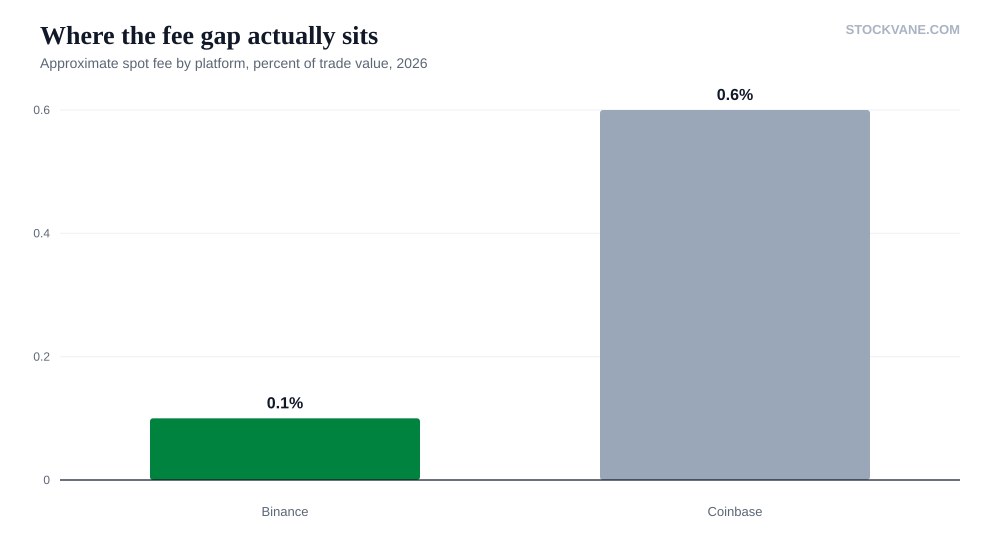
Binance charges about 0.1% on a spot trade. Coinbase charges up to 0.6%-plus on its simple buy-and-sell flow. That’s a 6x gap on the exact same transaction, and it’s the number every comparison article leads with. In my experience it’s also the wrong number to decide on.
Ask around and you’ll hear the same line: Binance is cheaper, Coinbase is easier. True, and it still shouldn’t be what decides this for you. What usually happens instead: someone picks based on fees, trades for a few weeks, and quietly realizes the platform doesn’t match how they actually use crypto. The question worth asking has nothing to do with which platform charges less. It’s about where you’re more likely to make an expensive mistake, and where you’re more likely to stay consistent for a full year rather than three months. The Bitget vs OKX comparison and the Bitget review run the same fit-over-features test on a different pair of exchanges, and the conclusion holds up there too: the cheaper platform on paper isn’t automatically the cheaper one in practice.
Disclosure: this article contains affiliate links. If you sign up through them, StockVane may earn a commission at no extra cost to you; see our Editorial Standards for how that works.
Two platforms built for two different accounts
| Binance | Coinbase | |
|---|---|---|
| Best for | Active traders, cost-conscious users | Beginners, buy-and-hold |
| Fees | Low | High on the simple flow (up to ~0.6%+), competitive on Advanced Trade |
| Ease of use | Steep learning curve | Very simple |
| Features | Deep: spot, derivatives, staking, more | Basic: buy, sell, hold, some staking |
| Asset range | Very wide | Narrower, more curated |
On paper, Binance wins the fee argument almost every time: low spot fees, easy volume discounts, and a real cost gap once you’re trading actively rather than occasionally. Coinbase is expensive, especially on the default buy-and-sell flow rather than its separate Advanced Trade interface, which prices closer to Binance’s baseline but asks more of the user setting it up.
But fees only matter if everything else goes right, and early on, things often don’t. Binance hands you more control: order types, trading pairs, a choice of network on every withdrawal, advanced charting built for someone already comfortable reading a book of bids and asks. Great if you know exactly where the small mistakes happen. Coinbase strips most of that away. You pay for the simplicity, and in exchange you remove a lot of ways to lose money to a bad click rather than a bad idea. Binance’s current fee rebate is worth checking if the cost side is what’s pulling you toward it, though the rebate itself shouldn’t be the deciding factor either.
Stock brokers split along a similar line, for what it’s worth. A comparison between a control-and-depth broker and a beginner-friendly one covers a nearly identical trade-off: one platform built for control and depth, the other for people who’d rather not think about the mechanics. The instrument changes, crypto instead of equities, but the underlying question, how much complexity are you actually equipped to manage, repeats almost word for word.
They feel completely different to use
Coinbase is built for someone who doesn’t want to think about the mechanics: open the app, see a clean balance, buy in a few taps, done. It’s almost boring, and that’s the point of the product. Binance looks closer to a trading terminal the first time you open it: order books, charts, tabs inside tabs, and a settings menu that keeps unfolding. Powerful once you’re used to it, and a real reason plenty of people never fully get comfortable with it even after months of use.
That difference in feel shapes behavior more than the fee schedule does. On Coinbase you tend to buy and hold, because there’s little in the interface nudging you toward anything else. On Binance you tend to act: trade, adjust, experiment, check the chart again. The more you do that, the more your results depend on your own discipline rather than the platform’s design. Traders who’ve already spent time on interfaces built for depth tend to adapt faster to Binance’s layout; everyone else pays a longer learning-curve tax before the tools start paying for themselves.
Where people actually get burned
With Binance, the problems come from complexity: sending an asset on the wrong network, losing track of funds split across two wallets, drifting into a futures position that wasn’t the plan for the day. None of these are platform errors exactly. The platform simply makes them possible in a way a simpler interface doesn’t, and it rarely stops you before the click goes through.
With Coinbase, the complaints run differently: fees adding up faster than expected, an account getting temporarily restricted during a routine review, slow support during a busy stretch. Less about mistakes made in the moment, more about feeling limited or overcharged over time. It’s a pattern that shows up on the equity side too. The eToro fee and complaint review turns up a similar shape: a beginner-friendly platform whose costs and restrictions surface gradually rather than all at once, so the frustration builds quietly instead of arriving as one clear mistake. Neither platform is objectively worse here. It’s a question of which kind of friction you’d rather manage on a Tuesday afternoon.
What security and support actually look like
Both exchanges run standard custody and verification: KYC on signup, two-factor authentication, withdrawal allowlisting if you turn it on, which you should. Binance has weathered more scrutiny historically simply by being larger and by operating across more jurisdictions with more regulatory touchpoints; Coinbase, as a US-listed company, files public disclosures that give outsiders more visibility into how the business itself is run. Neither fact settles the safety question on its own, since custody risk and business risk aren’t the same thing and shouldn’t be graded on the same scale.
Support is where the day-to-day difference actually shows up. Coinbase’s support queue tends to move slower during volatile weeks, a familiar complaint among users who need an account issue resolved before a trade window closes. Binance’s support is faster to reach in some regions and slower in others, a function of the exchange’s sheer transaction volume more than any policy choice. Neither is a dealbreaker by itself. Both are the kind of detail that only matters the one week you actually need it, so it’s worth testing a small transaction and a support ticket before committing real size to either account.
None of this is a reason to avoid either exchange. It’s a reason to treat “safe” as a spectrum rather than a label. A platform can be well-run and still leave you exposed if you skip two-factor authentication or reuse a password from another account, and a platform with a rockier compliance history can still be the right custodian for a small position you’re comfortable losing track of for a year. The exchange’s reputation matters less here than your own habits around the account: withdrawal allowlists on, a unique password, and a realistic sense of how much you’d actually notice going missing.
A more honest look at the fee schedule
Spot trading on Binance runs about 0.1%, lower still with volume discounts once monthly turnover climbs. Coinbase’s simple interface runs up to 0.6%-plus, though its Advanced Trade tier prices lower than the default flow, still higher than Binance’s baseline even after that adjustment. Both platforms charge network fees on crypto withdrawal, and Coinbase’s can carry a markup on top of the network cost depending on the asset. These are approximate 2026 figures, and both exchanges change their schedules often enough that I’d confirm the live rate before moving size.
6x versus 1x feels like an easy decision on its own. It isn’t, because your real cost depends on how often you trade, how much you move assets around between wallets, and how comfortable you actually are with the tools sitting in front of you. A beginner who overtrades on the cheap platform can lose more to slippage and bad entries in a single bad week than someone who buys occasionally on the expensive one and never touches the position again. The fee schedule is a real number. It just isn’t the only one that determines what you keep.
So, is it Binance or Coinbase?
New to crypto, or not planning to trade often: Coinbase. You’ll pay more per transaction and spend less time figuring out the interface, and you’re less likely to make an avoidable mistake in your first few months of holding an asset you’re still learning to trust.
Already comfortable with how exchanges work, or want lower costs while trading regularly: Binance. The fee difference becomes real money at that point, and the extra tools start helping instead of getting in the way of what should be a simple decision.
A meaningful share of people land in the middle: onboard on Coinbase with fiat, then move funds to Binance to actually trade. Not the most efficient setup on paper, but common, because it balances simplicity at the entry point against cost once you’re active. Neither choice has to be permanent, and switching later costs nothing but a bit of friction moving assets between accounts.
The real risk here has little to do with picking the platform that looks “wrong” in six months. It has to do with picking one off a fee comparison that doesn’t match how you actually plan to use it, then only discovering the mismatch after you’ve already built habits around the wrong tool. That mismatch is rarely dramatic. It shows up as a small account you stop checking, a fee statement that surprises you every few months, or a set of tools you never learned because the platform assumed you already knew them.
Watch your own trade count over the next month before assuming either fee schedule will define your real cost. If you’re placing more than a handful of trades a week, the 6x gap stops being theoretical and starts showing up on a monthly statement. If you’re not, the interface you’re more likely to actually use correctly probably matters more than the rate printed on the fee page. That number, not the headline rate, is the one that decides which platform was worth the switch.
Financial disclaimer: The content on StockVane is for educational and informational purposes only and should not be construed as professional financial advice. Stock market investing involves risk of loss.
Sources: Earnings reports (SEC Investor.gov glossary) (https://www.investor.gov/introduction-investing/investing-basics/glossary/earnings-report) · How to read a company's 10-K (SEC Investor.gov) (https://www.investor.gov/introduction-investing/investing-basics/glossary/10-k)