
The 10-year Treasury briefly touched 5% this month, and the S&P 500 pays a dividend yield of about 1.1%. Put those two numbers next to each other and the old argument over which kind of dividend stock to buy starts to feel beside the point. Why hold a stock for its income when a government bond pays almost five times as much and asks for nothing else?
I still think dividend stocks belong in a lot of portfolios. But the reasons have to be better than “the yield looks nice,” because that reason lost most of its force when rates rose. What is left is a choice between two ideas that pull in opposite directions: a high yield you can spend now, or a low yield that grows fast enough to be large later. I lean toward the second for most people and I will show the arithmetic behind that, along with the cases where I would pick the first.
Why a high yield is a price signal first
Yield is a dividend divided by a price. When the price falls, the yield rises, whether or not anything good has happened to the payout. A stock that drops from $50 to $25 has doubled its yield without a single board meeting. That is why the top of any yield screen is crowded with companies the market is worried about, and why the highest number on the list is usually a warning before it is an opportunity.
Some perspective from our own data helps. Of the 244 dividend-paying stocks StockVane tracks, 70 yield under 1% and 63 yield between 1% and 2%. Only 59 yield 3% or more, and 16 of those yield 5% or more. None yields as much as 8%. High yield is scarce among large U.S. companies, and the few that offer it tend to sit in a handful of slow, mature industries.
The stocks at the top of that ranking deserve a second look before anyone treats them as a bargain. A number above 6% often means the market expects the payout to fall, or that earnings are shrinking underneath it. The names near the top are also the least likely to grow the dividend much. A payout that already takes most of a company’s earnings has nowhere to go but sideways.
What you can actually measure
There is a difference between a high yield and a safe high yield. The safe kind is paid out of cash that arrives on a schedule: a pipeline collecting fees, a landlord collecting rent under long leases, a carrier collecting bills from subscribers. The dangerous kind is paid out of earnings that swing with the economy, or out of borrowing.
Verizon is the standard example of the first kind, with a yield near 5.8% and a trailing P/E of about 12.5. You can see its payout record on the Verizon dividend page. Altria has a higher yield and a similar multiple. Neither is a growth story, and the market prices them that way.
| Company | Dividend yield | Trailing P/E | Price (approx.) |
|---|---|---|---|
| Altria (MO) | 6.10% | 14.6x | $69.52 |
| Verizon (VZ) | 5.81% | 12.5x | $48.09 |
| PepsiCo (PEP) | 4.43% | 17.0x | $129.75 |
| Coca-Cola (KO) | 2.36% | 26.5x | $88.25 |
| Johnson & Johnson (JNJ) | 1.94% | 31.3x | $269.99 |
| Visa (V) | 0.71% | 31.3x | $368.29 |
The table sets six well-known payers side by side. What stands out is how tightly yield and multiple move together. The two highest yields, Altria and Verizon, trade at the lowest P/Es. Visa, at the other end, yields about 0.7% and trades near 31 times earnings. Growth costs more per dollar of earnings and income costs less, so a screen that sorts only by yield keeps landing on the cheap end of that trade, and the low multiple is the market’s discount for a reason.
The compounding argument
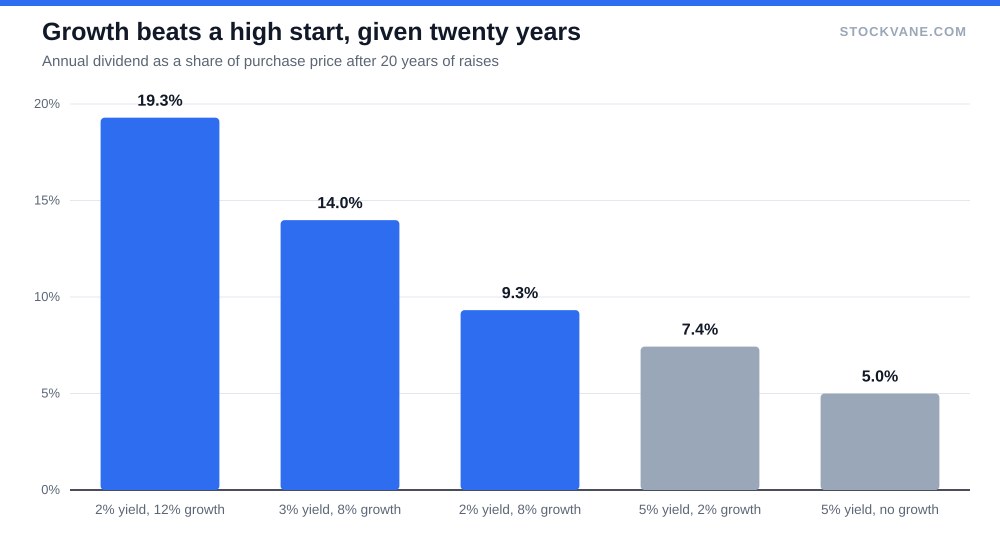
The case for a low starting yield rests on how fast a growing payout piles up. Start with a stock yielding 2% and raise the dividend 12% a year. After ten years of raises the payout equals 6.2% of your original cost. After twenty it is 19.3%. A single dividend cut would reset the whole calculation, so the growth rate is really a bet that the business stays healthy. No stock is promised to do this. It is simply the arithmetic of 12% growth applied to a small starting number.
| Starting yield | Annual dividend growth | Payout after 10 years of raises | Payout after 20 years of raises |
|---|---|---|---|
| 2% | 5% | 3.3% | 5.3% |
| 2% | 8% | 4.3% | 9.3% |
| 2% | 12% | 6.2% | 19.3% |
| 3% | 8% | 6.5% | 14.0% |
| 5% | 2% | 6.1% | 7.4% |
| 5% | 0% | 5.0% | 5.0% |
Read the bottom of that table. A stock that starts at 5% and grows its dividend 2% a year reaches 7.4% after twenty years. The stock that starts at 2% and grows 12% reaches 19.3%. Given enough time, the growth rate matters more than where you start. The 2% grower does not catch up quickly, though. Its payout passes today’s 5% Treasury yield in year 9.
The cash you collect along the way tells the same story with a longer wait. A flat 5% yield pays 25% of your cost in five years. A 2% yield growing at 12% pays about 12.7% over the same period, so the high yielder is well ahead for the first stretch. The growing payout does not overtake the flat one in cumulative cash until year 16. At 10% growth, it takes until year 18.
So the trade is real. If you need income within a decade, the higher yield wins on the cash it pays. If you will not touch the money for twenty years, the growth wins by a wide margin. The useful question is which of those two investors you are.
Where the theory breaks
Twelve percent dividend growth for two decades is rare. It requires earnings to grow about as fast, and few companies manage that for that long. The point of the arithmetic is not to assume it will happen. It is to show how much of the outcome rides on the growth assumption, which is exactly the number that is hardest to know in advance.
The Visa dividend history is a fair illustration. The yield is about 0.7%, low enough that no income investor would notice it. Nobody owns Visa for the income. You own it for earnings growth that eventually feeds the payout.
Coca-Cola sits in the middle. Its yield is about 2.4%, its multiple is near 26.5, and its recent payments are on the Coca-Cola dividend page. That puts it between the two camps, with some income now and some growth later.
The checks I run before trusting a payout
A dividend is not safe because it has been paid for a long time. It is safe if the cash to pay it will keep arriving. I look at three things. The first is free cash flow against the dividend, not earnings, because earnings include accounting items that never touch the bank. If free cash flow does not cover the payout for several years in a row, the company is borrowing to pay shareholders, and that ends one way. The second is the number of years of consecutive increases, which measures how the company behaved in recessions. The third is debt against operating cash earnings, because interest gets paid before dividends do.
None of it is a guarantee, since companies that pass all three have still cut payouts when an industry turned.
How I would split it today
I cannot tell you whether the 10-year stays near 5%. If it slides back toward 4%, a solid 4% or 5% payer looks better than it does today. With Treasuries near 5% right now, I would not stretch for yield. If a stock yields 3% and offers no growth, a bond does the same job with less risk. That pushes me toward dividend growers for money I will not need for a long time, and toward Treasuries or a small slice of proven high-yield names for money I need soon. I would also keep an eye on how the market is pricing the whole index, which I covered in our look at whether the S&P 500 is overvalued, because a rich market makes low starting yields harder to justify.
Taxes tilt the comparison a little further. Qualified dividends are taxed at the lower long-term capital gains rates, while Treasury interest is taxed as ordinary income at the federal level and is exempt from state and local tax. For someone in a high bracket in a state with an income tax, a 5% Treasury and a 4% qualified dividend are closer than the headline numbers suggest. In a tax-deferred account none of that matters, and the pure yield comparison comes back. Check which account each holding sits in before you compare.
If you want income without waiting twenty years and you are comfortable with options, selling cash-secured puts is another way to generate it. It has its own risks and I would not treat it as a substitute for a dividend.
The order I would check things in
Start with the time horizon, because it decides most of the rest. Under ten years, favor the higher yield, but verify the cash behind it. Over fifteen, favor growth, and be patient with a small starting yield. In between, mix the two and let each cover the other’s weakness. If I had to keep one rule, it would be to treat any yield above 6% as a question about the business before it is an answer about income.
Financial disclaimer: The content on StockVane is for educational and informational purposes only and should not be construed as professional financial advice. Stock market investing involves risk of loss.