
On a $150,000 balance, the gap between a fund charging 0.03% and one charging 0.75% is $1,080 a year. Nobody sends you that bill. It is taken out of the fund’s return before you see the number on the statement.
That is the real problem with building a three-fund portfolio inside a 401(k). The idea is simple: one fund for U.S. stocks, one for international stocks, one for bonds. The difficulty is that you cannot buy the funds you want. You get the menu your employer’s plan committee chose, and the menu decides what you can build. My argument is that the tickers matter far less than three decisions you do control: which fund fills each role, what to do when a role has no good fund, and how you rebalance. Get those right and an ordinary menu can produce a very ordinary, very effective portfolio.
Match the role, not the name
A brokerage account lets you pick from thousands of funds. A plan gives you a short list, with names that seldom say what is inside. So start with the job each holding does and then find whatever on the menu does it. If you are new to all of this, our beginner guide to investing with little money covers the basics first.
| Role | Labels you may see on a plan menu | What to check |
|---|---|---|
| U.S. stocks | S&P 500 Index, Large Cap Index, Total Stock Market | Index tracked, expense ratio |
| International stocks | International Index, Foreign Fund, EAFE Index | Whether emerging markets are included, expense ratio |
| Bonds | Total Bond Market, Core Bond, Aggregate Bond Index | Index versus managed, average maturity, expense ratio |
| Not a core holding | Growth, Value, Select, company stock, annuity | Why it is there and what it costs |
The labels in the middle column are the ones I would expect to see, not a guaranteed list. The right-hand column is what actually matters: read the fund’s fact sheet for the index it tracks and the expense ratio. Two funds both called “Large Cap Index” can hold different things, and the plan’s own administrator page usually lists both numbers.
A fund labeled “Growth,” “Value” or “Select” is a different animal. Those are managed choices about which part of the market to own, and they belong in a different conversation from a core holding. If the only U.S. stock fund on your menu is a large-cap growth fund, you can still use it, but you are no longer building the classic version and you should know why.
Fees are the first filter
Menus often offer two or three funds that could fill the same role. Take the cheapest one that tracks a broad index. The arithmetic below is illustrative: $100,000 grown for 25 years at a 6% annual gross return with no new contributions, less each expense ratio, which is a simplification but a fair one for comparing funds.
| Expense ratio | Value after 25 years | Cost against the cheapest |
|---|---|---|
| 0.03% | $426,161 | $0 |
| 0.10% | $419,179 | $6,982 |
| 0.50% | $381,339 | $44,821 |
| 1.00% | $338,635 | $87,525 |
A 0.03% fund ends the period at $426,161. A 1.00% fund ends at $338,635, which is $87,525 less on the same account with the same market. The gap between 0.03% and 0.10% is only about $6,982 over the whole stretch, so if the menu’s index fund costs a tenth of a percent, do not agonize. Above half a percent, do.
One more caution on cost. Some plans add a separate administrative charge on top of fund expenses, and some funds carry a wrap or revenue-sharing arrangement that raises the expense ratio you see. Add them together before comparing.
When a role has no good fund
This is where most menus disappoint, and there are three common cases.
No international fund at all. Then the U.S. fund is your equity exposure, and I would not force a poor substitute in just to have the third leg. Many large U.S. companies earn sales abroad, so a portfolio of only large-cap U.S. stocks has some foreign sales built in. That does not replace owning foreign markets.
An international fund that costs a lot, or is actively managed and trails. Here the choice is between a costly fund that fills the role and a zero allocation. A one-percent fund with a 10% weight costs you 0.10 points a year on the whole portfolio, which is smaller than it sounds, so I would tolerate it if the alternative is nothing.
No bond index fund. Look for a “stable value” fund or an intermediate-term bond fund. Stable value is a different asset. In a plan it still does the same job of steadying the balance. Our piece on the Fed and inflation explains why the bond leg is less comfortable than it used to be, and the argument for holding it anyway is the same one: it is what you sell when stocks fall.
If none of the three roles is well covered, a target-date fund may be the honest answer. It holds a mix of the same building blocks and rebalances itself. What I would not do is hold a target-date fund and also build a three-fund portfolio next to it, because you would own the same assets twice and lose track of the total mix.
What the U.S. leg has done lately
The fund families a plan uses are not in our data, but the market indexes they track are. Here is where four U.S. index funds stood in the StockVane snapshot in September 2026.
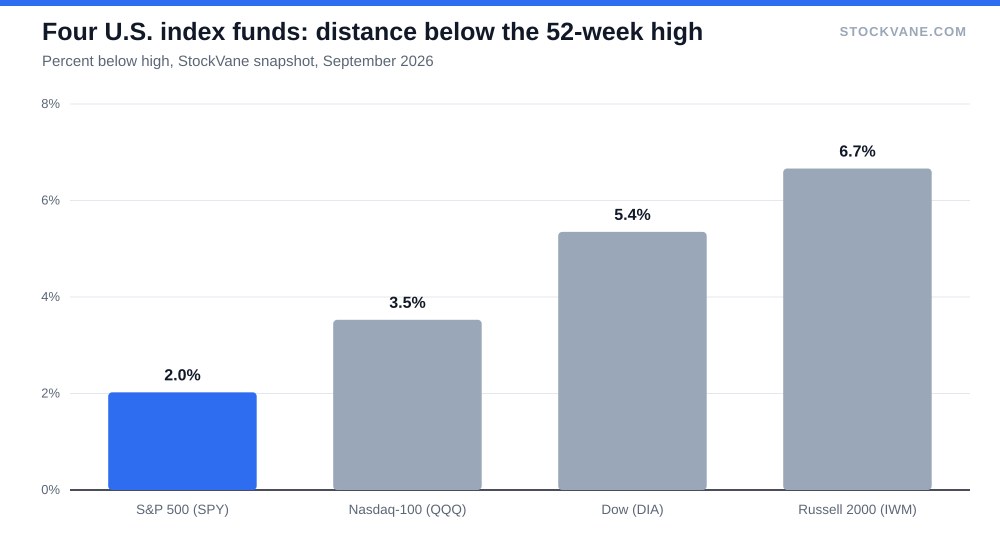
The SPDR S&P 500 ETF is 2.0% below its 52-week high and 21.7% above its 52-week low. The Nasdaq-100 fund (QQQ) is 3.5% below its high, having gained 30.0% from its low. The Dow fund is 5.4% below and up 15.3%, and the Russell 2000 fund (IWM) is 6.7% below after a 25.4% climb. Four funds, four different ranges. If your menu offers an S&P 500 fund and a small-cap fund, they are already behaving differently.
I do not read any of this as a forecast. It explains why the mix you chose last year is no longer the mix you hold.
Weights, and what happens to them
Say you start at 60% U.S. stocks, 25% international and 15% bonds. Suppose the U.S. sleeve rises by the S&P 500 fund’s move from its 52-week low, 21.7%, while the other two hold still. The U.S. weight becomes 64.6%, international slips to 22.1% and bonds to 13.3%. Nothing was bought or sold. The portfolio simply became a more aggressive one.
That is drift, and it is the only reason to rebalance. The point of the three-fund structure is a risk level you chose on purpose. Once the weights move about five percentage points from target, or once a year on a date you pick, put the mix back.
Inside a 401(k) there is one advantage worth using: exchanges between funds in the plan do not create a tax bill, so the cost of rebalancing is close to zero. Use that. Two ways work. You can exchange balances between funds, or you can leave the balances alone and point new contributions at whichever sleeve is below target. The second is gentler and it works well for someone still adding money each paycheck.
Bonds are the leg most likely to move on news you cannot control, and our September 16 Fed hike piece argues that the trade was never the rate move itself. That is a reason to keep the bond sleeve inside a stated range and not react to each rate headline.
The counter-case: why not simply buy the target-date fund?
A fair objection is that a target-date fund does all of this for you. It picks the mix, rebalances it and shifts toward bonds as the retirement year nears. For a saver who will not look at the account, that is a strong argument, and I would not talk anyone out of it.
The price is control. You cannot change the stock and bond split to fit your own tolerance, and the fund’s fee is usually above that of the plain index funds it holds. Read its expense ratio before assuming it is the cheap option. If the target-date fund charges close to the index funds and its glide path suits you, use it. If it charges several times more, the three-fund build pays for the effort you put into it.
Three traps that are not on the map
Company stock. Some plans offer your employer’s shares as a choice. Your paycheck already depends on that company, so putting your retirement account there as well doubles a single bet. I would keep it at a small fraction or at zero.
The employer match. If the plan matches contributions up to a stated percentage, take the full match before any fund-selection question. It is an immediate return on the money that no expense-ratio saving will beat, so the order of decisions is match first, funds second.
Duplicate exposure. A menu might offer an S&P 500 fund, a “Total Stock Market” fund and a large-cap growth fund. Buying all three gives you one big position in the same companies, with a fee on each. Count how many of your funds hold the same top ten stocks before adding another. Three funds that overlap are one fund with extra steps, and the fee gap discussed above applies to each of them.
What I would do on the enrollment screen
Three steps, in this order. Find the broadest, cheapest U.S. stock fund and note its expense ratio. Find the international and bond funds the same way. Then write the target weights, and one date each year, next to the funds, in a place you will see them.
The number I would put in that note is the five-point band. If the U.S. sleeve reaches 65% against a 60% target, move it back. In the illustration above the U.S. sleeve ends at 64.6%, just inside the band, so a little more gain would trigger the note.
Financial disclaimer: The content on StockVane is for educational and informational purposes only and should not be construed as professional financial advice. Stock market investing involves risk of loss.
Sources: Stock options tax topic (IRS) (https://www.irs.gov/taxtopics/tc427) · Federal Reserve monetary policy (https://www.federalreserve.gov/monetarypolicy.htm)