
Two drugs, Eliquis and Opdivo, produced 54 cents of every dollar Bristol-Myers Squibb booked from its named product lines in the June 2026 quarter. Eliquis alone was $4.48 billion of it, and Opdivo added $2.49 billion. When one company depends on two patents for more than half its sales, the dividend yield of 3.98% is a payment for a schedule, and the schedule belongs to someone else.
At $63 on 2026-09-18, the stock stands 8.1% below the 52-week high of $69 and 53% above the low of $41. The Bristol-Myers Squibb quote page carries a market value of $128.8 billion. Most income buyers see the yield first, and it is a decent one for large-cap pharma. My argument is that the yield says little until you know how many years of Eliquis and Opdivo sales stand behind it, and that the market’s own multiples already show it has started to price that question, contrary to the title’s suggestion that nobody does. It prices it partially and unevenly, and the uneven part is where the risk sits.
What the market already discounts
Bristol trades at 13.9 times trailing earnings, against a five-year average of 8.8. That average looks strange, because it is dragged around by the two loss years in the window, and the database band runs from -8.3 to 25.9. I would not lean on it. The cleaner comparison is between two answers the database gives to one question: trailing earnings per share of $4.54 and a forward estimate of $3.95. The forward multiple is 16.0 against 13.9 on trailing numbers. Analysts, in other words, expect profit per share to fall about 13% from the trailing figure, and the stock is priced on the lower number.
That is a form of pricing in the cliff. Nobody at a sell-side desk models flat earnings for a company whose two largest products face generic competition later this decade (the exact dates are outside this database, and I will say only that they fall roughly in the second half of the 2020s). But the size of the cut in the forward number is modest. A 13% step-down is what you would expect from one moderate drug losing a portion of its sales. It is not what you would expect from a business where 54% of named-product revenue sits in two franchises.
Analysts are lukewarm rather than alarmed. Of 18 covering the stock, 44% rate it a buy, half hold, and the average target of $68 is 8% above the price. The range is wide: $40 at the low end (-37% from here) and $82 at the high end (30%). A spread that wide, on a stock that moves about 4.6% on an average earnings day, tells me analysts disagree on how fast the two big products fade, not on whether they will.
The 2024 loss that is easy to forget
Net income was $6.34 billion in 2022, $8.04 billion in 2023, a loss of $8.93 billion in 2024, and $7.05 billion in 2025. Diluted EPS ran $2.95, $3.86, -$4.41 and $3.46. Anyone screening on the last two years sees a recovery. Anyone screening on the last four sees a company that lost more in one year than it earned in the two before it.
Revenue did not fall in 2024. It rose 7% to $48.30 billion. Operating income did fall, from $8.20 billion to $5.89 billion, and the DB’s EBIT margin went to -13.3% from 21.3%, which means a large charge sat below the operating line or inside the EBIT calculation, depending on how you read the two figures. The database does not say what the charge was. Acquired research written off at closing is the usual cause in pharma and I read it that way, but that is my inference, not a fact from the data, and the 10-K for that year is where to confirm it.
The point for a dividend buyer is narrower. In the loss year the payout did not move. A company that keeps paying $2.5 a share through an $8.9 billion loss has told you something about how the board weighs the payment. It has told you nothing about what happens when the loss comes from revenue rather than from a write-off.
Dividend cover on three earnings bases
The trailing dividend is $2.51 a share. On fiscal 2025 diluted EPS of $3.46 that is a 73% payout. Use trailing EPS of $4.54 and it drops to 55%; the forward estimate of $3.95 puts it at 64%.
At roughly 2.0 billion shares (market value divided by price), the cash bill is about $5.1 billion a year. That is my arithmetic, not a reported figure. It sits comfortably inside the $13.7 billion of 2025 operating income and the $7.05 billion of net income, but it takes up most of the net figure.
| Metric | Value | Context |
|---|---|---|
| Price (approx.) | $63.06 | 52-week range $41 to $69 |
| P/E (TTM) | 13.9x | Five-year average 8.8x |
| Price-to-sales | 2.6x | Five-year average 2.6x |
| Analyst ratings | 44% buy, 50% hold | 18 analysts; average target $68 |
| Dividend yield | 3.98% |
The table shows why the payout is not the weak point today. A 64% ratio on forward estimates leaves room. The weak point is what happens to the denominator. If forward EPS slipped to $3.00, the same dividend would consume 84% of earnings, and at $2.50 it would take all of it. Those are illustrations of sensitivity, not forecasts. They mark the level where a dividend stops being covered, which is more useful to an income buyer than the analyst target.
Where the revenue sits
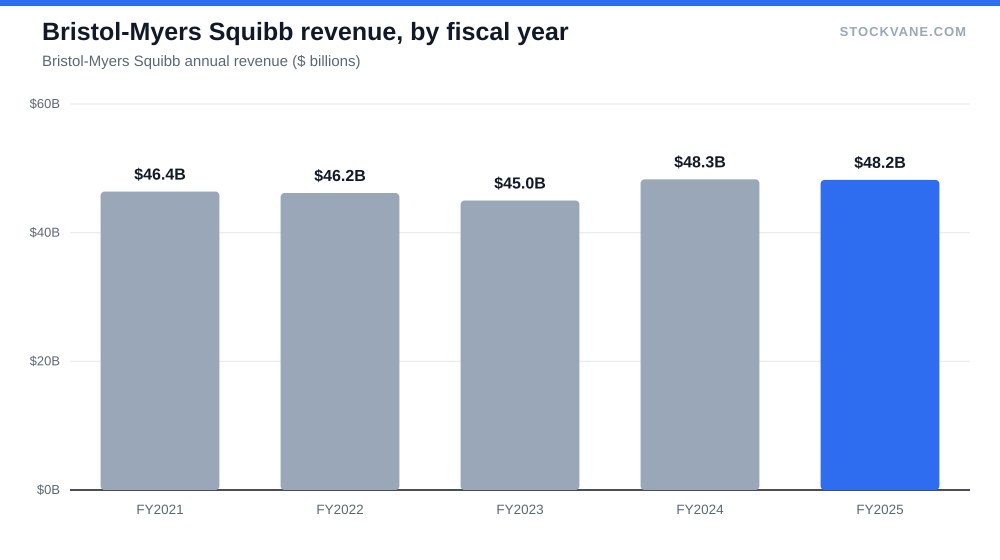
Revenue was $48.2 billion in fiscal 2025, flat against $48.3 billion the year before. The run rate from the latest quarter, $13.0 billion, annualizes to $51.9 billion. That quarter grew 6% from a year earlier and 13% from the March quarter. Two years earlier, in FY2023, revenue was $45.0 billion. So the company has added about $3 billion over that stretch while gross margin slid from 76.2% to 71.1%.
The segment table for the June quarter is where the concentration is visible. Eliquis at 34.5% of the named lines and Opdivo at 19.2% together account for 53.7%. Orencia adds 8.0%, Yervoy 5.9% and Reblozyl 5.7%. The remaining 11.5% sits in a bucket labeled Other. If you strip out the two big names, what is left is a set of mid-sized drugs that would have to grow briskly, and for years, to replace a meaningful fraction of the lost sales.
I use the word fraction advisedly. Generic entry typically takes a large share of a drug’s sales within a few years, but the pace differs by product and by market, and I do not have a DB number for it. What I can do is measure the exposure. If a third of Eliquis sales and a third of Opdivo sales disappeared, that would remove roughly 18% of named-product revenue. Rebuilding that from Orencia, Yervoy and Reblozyl, which together were 19.6% of the base, would mean roughly doubling them. That is arithmetic on the June split, not a forecast of what will happen.
The counter-case
Bristol has been through this before, and the case for calm is real. Revenue held near $48 billion through two years in which the loss and recovery rotated around it. The latest quarter grew 6% year over year. The quant rating in the database moved from C to B over the last stretch, a sign that the model sees improvement in whatever it measures. The operating margin in the DB rose to 23.3% on an EBIT basis in 2025 from -13.3%, and operating income of $13.7 billion is the highest in the six-year series (2021 was $8.5 billion). The company also owns a large enough balance sheet and research organization to keep buying growth, as it did in the years the DB’s numbers show heavy charges.
One caution on margins. Operating profit divided by revenue is 28%, while the DB’s EBIT margin is 23.3%. They differ because they are built from different line items, and I cite the EBIT figure when I talk about the margin trend and the operating income figure when I talk about dollars.
The short interest is small at 2.2% of float, so few traders are betting on a collapse. That cuts two ways. It removes a squeeze risk, and it shows that the bear case is already the consensus quiet view: everyone knows the cliff exists, few are willing to short a 4% yielder ahead of it.
What the stock has to earn
At $63 and a 3.98% yield, a buyer collects about $2.51 a year per share. Over five years that is about $12.5 if the dividend holds flat, or roughly 20% of today’s price. The stock has to hold its value for that number to count as return rather than a refund of capital. On a forward multiple of 16.0, the stock is not cheap enough to carry a large loss of earnings without the price falling too. Book value is the other gauge: price to book is 5.8 against a five-year average of 5.1, the 74th percentile of its own range. Price to sales of 2.6 matches its five-year average of 2.6. So on sales the stock sits exactly where it has usually sat, while on book it is above its usual range. Neither says bargain.
The risk/reward calculator is a fast way to test a position size against a downside level. If I assumed a 20% price drop on an earnings reset against a 4% annual dividend, the yield offsets five years of holding only after a long wait. That framing is why I would size this as an income position, not a growth position. For a pharma peer with the opposite profile, a growth story where the forecast keeps getting larger, see the Eli Lilly obesity-market post, which frames that market’s sizing debate; Bristol has no equivalent product in the database’s segment list.
The Eliquis line I would check on October 29
The next report is due 2026-10-29. Last time, on July 30, the stock moved +2.8%, against an average earnings move of 4.6%, and the quarter before it moved 5.2%. What I would read first is the Eliquis line. If it stays near $4.5 billion, the concentration story is still a future problem. Eliquis sliding to under a third of named revenue while the total holds would mean the replacement drugs are doing their job, and the yield would deserve more trust. Should Eliquis hold while the smaller lines stall, the cliff is closer than the title says. I would also want forward EPS to stay above $3.60, at which the payout ratio stays under 70%. A print below that, with the price still near $63, would make the yield the cheapest part of a stock that has not repriced.
Financial disclaimer: The content on StockVane is for educational and informational purposes only and should not be construed as professional financial advice. Stock market investing involves risk of loss.
Sources: Dividends (SEC Investor.gov glossary) (https://www.investor.gov/introduction-investing/investing-basics/glossary/dividend) · Dividends tax topic (IRS) (https://www.irs.gov/taxtopics/tc404)