
Fortinet closed at $170, 131% above its 52-week low of $74. The average analyst target is $173, only 2% above the price. And of 27 analysts covering the stock, just 22% rate it a buy.
The headline says the business is fine and the rating says otherwise. Both halves hold up, and they are not in conflict. The business has grown revenue 14% in fiscal 2025 and 26% in the latest quarter. The rating is a price call. A stock that has more than doubled from its low leaves an analyst little to recommend except the next year’s earnings.
What is fine about the business
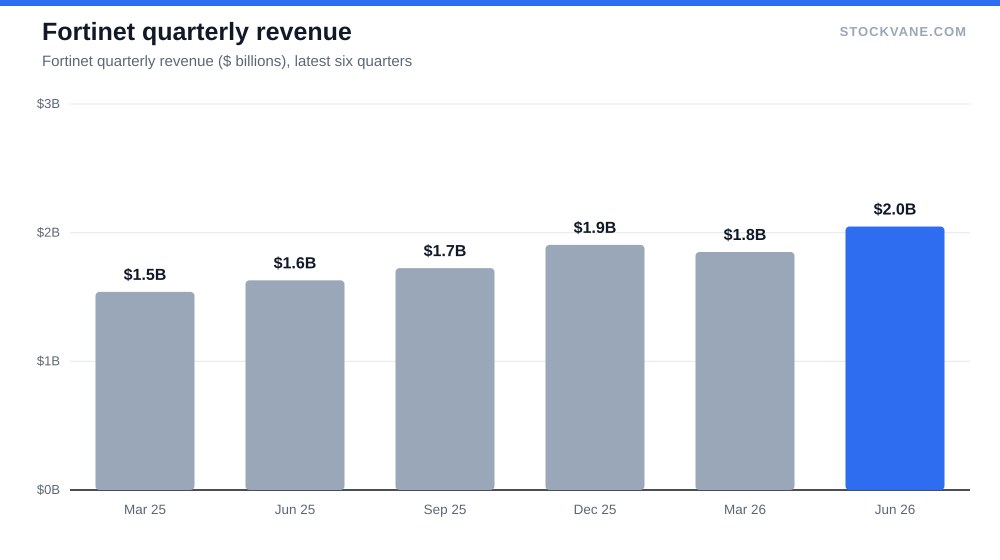
Revenue was $6.8 billion in fiscal 2025, against $2.6 billion in 2020, so it has more than doubled in five years. Growth rates over the period were 20%, 29%, 32%, 20%, 12% and 14% from 2020 through 2025. The pace peaked in 2022 and settled near the low teens, before the latest quarter, $2.0 billion, jumped 26% from a year earlier and 11% from the quarter before. Earlier quarters in our database grew 14%, 15% and 20%. The trend has gone the right way for three quarters running.
Margins are the stronger part. Operating income divided by revenue was 20.5% in 2020, 21.9% in 2022, 30.2% in 2024 and 30.6% in 2025. The big move came in 2024, when operating income went from $1.24 billion to $1.80 billion on revenue growth of 12%. The database’s EBIT margin, a slightly different measure, was 34.9% in 2024 and 33.9% in 2025, so on that series margin slipped by a point last year. We use the operating figure above and flag the EBIT number so nobody compares the two.
Gross margin has held at about 80.5%, against 80.6% the year before. Net income was $1.9 billion on a net margin of 27%. Few hardware-heavy companies earn that.
The comparison worth making is with the software argument. Palantir’s valuation math asks how many years of growth a high multiple needs to pay back. Fortinet’s version is milder, with a lower multiple and steadier profits, but the arithmetic is the same and the answer depends on how long 20% growth lasts.
Earnings per share have grown less than the top line lately. Diluted EPS rose 55% in 2024, to $2.26, then 7% in 2025, to $2.42. Trailing twelve-month EPS in the valuation data is $2.83, which is the figure behind the 60.0 multiple.
Where the rating comes from
The multiple. Fortinet trades at 60.0 times trailing earnings against a five-year average of 54.3, so it costs 1.11 times its own history, and the group average is 32.1. On forward estimates of $3.16 per share the multiple is 53.7, still well above the industry. The forward figure implies 12% growth in profit, well below the 55% of 2024 and only a little faster than the 7% of 2025.
Price-to-sales is starker. Fortinet stands at 16.7 times revenue against a five-year average of 11.7 and a group average of 7.3. That is the 95th percentile of its own range. The stock is priced at 1.43 times its own historical sales multiple and more than twice the industry.
A consensus rating that sits at hold for a company like this follows almost mechanically. Of the 27 analysts, six rate it a buy, seventeen a hold and four a sell. With the average target 2% above the price, a hold is a reasonable label for a stock whose expected return is about the dividend it does not pay. The lowest target is $102 (-40%) and the highest $220 (+30%), a range wide enough to make a case for either side.
Costco at 50 times earnings works through the same question, what the market pays for a very good business, with a very different stock. Fortinet sits in that family: the numbers are good, and the multiple assumes they stay good.
| Metric | Value | Context |
|---|---|---|
| Price (approx.) | $169.84 | 52-week range $74 to $176 |
| P/E (TTM) | 60.0x | Five-year average 54.3x |
| Price-to-sales | 16.7x | Five-year average 11.7x |
| Analyst ratings | 22% buy, 63% hold | 27 analysts; average target $173 |
What the tape has done
The stock is 3.6% below its 52-week high of $176. The market value is $124.6 billion. From the low of $74 the shares have added 131%. Fortinet’s earnings-day moves have been large: the last four one-day reactions in our database were -22.0%, -6.3%, +20.0% and +0.7%, newest last, with an average absolute move of 12.3%. So a quarter can move the stock by a fifth in either direction. The July 29 report produced a quiet +0.7%, after a quarter with 26% revenue growth. A good number was expected.
The database’s quantitative score went from C to B over the last forty trading days. Short interest is 1.8% of float, low enough to leave squeeze dynamics out of it. There is one item in the news feed worth a line: an officer sold $9.39 million of common stock on September 17. One sale says little on its own, and the data does not tell us whether it was scheduled, so we do not read it as a signal.
Those who use options on names like this can turn a hold rating into income. The mechanics are in our guide to selling puts, and a stock that swings 12.3% on average around earnings pays a fat premium for a reason. It is a poor idea to sell a put just before a report, since the whole premium is compensation for the gap risk.
One more comparison belongs here. The quarter that just reported grew revenue 26%, yet the shares moved less than one percent on the day. When a company posts its fastest growth in the database and the stock shrugs, the market is telling you the growth was already in the price. That is the strongest evidence in this note for the price-call reading of the rating: the analysts are not doubting the quarter, they are doubting what is left to gain from it.
What the price asks of the next three years
Take the trailing multiple of 60.0 and ask what earnings must do to bring it to the group’s 32.1. Divide, and the answer is that EPS has to rise by about 87% with the price unchanged. At the forward estimate’s 12% annual pace that takes about 6 years. At the 26% quarterly revenue pace, with margins flat, it takes closer to three. The price is a bet on the second pace, and the rating reflects the arithmetic of the first.
Nothing in that calculation is exotic. It is the reason the target range looks the way it does. Analysts anchored to the estimate see a stock at about fair value. Those anchored to the last quarter see room to $220.
The five-year record adds context. Fortinet’s diluted EPS rose from $0.58 in 2020 to $2.42 in 2025, a fourfold gain, and the shares’ multiple has swung between 35.3 and 73.3 over the same window. At 60.7 today, the stock is in the 73rd percentile of that band. It has been more expensive, and it has been much cheaper, and both happened while the business was compounding.
Put dollars on the target range. From $170, the average target of $173 is a gain of 2%, or about $3 a share. The high target of $220 adds $50, and the low of $102 takes away $68. The downside leg is larger than the upside leg in dollars, and that asymmetry, more than any judgment about the company, is what an analyst is writing down when the rating says hold.
What would make the hold rating wrong
Two things. The first is faster growth. If revenue growth holds at or near the 26% of the latest quarter for another two quarters, forward estimates of $3.16 will look low, and the 53.7 forward multiple will compress quickly through earnings. The rating would be behind the data, and upgrades would follow.
The second is that a hold could also be too generous. Roughly six in ten analysts sit in the middle, and if growth returns to the 12% to 14% of the past two fiscal years while the multiple stays where it is, the stock has -40% of downside to the lowest target on the street. The price-to-sales ratio of 16.7 does not survive a return to low-teens growth for long.
What we are not covering: cash flow, deferred revenue and any product-level detail beyond the three reported revenue lines. The latest quarter had product sales of $773 million (37.7%), security subscriptions of $730 million (35.6%) and technical support of $545 million (26.6%). Product is the largest, and it is the hardware side of the business that the earlier bear argument aims at. We have no data here to say whether that mix is shifting.
Two numbers for the November report
Revenue growth and operating margin. Growth has to stay above 20% to justify a multiple of 53.7 on forward earnings, and the operating margin has to stay above 30%, where it has been for two fiscal years. If both hold, the 22% buy share is too low and we would expect it to rise. If growth falls under 15% while the price stays near $170, the hold rating will look like the optimistic side of the argument.
Financial disclaimer: The content on StockVane is for educational and informational purposes only and should not be construed as professional financial advice. Stock market investing involves risk of loss.
Sources: Dividends (SEC Investor.gov glossary) (https://www.investor.gov/introduction-investing/investing-basics/glossary/dividend) · Dividends tax topic (IRS) (https://www.irs.gov/taxtopics/tc404)