
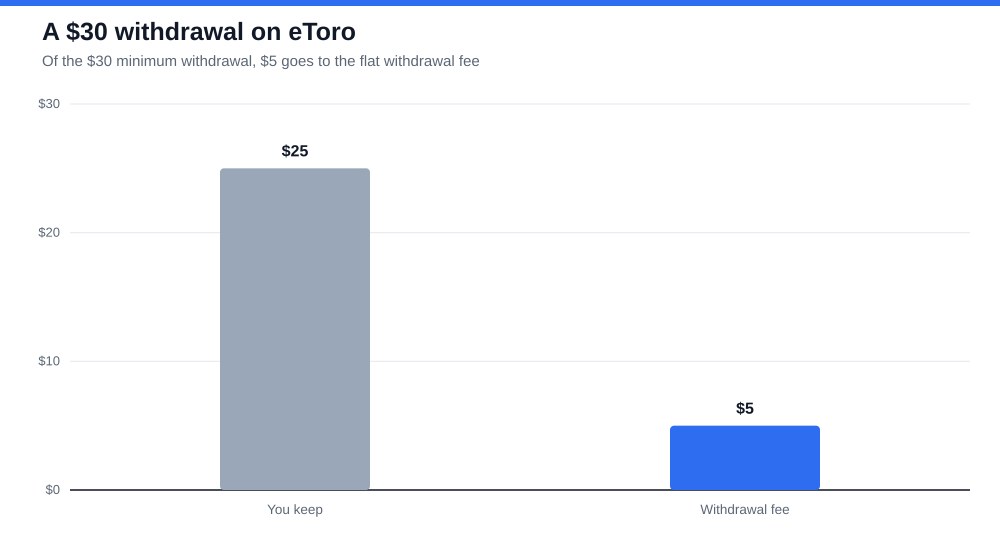
She wanted her $30 back. That was the whole request, a small withdrawal from an eToro account she’d funded to try CopyTrader for a few weeks. Five dollars of it stayed behind, a flat withdrawal fee that doesn’t scale down for small amounts any more than it scales up for large ones. On $30, that’s not a rounding error. That’s 16.7 percent of the money she asked for, gone before it left the platform.
eToro’s pitch works, and I’ve watched enough new investors get pulled in by the clean interface and the CopyTrader feature to know why. The question worth answering isn’t whether the pitch works. It’s whether the fee structure behind it holds up once real money is moving, and the honest answer is neither “eToro is a scam” nor “eToro is great for beginners.” It’s conditional, and the conditions are exactly the parts the sign-up flow doesn’t dwell on.
The fee structure looks simple until you actually trade
eToro markets itself as commission-free, and for US stocks and ETFs bought outright, not on margin, that part is true. The cost lives everywhere else. Crypto carries a flat 1 percent fee on both the buy and the sell, so a round trip costs 2 percent before the position has moved a cent in your favor. Buy $1,000 of Bitcoin and eToro takes $10 at the moment of purchase, a number that doesn’t show up anywhere obvious on the order screen unless you already know to look for it. The Bitget review and the Binance vs Coinbase breakdown on this site cover the same pattern on other platforms: crypto fees that hide inside the spread instead of sitting on a clean line item the way a stock commission would.
| Cost | Rate | Example impact |
|---|---|---|
| US stocks/ETFs, no margin | $0 commission | True as advertised |
| Crypto, per leg | 1% each way | $10 fee buying $1,000 of Bitcoin |
| Crypto, round trip | 2% combined | About $20 on a $1,000 position, buy and sell |
| Withdrawal (USD account) | $5 flat, $30 minimum | 16.7% of a $30 minimum withdrawal |
| Currency conversion | 0.75% | $7.50 on a $1,000 conversion |
None of that makes eToro unusual. It makes eToro ordinary in a category where “commission-free” almost always means the cost moved somewhere less visible, not that it disappeared.
The withdrawal fee is a tax on caution
Then there’s the flat $5 withdrawal fee on USD accounts, paired with a $30 minimum withdrawal. To someone moving five figures at a time, $5 barely registers. To a beginner pulling out a small amount while they’re still deciding whether to trust the platform, it’s a direct cost on exactly the cautious behavior a new investor is supposed to practice. The math doesn’t improve with patience, either: withdraw the $30 minimum three times over a year while you’re testing the account, and the fee has already cost you half a percent of the entire balance before a single trade made or lost anything. Beginners funding accounts with very little money, the audience covered in the investing with little money guide, feel a flat fee like this far harder than an account with five figures in it ever will.
Currency conversion is the fee most people never see coming
On top of the crypto and withdrawal costs sits a currency conversion fee of 0.75 percent, charged whenever a deposit, withdrawal or trade crosses currency lines. On a $1,000 conversion, that’s $7.50, small next to the crypto fees but easy to trigger without noticing if your funding source isn’t in dollars. Layer it on top of a crypto round trip and a withdrawal, and three separate line items, each individually forgettable, add up to a cost structure that a beginner comparing headline commissions across brokers would never see coming.
What the complaints actually cluster around
Read enough forum threads and app-store reviews and a pattern holds that’s more useful than any single anecdote. Complaints rarely mention the stock-trading side of the account at all; commission-free US equities work about as advertised, and that part of the product doesn’t generate much noise. The complaints cluster tightly around the three costs above, plus a fourth theme that isn’t a fee: support response time once a withdrawal or a verification issue actually needs a human. New users expecting a quick reply on a stuck withdrawal describe waiting days, and a delay like that reads very differently on an account holding rent money than it does on a trading account someone can afford to be patient with.
None of that makes eToro an outlier among beginner-friendly brokers. Slow support during a dispute is a common complaint across the category, not a StockVane-specific finding about this one platform. What’s specific to eToro is that the underlying fees, crypto, withdrawal, conversion, are exactly the ones a first-time user is statistically most likely to trigger, which turns an ordinary support delay into a worse first impression than it would be on an account that never touched those fees in the first place.
CopyTrader is the actual product, not a bonus feature
CopyTrader is the reason most beginners land on eToro in the first place, and it’s worth being straight about what it is: a tool that mirrors another user’s trades into your own account, proportionally, in something close to real time. It lowers the bar to entry in a way few other platforms do, and for someone who has never placed a trade, watching a strategy execute automatically is a useful way to learn the mechanics before risking judgment of your own. It is not a research process, and it is not a substitute for reading what the person you’re copying is actually doing and why. A copied trader who trades crypto heavily passes every one of those crypto fees straight through to you, multiplied by however many trades they make in a week.
There’s a second cost CopyTrader creates that has nothing to do with the fee schedule: it teaches a beginner to outsource the decision before they’ve built any framework for making one themselves. Watching someone else’s trades execute is a fine way to learn what a stop order looks like in practice. It’s a poor substitute for learning why a position was sized the way it was, or what would make the person you’re copying exit early. Treat it as a demo account with real fees attached, not as a finished strategy, and it earns its place in a beginner’s toolkit. Treat it as the whole plan, and the fee structure becomes the least of the problems building underneath it.
Stack the three costs on the same test case and the pattern is consistent: each one is small in isolation and each one is easy to hit if your behavior looks anything like a typical beginner’s, funding in a foreign currency, trying crypto once, moving small amounts while still deciding whether to stay.
Who I’d actually put on eToro
Someone buying and holding US stocks and ETFs without margin, funding in dollars, and withdrawing rarely pays almost none of this. The commission-free claim is true for that person, full stop, and CopyTrader gives them a low-friction way to watch how other investors think before committing capital of their own. That’s a real use case, not a marketing fiction.
Someone planning to trade crypto regularly, fund from a non-dollar account, or move money in and out in small increments pays for all three fees repeatedly, and the “beginner-friendly” framing stops matching their actual experience fast. For that person, a platform built around explicit per-trade commissions rather than percentage-based crypto and conversion fees, the kind of structure the IBKR Lite vs Pro comparison or the Moomoo vs IBKR breakdown on this site walk through, usually ends up cheaper once trading gets frequent, even before accounting for the withdrawal fee eToro charges on every exit.
I’d put a third group in between those two, and it’s the largest one in practice: beginners who start out sure they’ll stay in the first category and drift into the second without deciding to. Someone who opens an eToro account to hold a handful of ETFs tries crypto once because it’s one tap away in the same app, funds an extra $200 from an account in a different currency because it was convenient that week, and withdraws small amounts twice while they’re still building confidence. None of those three moves is reckless on its own. Together they touch every fee on the list above, and the account ends up costing meaningfully more than the “commission-free” headline promised, not because anything went wrong, but because the platform’s easiest path and its cheapest path aren’t the same path.
The number to check before you fund the account
Not the commission line. Count how many withdrawals you expect to make in a normal year, and multiply by five. If that number is small next to the balance you’re funding with, the fee structure barely touches you. If it isn’t, run the same trade pattern through a broker that charges per transaction instead of per percentage point, because eToro’s costs scale with behavior a genuine beginner is likely to have, small trades, small withdrawals, at least one attempt at crypto, and none of that behavior is a mistake. It’s just the wrong fit for this particular fee schedule.
Financial disclaimer: The content on StockVane is for educational and informational purposes only and should not be construed as professional financial advice. Stock market investing involves risk of loss.
Sources: How to read a company's 10-K (SEC Investor.gov) (https://www.investor.gov/introduction-investing/investing-basics/glossary/10-k) · Price-to-earnings ratio (SEC Investor.gov glossary) (https://www.investor.gov/introduction-investing/investing-basics/glossary/price-earnings-pe-ratio)