
Micron closed June at $1,154. It closed July at $823, a fall of 29% in one month, and closed August at $959. As I write this the stock trades around $1,016. A holder who lived through that swing was watching a company that had just earned $28.2 billion in a single quarter.
That quarter is the reason this stock is hard to price. Micron’s net income was 68% of its revenue, more than double the 28% it earned at the last cycle peak in fiscal 2022. Either memory has become a different business, or the market is looking at a peak and calling it a baseline. My view is that the price already gives Micron most of the credit for the first possibility, and the trailing multiple of 23.0 looks cheaper than it is.
Two quarters that changed the arithmetic
The financials tab shows a company that was ordinary a year ago. Revenue in the quarter ended August 2025 was $11.3 billion. Then came $13.6 billion, then $23.9 billion, then $41.5 billion in the quarter reported on June 24. The last two steps were sequential gains of 75% and 74%. Against the same quarter a year earlier, the latest figure is up 346%.
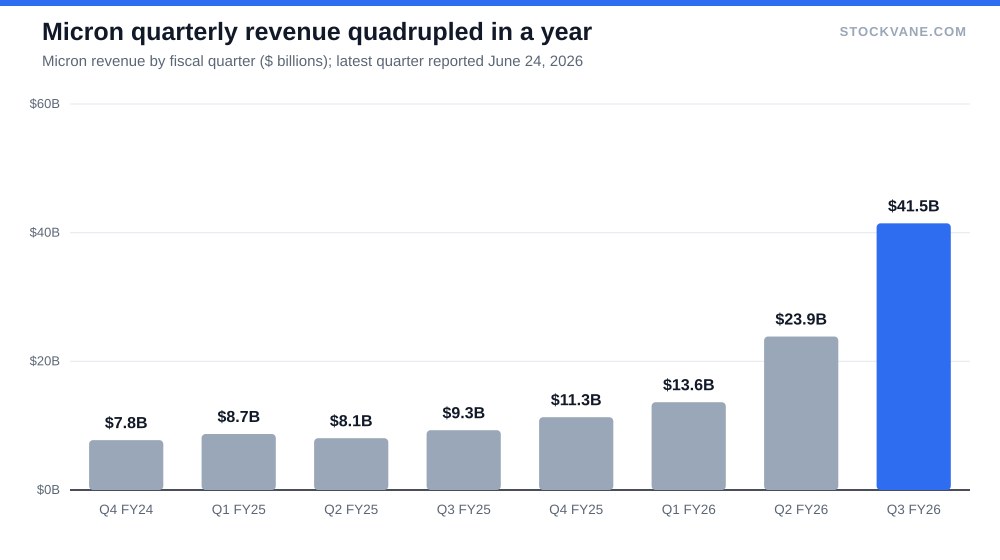
For most manufacturers a chart like that would prompt a search for an acquisition. Here there is none. The segment data does not explain it either, but it shows where the revenue sits: the two data-center units, cloud memory and core data center, made $25.3 billion of the $41.5 billion, or 61% of the total. Mobile and client was $11.5 billion and automotive and embedded $4.6 billion. I would read the mix as AI server demand pulling on a supply base that was slow to add capacity, though our data cannot confirm the mechanism, and I would treat that as an inference. The wider question of who else profits from that spending is in our breakdown of the semiconductor names beyond Nvidia.
Profit rose faster than sales. Net income was $3.2 billion in the quarter ended August 2025, $5.2 billion, $13.8 billion, and then $28.2 billion. Net margin climbed from 28% to 38%, 58%, and 68%.
What a 68% margin has to be compared with
Here is the number I keep returning to. In fiscal 2022, the last time memory was tight, Micron kept 28 cents of each sales dollar as net profit. In fiscal 2025 it kept 23 cents. In fiscal 2023, when revenue fell 49.5% from $30.8 billion to $15.5 billion, it lost 38 cents. Set those against 68 cents and the latest quarter looks like a statistical outlier, and the burden of proof lies with anyone who says it is the new normal.
There is a fair case that it is. Data-center memory is a tighter market than phone or PC memory, buyers there plan further ahead, and three suppliers dominate DRAM. I take that argument seriously. What I cannot see in our data is contract length or how much of the latest quarter’s pricing is locked in, which is the piece that would settle it. Without it, I would not underwrite a margin that is 2.4 times the previous peak for more than a few quarters.
| Metric | Value | Context |
|---|---|---|
| Latest quarter revenue | $41.5B | Up 346% on the year; fiscal Q3, reported June 24 |
| Latest quarter net income | $28.2B | 68% of revenue, against 28% in fiscal 2022 |
| Price (approx.) | $1,015.80 | 52-week range $154 to $1,255 |
| P/E (TTM) | 23.0x | Five-year average 13.5x |
| Price-to-sales | 12.2x | Five-year average 5.2x |
| Analyst ratings | 97% buy, 3% hold | 29 analysts; average target $1,566 |
| Dividend yield | 0.05% |
What 23 times earnings is really saying
Micron’s valuation tab puts the trailing P/E at 23.0, against a five-year average of 13.5. That is a premium of about 70% to its own history, which sounds steep until you remember how fast profit has grown. The comparison flatters, though. Trailing earnings here are the sum of four quarters, and only the last one carries the extraordinary margin. The $50.5 billion of net income over twelve months works out to about $44 a share, but the latest quarter alone, annualized, points to something closer to $100.
The forward multiple is the more revealing figure. It sits at 6.8, which at today’s price implies analysts expect roughly $150 a share over the next twelve months, 3.4 times the trailing figure. Even the annualized latest quarter, about $100 a share, falls short of that. So the consensus is already assuming revenue keeps growing from $41.5 billion, at a margin close to today’s. That is a lot to ask of an industry that lost half its sales three years ago.
Other measures say the same thing. Price to sales is 12.2, against a five-year average of 5.2, in the 96th percentile of its range. Price to book is 10.9 against 3.2. Earnings are the only ratio that looks tame, and they are the one that can shrink fastest.
The grid below holds revenue at the annualized latest quarter, about $166 billion, and varies two things: how much of it turns into profit and what multiple the market pays. It is arithmetic, not a forecast.
| Net margin P/E multiple | 8x earnings | 12x earnings | 16x earnings |
|---|---|---|---|
| 68% net margin (about $100 a share) | $799 | $1,198 | $1,597 |
| 45% net margin (about $66 a share) | $529 | $793 | $1,057 |
| 28% net margin (about $41 a share) | $329 | $493 | $658 |
Read across the middle row. If the margin settles at 45%, still well above anything Micron has posted in a full year, earnings would be about $66 a share, and the current price of $1,016 would already be 15.4 times that. The five-year average P/E is 13.5. At the 10.2 times the price implies if the 68% margin lasts, the stock is cheap. At 24.7 times a fiscal-2022 margin, it is expensive. The price is a bet on which row you are in.
The bear case has an outside author
Morningstar rates Micron three stars with a fair value estimate of $850, and it says plainly that it does not see an economic moat: DRAM and NAND are commodity-like products, and returns across a full cycle have not been high enough to justify one. The stock trades about 20% above that fair value. That is one firm’s opinion, and it was formed with different inputs from the ones I have used, so I would not weight it heavily on price. I include it because it states the history the bulls have to argue against.
The other side of the ledger is the analysts. Twenty-nine of them cover the stock, 97% rate it a buy, and the targets run from $1,100 to $2,200 around an average of $1,566, or 54% above the price. Even the lowest target is 8% above it. A reasonable person would ask why I am not simply following them. Partly it is that Bernstein reiterated a Buy with a $1,300 target on September 8, which is 28% above the price and well below the average. The distribution is wide, and the middle of it is not where the headline number sits.
The other reason is the 2023 precedent, which our piece on the AI capex cycle covers from the demand side. Micron’s revenue fell by half in fiscal 2023, and inventory digestion is the usual explanation for a memory downturn: when buyers order beyond their needs and then stop, a supplier’s sales fall by more than the buyers’ own. Nothing in our data says that is happening now. It also could not show it until it did.
What the tape and the score say
The StockVane quant rating is an A with a score of 100, up from a C at 60 on September 8. I do not lean on it here. It reads price behavior, and the price went from $823 to $1,016 in two months, so a perfect score is close to a restatement of the rally. Short interest is 2.6% of the float with about 1.2 days to cover, which is too small to squeeze the stock or to restrain it.
Daily closes tell the same story more sharply. The stock peaked at $1,213 on June 25, the day after the last report, and fell 39% to $739 by July 29. It has since bounced 37% off that trough. I do not have a news item in our data that explains the drop, so I will not offer one. The size of it is the useful fact: a holder who sized the position for a 15% pullback would have been forced to decide in July.
The dividend does nothing to cushion this. Micron pays $0.15 a quarter, up from $0.115 last year, which is a yield of 0.05% at the current price. Nobody owns this stock for income, and the balance sheet, with an equity ratio near 75% in the latest quarterly ratios, suggests the company can carry a downturn better than it could in 2023. That helps the business survive. It does not protect the share price.
The stock is 19% below its 52-week high of $1,254.81 and 6.6 times its low of $154.40. Anyone who bought at the September 2025 month-end close of $167 is up about six times. I would not buy today as though that were the base rate.
What the September 30 report has to show
Micron reports fiscal fourth-quarter results on September 30. The last four earnings-day moves were a gain of 15.7% in June, a decline of 3.8% in March, a gain of 10.2% in December and a decline of 2.8% a year ago in September. The reactions have been large in both directions, and I would not read the direction of the last one as a pattern.
I care about two numbers. The first is sequential revenue growth. It has been running above 70% for two quarters, and it would be a fine result even at 25%; a figure in the single digits would tell me the pricing surge has stopped. The second is net margin. If it holds above 60%, I would take the forward multiple more seriously. If it slips toward the 45% row of the grid, the stock is priced for a result the company has not delivered.
I am neither buying nor selling ahead of that report. I would hold no more than a position small enough that a month like July, down 29%, would not force a decision, and I would add only if the margin holds and the price pulls back toward $850, Morningstar’s fair value.
Financial disclaimer: The content on StockVane is for educational and informational purposes only and should not be construed as professional financial advice. Stock market investing involves risk of loss.
Sources: Dividends (SEC Investor.gov glossary) (https://www.investor.gov/introduction-investing/investing-basics/glossary/dividend) · Dividends tax topic (IRS) (https://www.irs.gov/taxtopics/tc404)