
The best thing a portfolio can do is bore you. If you check it every morning because something interesting might have happened, you have probably built it wrong, and adding a fifteenth fund to fix that feeling usually makes the boredom problem worse and the diversification problem no better.
This is the case for owning three funds, and only three, for most of your investing life. We are going to put numbers on it, including the ones that argue against it, because the strongest version of the idea is the one that admits where it can fail.
Three funds, three jobs
The classic version pairs a total U.S. stock market fund, a total international stock fund and a total bond market fund. Each fund owns a whole asset class instead of a hand-picked slice of it, and each has one job.
The U.S. fund is the growth engine. A fund like Vanguard’s VTI holds more than 3,500 U.S. stocks, from the giants at the top to small companies most people have never heard of, and charges 0.03% a year. The international fund, such as VXUS at 0.05%, owns companies in developed and emerging markets outside the United States. It exists because nobody can reliably say in advance which country’s stocks will lead over the next decade. The bond fund, such as BND at 0.03%, is the ballast. It will not make you rich, but it softens the years when stocks do not cooperate, and it gives you something to sell from without selling shares at a bad moment.
That is the entire structure: three tickers to track and one yearly decision about whether to rebalance.
Why the international slice is the hard one to hold
The international fund is the one investors tend to drop, because for long stretches it has looked like dead weight. The comparison in one recent year makes both sides of the argument. According to CNN’s year-end review of global markets, the MSCI All Country World ex-USA index gained 29.2% in 2025 against 16.4% for the S&P 500. A weaker dollar explained much of the gap. Over the years before that, U.S. stocks had led by a wide margin, which is exactly why so many investors dropped the international fund at the wrong time. Part of that lead came from rising valuations, and our look at whether the S&P 500 is overvalued tests how much of it is still priced in.
We do not know which of those two patterns comes next, and that is the point. A three-fund portfolio does not bet on either. It holds both because the person who chooses the winner in advance has to be right twice: once when they pick, and once when they switch.
The Bogleheads community, which popularized this structure, often suggests putting about 40% of the stock portion outside the United States. We use that as the illustration below. It is one reasonable convention, not a law, and reasonable investors hold anywhere from 20% to 50%.
What the mix looks like at different ages
The right weights depend on how long until you need the money and how you behave when a portfolio falls 20% in a month. These three examples hold the international share at 40% of the stock portion and change only how much sits in bonds. They are illustrations, not advice.
| Stage (illustrative) | U.S. stocks | International stocks | Bonds | Blended fund cost |
|---|---|---|---|---|
| Long horizon | 54% | 36% | 10% | 0.037% |
| Middle years | 42% | 28% | 30% | 0.036% |
| Near retirement | 30% | 20% | 50% | 0.034% |
The last column is the part people miss. Across all three mixes, the blended annual fund cost lands between about 0.034% and 0.037% of assets. On $100,000 that is roughly $34 to $37 a year for the entire portfolio.
Compare that with the portfolio we mentioned at the start. Fourteen funds at an average of 0.20% would cost about $200 on the same $100,000, roughly five times as much. That is a hypothetical, and plenty of multi-fund investors pay less, but the direction is reliable: each specialty fund tends to cost more than the broad index fund it partly duplicates. The difference is small in one year and large over thirty.
The overlap you cannot see
The bigger problem with a pile of funds is not the fee. It is that the funds quietly hold the same things. Here are four U.S. funds and how far each has moved from its 52-week low as of September 18, 2026, using StockVane’s price data.
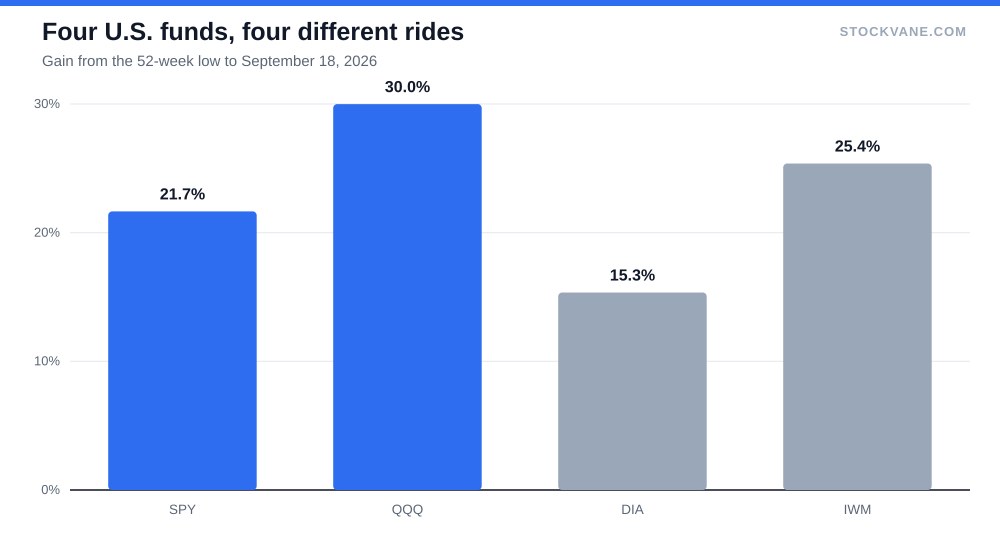
The S&P 500 fund, SPY, is up about 21.7% from its low. The Nasdaq-100 fund, QQQ, is up about 30.0%. The Dow fund, DIA, is up about 15.3%, and the small-cap fund, IWM, about 25.4%. They do differ, and if you wanted to hold a small-company tilt on purpose, IWM is a fair way to do it. But the S&P 500 and Nasdaq-100 funds share many of the same largest holdings, so owning both mostly means owning the same mega-cap companies twice.
A total-market fund already holds all four groups in the proportions the market assigns. If you add QQQ to a total-market fund, you have not added a new kind of stock. You have raised your bet on the biggest technology names, which may be what you want, but it should be a decision and not an accident. Our guide to investing with little money makes the same point from the beginner’s side: most first portfolios fail from too many decisions, not too few.
What a bond fund can lose
A bond fund can lose value too. When interest rates rise, the market price of existing bonds falls, and a broad fund like BND holds intermediate-term bonds, so it feels those moves. It has also paid a yield near 4% recently, and that interest is taxed as ordinary income in a regular brokerage account, which is one reason many people hold bond funds inside a retirement account instead. If you have both kinds of account, the location of each fund matters almost as much as the choice of fund.
The bond slice also does something psychological that the spreadsheet does not capture. When stocks fall hard, a portfolio with a real bond position lets you rebalance by buying shares with money from the part that held up. That is a mechanical rule you can follow without needing courage.
Rebalancing without a spreadsheet
Rebalancing is the only maintenance a three-fund portfolio needs. Say you start at 54% U.S., 36% international and 10% bonds, and both stock funds rise 20% while bonds go nowhere. Your $100 becomes about $118, and the mix drifts to roughly 55% U.S., 37% international and 8% bonds. Nothing dramatic has happened, but you now hold less of the boring asset than you planned.
Most people rebalance once a year, or when any slice drifts five percentage points from its target. New contributions make it easier: send each paycheck to whichever fund is furthest below target, and you may never have to sell anything. In a retirement account there is no tax cost to selling, so that is the place to do the larger moves.
The reason this works is that it turns a feeling into a rule. After a strong year for stocks, the rule says trim some. After a bad year, it says buy. Doing either on instinct is hard, which is why a schedule works better than a judgment call.
When a fourth fund earns its place
Three is not a rule. A REIT fund adds real estate, which is a small part of the broad stock index. A short-term bond fund makes sense alongside a broader one when you know you need cash in two years. The dividend growth piece we wrote covers one such tilt in more depth, and its limits.
Each of those choices is a bet on something specific, and that is fine. The problem starts when the fourth, fifth and sixth funds are there because each sounded good on its own. Then the portfolio grows without anyone deciding what it is for.
Our own uncertainty is about the split, not the structure. Whether 40% international is too much or too little has no settled answer, and someone who thinks the recent rebound abroad will fade could reasonably hold less. The structure itself is easier to defend than any particular set of weights.
The one-sentence test
Before you add any fund, try to finish this sentence out loud: “I am buying this because it gives me X, which I do not already own through my other funds.” If you cannot name X, or if X is really “the same big companies with a different label,” the fund does not go in.
If you already own more than three, do not sell everything on Monday. Check the top ten holdings of each one, write down how much of your money sits in the same five or six companies, and decide whether that number matches the risk you meant to take. If you own more than three, the exercise usually shrinks the portfolio on paper: five funds turn out to be one bet held five times. Three funds cover the job, and if checking them feels dull, that is the design working.
Financial disclaimer: The content on StockVane is for educational and informational purposes only and should not be construed as professional financial advice. Stock market investing involves risk of loss.