
On July 27 Goldman Sachs cut its target on Lockheed Martin to $503 and kept a sell rating. On September 8 UBS moved the other way, upgrading to buy with a target of $674. Between those two calls, six weeks apart, sits a stock at $533.38. It is 21.9% below its 52-week high of $683, and the analysts who cover it cannot agree on whether that is a bargain or a fair price.
The count is lopsided in the direction that matters for the headline. Of 14 analysts, 36% rate the stock a buy, 57% a hold and one, Goldman, a sell. My reading is that the defense budget story is well known, the margin story is what holds the ratings at hold, and cash decides it more than sales do. Trailing earnings are rebounding sharply from a bad 2025, but the stock at 19.7 times those earnings is not cheap enough to ignore the risk that the rebound is a one-off.
The backlog I cannot show you
The title of this post leans on Lockheed’s backlog, so I owe a plain statement. The database behind these numbers carries no backlog or order-book line for the company, and I will not quote one from memory. What the financials tab does carry is the revenue that backlog is being converted into, and that is a real stand-in for demand.
Revenue was $66.0 billion in 2022 and $75.0 billion in 2025. Growth ran 2% in 2023, 5% in 2024 and 6% in 2025. The last four reported quarters were $18.61 billion, $20.32 billion, $18.02 billion and $20.06 billion, and the June quarter was up 11% on a year earlier after a flat March quarter at 0%. From $65.4 billion in 2020 to $75.0 billion in 2025 is 15% growth over five years. That is demand showing up as sales. It is steady, with no explosive year in the run.
Where the money is made
Segment sales for the June quarter give the mix. Aeronautics, where the F-35 sits, brought in $8.22 billion, 41% of segment sales before eliminations. Rotary and Mission Systems was $5.02 billion, 25%. Missiles and Fire Control was $4.35 billion, 22%, and Space $3.58 billion, 18%. Intersegment sales subtract $1.11 billion. One program family carrying two-fifths of the sales is a concentration I would want a lot of margin cushion for.
The database has no segment margins, so I cannot tell you which of the four is dragging the total. That limits how far I can push the analysis, and I would rather say so than guess at a culprit.
Revenue up, margin down
Operating income was $9.12 billion in 2021 on revenue of $67.04 billion, a margin of 13.6%. In 2025 it was $7.73 billion on revenue of $75.05 billion, a margin of 10.3%. Sales rose 12% between those two years. Operating profit fell 15%.
The step down came in 2024. Margin held at 12.7% in 2022 and 12.6% in 2023, then dropped to 9.9% in 2024 and recovered only to 10.3% in 2025. Gross margin tells the same story: 9.8% in 2024, 10.2% in 2025, against 12.6% in 2023. (The database’s separate EBIT margin, 9.4%, uses a different definition, so it is a second lens, and it does not conflict with the figures above.)
That is a loss of roughly three points of margin in one year on a business with $75 billion of revenue. Each point is about $750 million of operating profit. Three points is over $2 billion a year that used to reach shareholders and no longer does. Fixed-price development programs running over budget are the usual cause in defense, and the pattern fits, but the numbers here do not prove it, so I am flagging it as an inference.
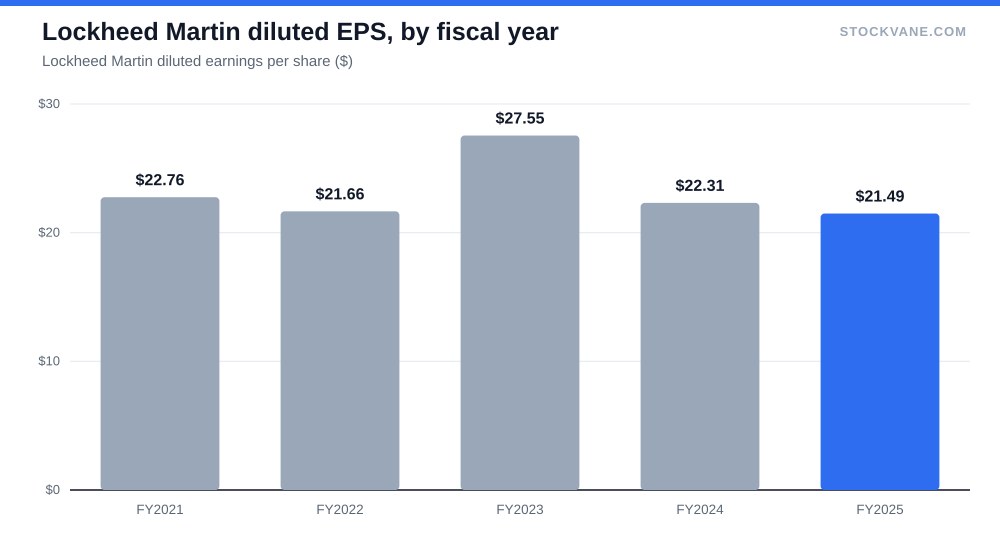
The EPS line makes the damage visible. Diluted EPS was $27.55 in 2023, $22.31 in 2024 and $21.49 in 2025. Net income fell from $6.92 billion to $5.02 billion in two years while revenue grew $7.5 billion.
A rebound that comes with an asterisk
The trailing twelve-month EPS in the database is $27.12, 26% above the 2025 figure of $21.49. On its face that is a recovery. Look at the quarters. Diluted EPS was $1.46 in the June 2025 quarter and $2.22 in the December 2024 quarter, both far below the roughly $6 to $7 that the other quarters produce. Those two weak quarters are the reason 2025 looked so poor; they have now mostly rolled out of the trailing window, which lifts the trailing figure from $21.49 to $27.12.
The most recent four quarters ran $6.95, $5.80, $6.44 and $7.94. That last one, for the June 2026 quarter, was the strongest in the run. No single outlier inflates the trailing number, yet it also compares against two unusually weak quarters, and a good part of the 26% is just the absence of those charges. I would treat the $27 trailing figure as the base case and the $30.70 that analysts assume for the coming year, a 13% gain, as the part that still has to be earned.
The market’s reaction supports some patience. After the July 23 report the shares gained +10.5%, but the April report had produced a drop of 4.6%. Across the last four reports the average move was 5.7% in absolute terms. This is a stock that reprices fast when margins surprise in either direction.
What the multiple says
| Metric | Value | Context |
|---|---|---|
| Price (approx.) | $533.38 | 52-week range $429 to $683 |
| P/E (TTM) | 19.7x | Five-year average 20.7x |
| Price-to-sales | 1.6x | Five-year average 1.7x |
| Analyst ratings | 36% buy, 57% hold | 14 analysts; average target $630 |
| Dividend yield | 2.56% |
The stock trades at 19.7 times trailing earnings (see the valuation tab) against a five-year average of 20.7, and the percentile gauge puts it at the 43rd percentile of its own range (16.6 to 24.8). On analyst estimates the forward multiple is 17.4. Price to sales is 1.6 against 1.7. The valuation group average in the database for P/E is 33.2, so Lockheed sits far below the group, though I would not lean on a group average alone.
At the five-year average multiple of 20.7, trailing EPS of $27.12 would put the shares near $561, about 5% above today’s price. That is the fair value on a repeat of the last twelve months. It is a modest gap and it leaves no room for the margin to slip again. Compare that with the analyst average target of $630, which is 18% above the price and requires the 13% EPS growth to arrive. The lowest target, Goldman’s $503, is 6% below the price. It is unusual to see a large-cap stock where the range of professional targets straddles the price this way.
Cash and the dividend
Operating cash flow is where the story turns less cheerful. In the last four reported quarters it was $3.73 billion, $3.22 billion, $0.22 billion and $3.24 billion, a total of $10.4 billion. The March quarter, at $220 million, was nearly nothing, and the year before, the June 2025 quarter, was $201 million. Lockheed’s cash arrives in lumps tied to contract milestones, so one weak quarter alone does not concern me, but it does mean that a single quarter’s cash figure says little and the trailing sum matters more.
The dividend is $3.45 a quarter, up 4.5% from $3.30, which is $13.80 a year and a yield of 2.56% on the DB’s trailing figure of $13.65 paid. Against trailing EPS the payout is about 50%, which is comfortable. A 4.5% raise is smaller than the roughly 10% raises I usually ask of a dividend grower; here it reads as a company keeping a payment safe while margins recover. I covered how I think about income versus growth payers in my guide to selling put options, where the trade-off is similar: yield is only worth collecting when the base business is not shrinking.
The case for the bulls
The best bull argument is arithmetic. If Lockheed returns to the 12.6% operating margin it earned in 2022 and 2023 on $77 billion or so of revenue, operating income would be near $9.7 billion, about $2 billion above 2025. That would produce EPS well above the $30.70 analysts assume. UBS made the upgrade call on September 8 with a $674 target, and Citi at $691 also has a buy. A 13% growth estimate is not aggressive if the margin repair is real.
I do not dismiss that. But a margin that took one year to fall three points does not obviously take one year to rise three points, because the programs that caused the loss run for years. The comparison I keep in mind is UnitedHealth’s margin crisis, where the question was also whether a step-down was temporary, and where the market kept asking to see it in the numbers first. In the same spirit, Oracle’s backlog shows how a large order book can coexist with a stock that wants proof, since the book does not become cash on its own.
What I am not covering: the F-35 program terms, budget legislation and the geopolitical picture. I have no sourced facts on any of them in my data, and I would only be guessing.
The third-quarter cash number I would hold it to
The next quarterly report brings two tests. Two numbers matter, and I would look at them before anything else. The first is operating margin above 11% for the quarter, which would say the 2024 hit is really rolling off. The second is operating cash flow above $3 billion, which the company produced in three of the last four quarters and missed only when the milestone timing worked against it.
If margin comes in near 10% again and the price is still above $530, the market would be paying 19.7 times earnings for a business that has not fixed the problem the hold ratings are pointing at. Below $500, near the Goldman target, I would call the risk priced. Above $600, I would want the margin already in the report.
Gavin Thorne has invested in U.S. stocks for six years and previously worked at a large publicly traded internet company. He writes about income-oriented strategies, including cash-secured puts, and about how he reads company data. This article reflects his personal research process and is for informational purposes only. It does not constitute investment advice.
Sources: Dividends (SEC Investor.gov glossary) (https://www.investor.gov/introduction-investing/investing-basics/glossary/dividend) · Dividends tax topic (IRS) (https://www.irs.gov/taxtopics/tc404)